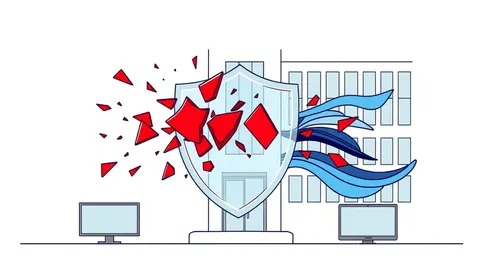
Stop Log Tampering: A Defensive Checklist for Integrity
Attackers often destroy logs to hide their tracks, making verification of data origin and transport more valuable than the volume of data collected.
Prevent log tampering by enforcing write-once storage, using cryptographic hashing for data integrity, and separating collection from analysis. Secure the pipeline between endpoints and central storage to stop interception. Verify timestamps with external sources. This checklist covers transport, storage, and verification controls.
Audience and Usage Context
This checklist serves security operations teams responsible for maintaining evidence integrity during incident response. You use it to audit your logging pipeline from generation to archival. Review each item against your current architecture. Identify gaps where an attacker with local or network access could alter, delete, or inject false entries.
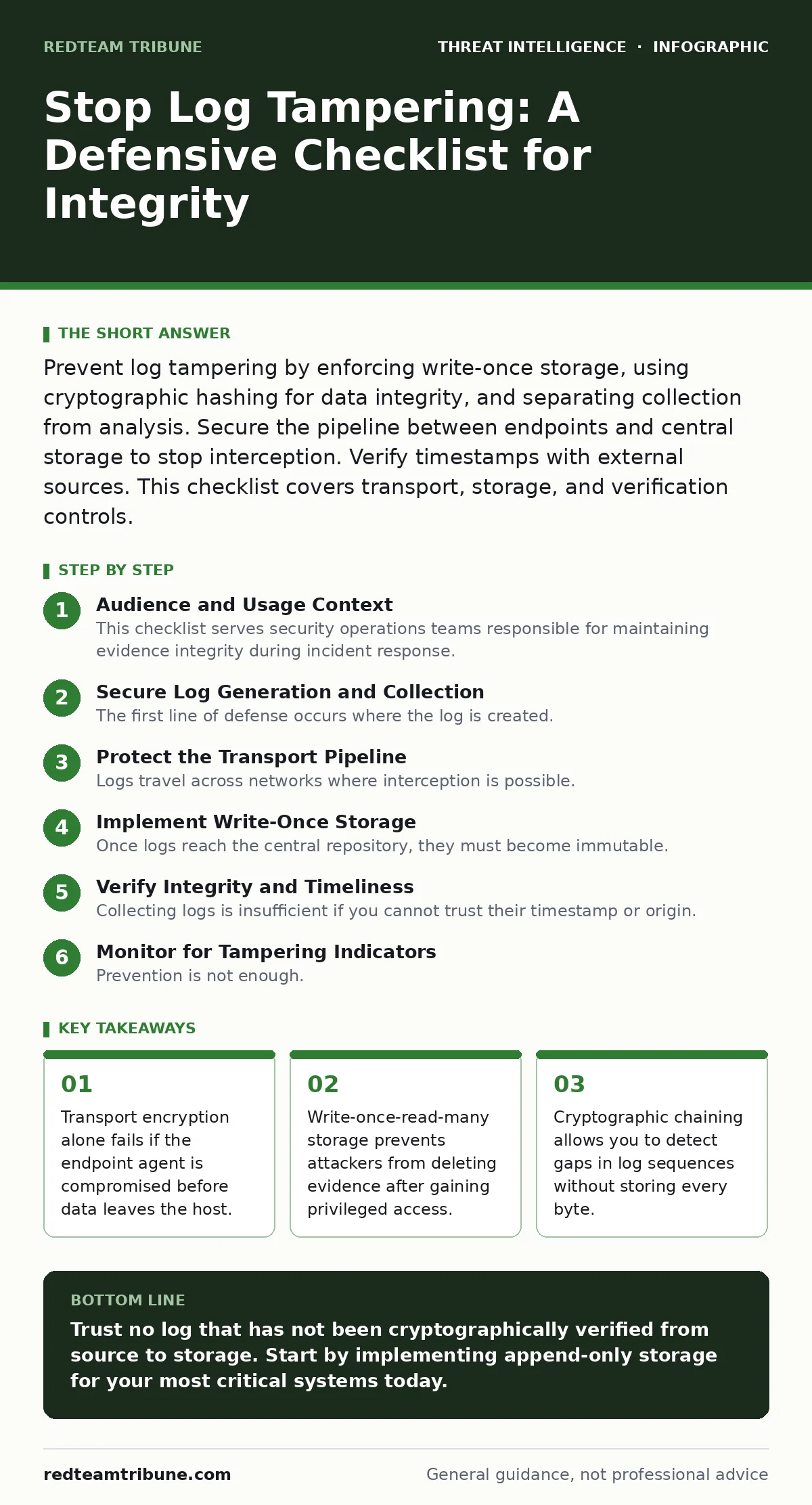
Secure Log Generation and Collection
The first line of defense occurs where the log is created. If an attacker controls the endpoint, they can manipulate data before it leaves the system. You must reduce the attack surface of the collection agent itself.
- Run collection agents with least privilege: Prevents attackers from elevating rights to modify agent configuration or inject false logs.
- Disable local log storage on endpoints: Forces data to flow directly to secure storage, reducing the window for local tampering.
- Use kernel-level hooks for critical events: Captures system calls before user-space malware can intercept or alter the data stream.
- Validate agent integrity via remote attestation: Ensures the collection software has not been replaced or modified by an adversary.
Protect the Transport Pipeline
Logs travel across networks where interception is possible. Standard encryption protects confidentiality but does not guarantee integrity if the endpoint is compromised. You need mechanisms that verify the data was not altered in transit.
- Enforce mutual TLS for all log shipments: Requires both client and server to authenticate, preventing man-in-the-middle injection attacks.
- Sign log batches at the source: Adds a cryptographic signature that breaks if any byte is altered during network transmission.
- Use out-of-band channels for critical alerts: Sends high-priority events via a separate path, ensuring visibility even if the main pipeline is blocked.
- Monitor for transport anomalies: Detects sudden drops in log volume or unusual packet sizes that indicate filtering or suppression.
Implement Write-Once Storage
Once logs reach the central repository, they must become immutable. Attackers often delete logs to cover their tracks after gaining administrative access. Write-once-read-many storage ensures that once data is written, it cannot be changed or deleted.
- Deploy append-only storage architectures: Prevents deletion or modification of existing records, preserving the original sequence of events.
- Use cryptographic hashing for each log entry: Creates a unique fingerprint for every record, allowing quick detection of any alteration.
- Chain hashes across time intervals: Links each new batch to the previous one, making it impossible to remove a single entry without breaking the chain.
- Separate archival from active storage: Moves older logs to isolated, read-only systems that are not connected to the production network.
Verify Integrity and Timeliness
Collecting logs is insufficient if you cannot trust their timestamp or origin. Attackers often backdate logs to confuse forensic timelines. You must verify that the time recorded matches reality and that the source is legitimate.
- Synchronize time via secure NTP: Prevents attackers from manipulating system clocks to create false timelines or cover gaps in activity.
- Validate source IP addresses against known ranges: Ensures logs originate from expected systems, flagging spoofed or injected entries.
- Cross-reference events with external signals: Correlates internal logs with DNS queries or firewall data to detect inconsistencies.
- Use detection engineering techniques: Builds specific rules that trigger on log gaps or unexpected silences, which often indicate tampering.
See also: 7 Mistakes That Expose You to Dark Web Search Engines · What Is Virtual Patching: How It Works Without Code Changes
Monitor for Tampering Indicators
Prevention is not enough. You must detect attempts to tamper with logs in real time. Silent failures or partial deletions are often the first sign of a sophisticated intrusion.
- Alert on sudden log volume drops: Identifies when an attacker disables logging or filters specific event types to hide their activity.
- Detect unauthorized access to log systems: Flags any attempt to modify permissions or access the storage layer without proper authorization.
- Monitor for agent restart patterns: Frequent restarts of collection agents may indicate an attacker trying to clear local buffers or reset connections.
- Use Sigma rules for tampering detection: Leverages open-source detection rules to identify known techniques for log manipulation and suppression.
Handle Edge Cases and Failures
Standard advice often fails in complex environments. You must account for scenarios where logs are lost due to technical issues, not just malicious intent. Distinguishing between accidental loss and intentional tampering requires careful analysis.
- Implement redundant collection paths: Ensures that if one agent fails, another can capture critical events, preventing data loss.
- Log the logging process itself: Records metadata about the collection agent, including its health and connectivity status.
- Test for silent failures: Regularly verify that logs are reaching storage by injecting test events and confirming their arrival.
- Review remote desktop abuse logs: Attackers often use remote access tools to interact with systems without generating standard user logs.
Integrate with Broader Defense Strategies
Log integrity supports other security domains. It provides the reliable data needed for effective threat hunting and incident response. Without trustworthy logs, other controls lose their effectiveness.
- Correlate logs with network scanning results: Identifies hosts that are active but not sending logs, indicating potential compromise.
- Use deception technology to validate logs: Deploys honeypots that generate known events, allowing you to verify that these specific logs reach storage.
- Align with adversary emulation exercises: Tests your logging pipeline against simulated attacks to identify gaps in coverage.
- Support cyber espionage investigations: Provides the forensic evidence needed to trace long-term, low-and-slow intrusions that rely on log deletion.
Key takeaways
- Transport encryption alone fails if the endpoint agent is compromised before data leaves the host.
- Write-once-read-many storage prevents attackers from deleting evidence after gaining privileged access.
- Cryptographic chaining allows you to detect gaps in log sequences without storing every byte.
Trust no log that has not been cryptographically verified from source to storage. Start by implementing append-only storage for your most critical systems today.
Frequently asked questions
How do I detect if an attacker deleted logs?
Look for gaps in the cryptographic hash chain or sudden drops in log volume. These indicators suggest that data was removed or suppressed.
Why do attackers tamper with logs?
Attackers tamper with logs to hide their activity, delay detection, and complicate forensic investigations. They aim to remove evidence of their presence and actions.
How this guide was produced: written by the RedTeam Tribune editorial team with AI assistance, checked against the public references listed below, and reviewed when the facts change. See our editorial policy or report an error.