Deception Technology Misunderstandings and Correct Usage
Deception networks shift detection to attacker actions, not defenses, forcing adversaries to reveal themselves through interaction with isolated assets.

Deception technology does not replace traditional security controls. It creates a separate network of isolated assets that look valuable but contain no real data. When an attacker interacts with these assets, the system generates high-fidelity alerts with zero false positives, allowing teams to focus on actual threats rather than noise.
Misreading: Deception replaces firewalls and endpoint protection
Correct reading: Deception technology works alongside existing security controls, not in place of them. Firewalls filter traffic based on rules. Endpoint detection and response monitors device behavior. Deception adds a layer of bait. If an attacker bypasses the firewall and compromises an endpoint, they enter the deception zone.
The decoy assets wait for interaction. This layered approach ensures that even if one control fails, the next one detects the breach. Imagine a castle with a moat, a wall, and a trapdoor. Removing the wall because of the trapdoor leaves the castle exposed. You keep all three. See our guide on defense evasion for how attackers bypass standard controls.
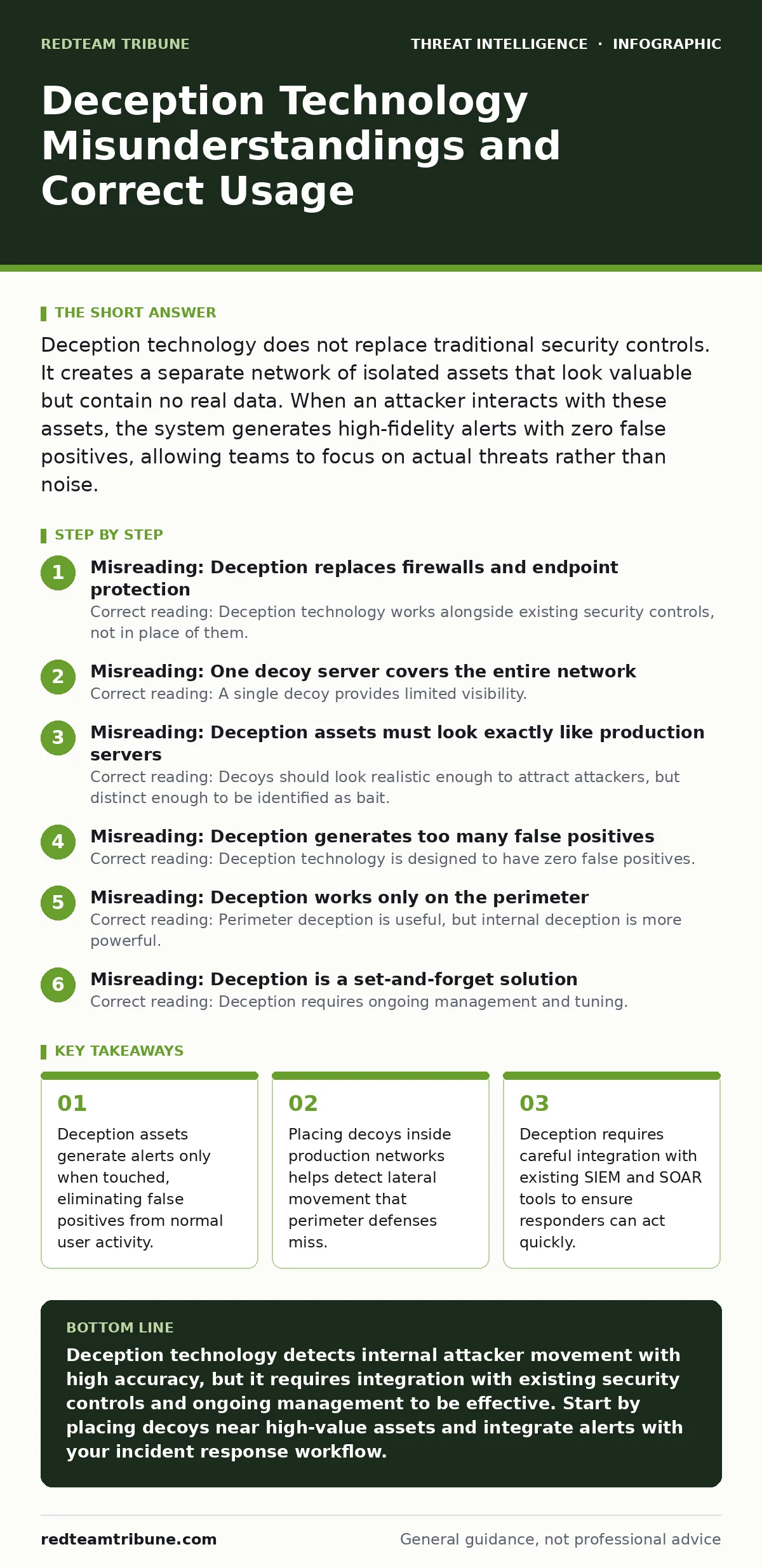
Misreading: One decoy server covers the entire network
Correct reading: A single decoy provides limited visibility. Attackers move laterally through networks. They pivot from one compromised host to another. If you place only one decoy, the attacker may never reach it. You must distribute decoys across different segments. Place them near high-value targets. Place them in areas where lateral movement is common. This distribution increases the chance of detection. It also helps map the attacker's path. If you see activity on a decoy in the finance segment, you know the attacker has moved there. This spatial awareness is critical for containment.
Misreading: Deception assets must look exactly like production servers
Correct reading: Decoys should look realistic enough to attract attackers, but distinct enough to be identified as bait. If a decoy looks identical to a production server, internal tools may interact with it by mistake. This causes confusion. The decoy should mimic the operating system, services, and open ports of real assets. It should not contain real data or critical applications. The goal is to mimic the surface, not the function. A realistic file structure with fake data works well. A fake database with sample records works well. The key is interaction. When the attacker runs a command or accesses a file, the alert fires.
Misreading: Deception generates too many false positives
Correct reading: Deception technology is designed to have zero false positives. Normal users and applications do not interact with decoy assets. Only attackers do. If a legitimate process touches a decoy, it indicates a misconfiguration or a compromised account. This is a signal, not noise. Traditional antivirus and intrusion detection systems generate many alerts from normal behavior. Deception cuts through this noise. It provides high-fidelity alerts. This allows security teams to focus on real threats. It reduces alert fatigue. See our guide on false positives in threat detection to understand the cost of noise.
Misreading: Deception works only on the perimeter
Correct reading: Perimeter deception is useful, but internal deception is more powerful. Attackers who breach the perimeter often move inside. They look for credentials, databases, and administrative tools. Internal decoys detect this movement. They reveal when an attacker has moved laterally. This early detection allows for faster containment. You can isolate the affected segment before the attacker reaches critical assets. Internal deception also helps identify compromised accounts. If an account accesses a decoy, you know it is compromised. This is valuable for incident response.
See also: Implement Network Traffic Analysis: A Step-by-Step Operational Guide · How False Positives Work in Threat Detection and How to Fix Them
Misreading: Deception is a set-and-forget solution
Correct reading: Deception requires ongoing management and tuning. You must update decoy images to match current operating system versions. You must rotate credentials on decoys. You must review alerts to ensure they are being processed correctly. You must integrate deception alerts with your security information and event management system. This integration ensures that responders see the alerts in context. You must also update your incident response plans. Include procedures for handling deception alerts. This ensures that your team knows how to react. See our guide on adversary emulation to test your response.
Misreading: Deception stops all attacks
Correct reading: Deception detects attacks, it does not stop them. It provides early warning. It gives you time to respond. It does not block traffic or kill processes. You still need firewalls, endpoint protection, and access controls to prevent attacks. Deception complements these controls. It fills the gap where traditional controls fail. It detects activity that other tools miss. It provides context. It helps you understand what the attacker is doing. This knowledge is vital for improving your defenses. Do not rely on deception alone. Use it as part of a broader strategy.
Misreading: Deception is only for large enterprises
Correct reading: Deception technology is scalable. Small and medium-sized businesses can benefit from it. You do not need a large team to manage it. Modern platforms are automated. They deploy decoys automatically. They manage updates automatically. They integrate with existing tools automatically. This reduces the operational burden. It makes deception accessible to smaller teams. The value is the same. Early detection. High-fidelity alerts. Reduced noise. The cost is often lower than traditional security tools. It is a force multiplier. It allows a small team to do more.
Misreading: Deception replaces threat intelligence
Correct reading: Deception provides internal threat intelligence. It shows what attackers are doing in your environment. It does not replace external threat intelligence. External intelligence tells you about new threats, tactics, and indicators of compromise. Internal deception tells you about active attacks in your network. You need both. External intelligence helps you tune your decoys. It tells you what attackers are looking for. Internal deception validates this intelligence. It shows if the attacks are happening in your environment. See our guide on threat intelligence sharing for how to use external data.
Key takeaways
- Deception assets generate alerts only when touched, eliminating false positives from normal user activity.
- Placing decoys inside production networks helps detect lateral movement that perimeter defenses miss.
- Deception requires careful integration with existing SIEM and SOAR tools to ensure responders can act quickly.
- Misunderstanding the technology as a standalone solution leads to gaps in coverage and wasted budget.
Deception technology detects internal attacker movement with high accuracy, but it requires integration with existing security controls and ongoing management to be effective. Start by placing decoys near high-value assets and integrate alerts with your incident response workflow.
Frequently asked questions
Does deception technology slow down the network?
No, deception assets are lightweight and isolated. They do not process production traffic or compete for resources with real servers.
Can attackers detect deception assets?
Sophisticated attackers may identify decoys, but the risk of interaction remains. The cost of touching a decoy is high for the attacker, as it triggers immediate detection.
How long does it take to deploy deception?
Modern platforms allow rapid deployment. Initial setup can take hours or days, depending on the size of the environment and integration requirements.
Is deception technology legal?
Yes, deception technology is legal in most jurisdictions. It involves placing assets on your own network to detect unauthorized access.
How this guide was produced: written by the RedTeam Tribune editorial team with AI assistance, checked against the public references listed below, and reviewed when the facts change. See our editorial policy or report an error.