Detection Engineering Checklist: Build Resilient Monitoring Logic
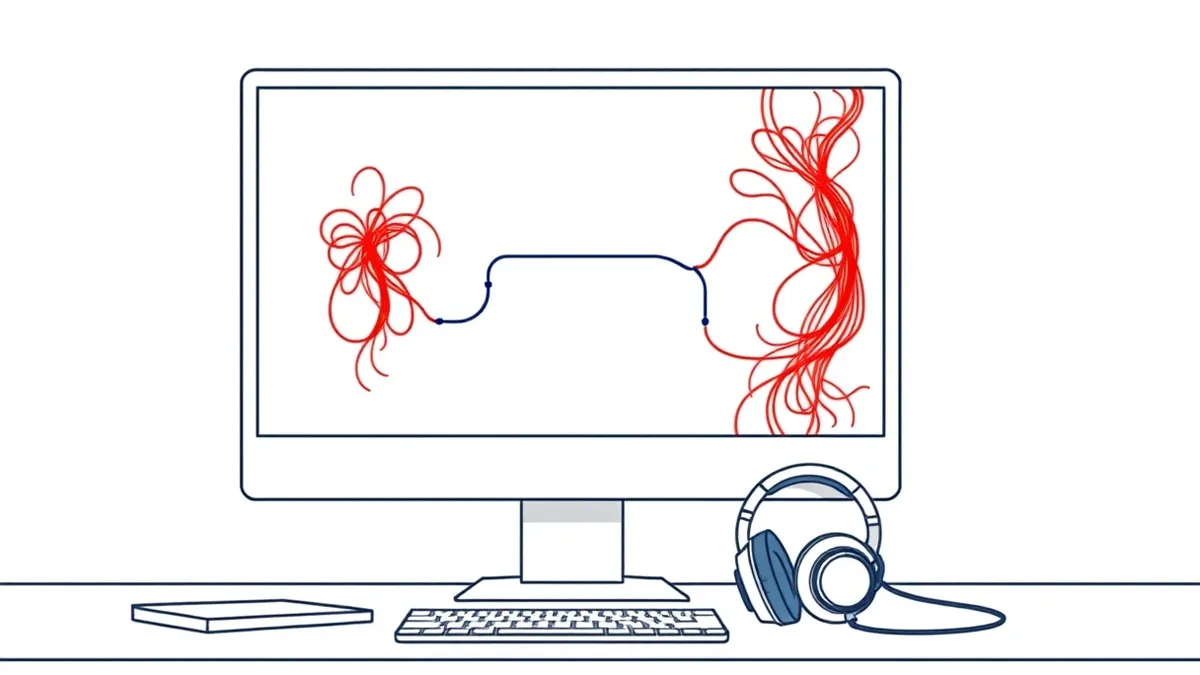
Most detection rules fail because they track noise instead of intent, leaving critical behavior patterns invisible to the monitoring infrastructure.
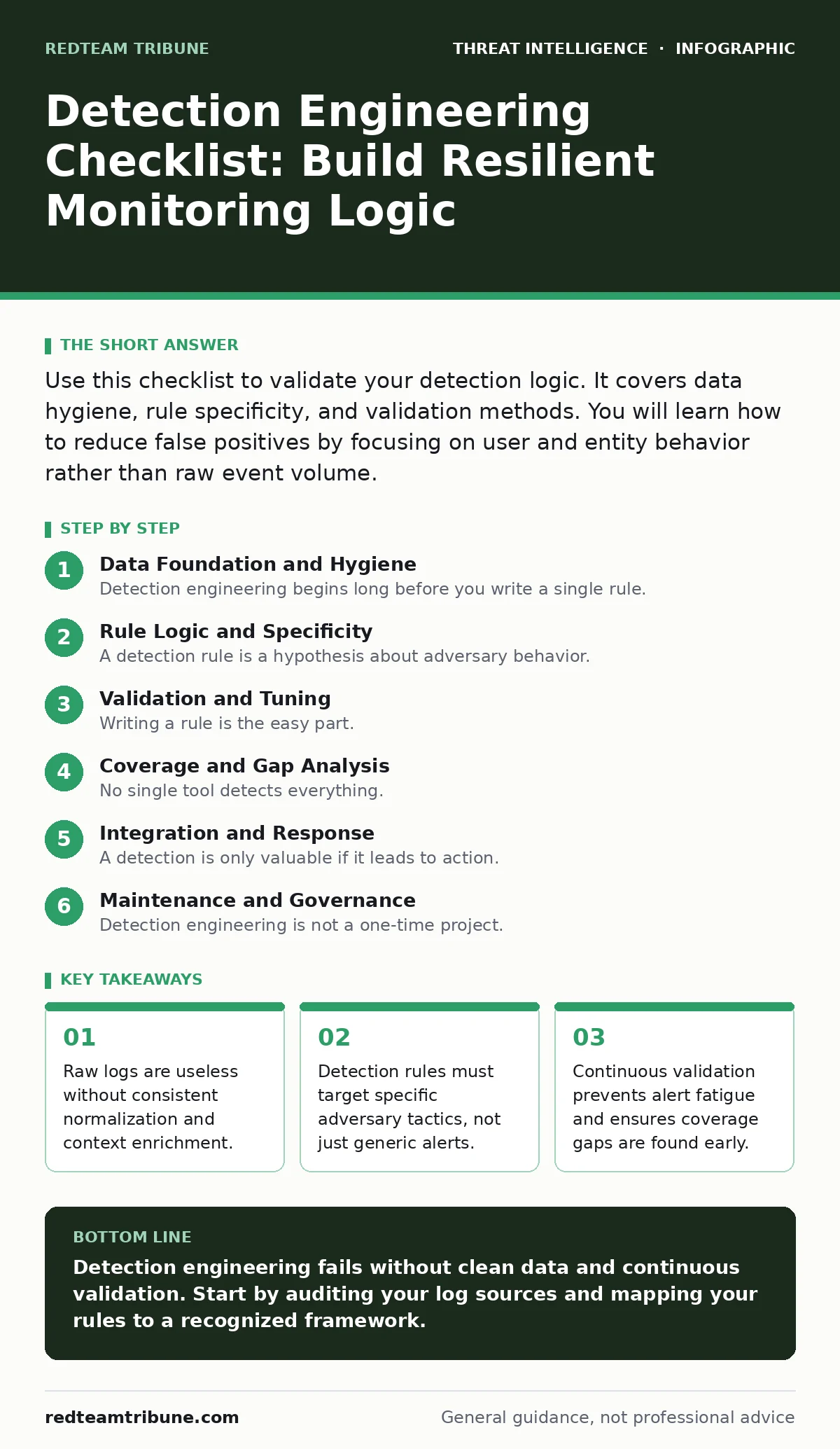
Use this checklist to validate your detection logic. It covers data hygiene, rule specificity, and validation methods. You will learn how to reduce false positives by focusing on user and entity behavior rather than raw event volume.
Data Foundation and Hygiene
Detection engineering begins long before you write a single rule. If your data pipeline is flawed, your alerts will be wrong. You must ensure that the raw events you collect are normalized, enriched, and available for analysis. Without this foundation, any subsequent logic is built on sand.
- Verify log source connectivity: Disconnected sources create blind spots that adversaries exploit immediately.
- Standardize timestamp formats: Inconsistent time zones make correlating events across systems impossible.
- Enforce schema consistency: Fields with varying names or types break automated parsing and rule logic.
- Define data retention policies: You cannot investigate threats if the relevant logs have already been purged.
Rule Logic and Specificity
A detection rule is a hypothesis about adversary behavior. It should not trigger on normal administrative activity. You must design rules that distinguish between intended system operations and malicious deviations. This requires deep knowledge of your environment’s baseline behavior.
- Target specific tactics and techniques: Generic alerts drown out true positives in a sea of noise.
- Define clear trigger conditions: Vague thresholds lead to inconsistent firing and analyst confusion.
- Exclude known good processes: Whitelisting trusted binaries reduces noise without sacrificing security coverage.
- Document the detection logic: Future engineers must understand why a rule exists to maintain it correctly.
Consider how remote desktop abuse often mimics legitimate help desk activity. A rule that flags all remote connections will fail. A rule that flags remote connections during non-business hours from unusual locations succeeds. This distinction relies on context, not just the action itself.
Validation and Tuning
Writing a rule is the easy part. Proving it works is difficult. You must test your detection logic against known malicious behavior and normal operations. This process, often called tuning, ensures that the rule fires when it should and stays silent when it should not.
- Test with adversary emulation: Simulate attacks to confirm the rule triggers on expected behavior.
- Review false positive rates: High noise levels cause alert fatigue and lead to ignored security events.
- Validate with benign traffic: Ensure the rule does not trigger on standard administrative tasks.
- Establish a feedback loop: Analysts must report missed detections or noisy rules for immediate correction.
Coverage and Gap Analysis
No single tool detects everything. You must map your detection rules to a framework like MITRE ATT&CK to identify gaps. This ensures you are covering the full spectrum of potential attacks, not just the ones you have seen before. Regular reviews prevent coverage from decaying over time.
- Map rules to framework techniques: Unmapped rules may be redundant or missing critical coverage areas.
- Identify unmonitored data sources: Some attacks leave traces only in specific logs that may be ignored.
- Review rule efficacy quarterly: Techniques evolve, and old rules may become obsolete or noisy.
- Assess coverage for critical assets: High-value targets require stricter detection logic than standard endpoints.
When analyzing Active Directory attacks, for example, you might find that you monitor login failures but ignore token manipulation. This gap allows lateral movement to go undetected. Closing such gaps requires looking at the entire attack chain, not isolated events.
Integration and Response
A detection is only valuable if it leads to action. Your rules must integrate with your incident response workflows. This means that when a rule fires, the right information is available to the analyst, and the right automated actions are triggered. Without this integration, detection is merely observation.
- Define response playbooks: Clear steps ensure consistent handling of detected incidents.
- Enrich alerts with context: Adding user or asset data reduces investigation time significantly.
- Automate initial triage: Simple, high-confidence alerts should trigger automated containment steps.
- Monitor integration health: Broken connections between detection and response tools create critical delays.
See also: Threat Intelligence Sharing Mistakes and How to Fix Them · Dark web threat intelligence implementation steps for early warnings
Maintenance and Governance
Detection engineering is not a one-time project. It is a continuous cycle of improvement. You must govern your detection rules to ensure they remain accurate, relevant, and efficient. This includes regular reviews, updates, and decommissioning of obsolete rules.
- Assign rule ownership: Every rule must have a designated maintainer responsible for its accuracy.
- Decommission unused rules: Old rules consume resources and add unnecessary noise to the environment.
- Track rule performance metrics: Monitor true positive rates to identify rules that need tuning.
- Share detection logic internally: Collaborative improvement across teams raises the overall security posture.
Refer to the guide on false positives in threat detection for deeper strategies on reducing noise. Also, see Sigma rules for a standardized approach to writing detection logic that works across multiple platforms. Finally, consult network traffic analysis to understand how to detect threats that do not leave logs on endpoints.
Key takeaways
- Raw logs are useless without consistent normalization and context enrichment.
- Detection rules must target specific adversary tactics, not just generic alerts.
- Continuous validation prevents alert fatigue and ensures coverage gaps are found early.
Detection engineering fails without clean data and continuous validation. Start by auditing your log sources and mapping your rules to a recognized framework.
Frequently asked questions
How do I prioritize which attacks to detect first?
Focus on the techniques most likely to impact your critical assets and those that are currently trending in threat intelligence.
What is the difference between detection engineering and threat hunting?
Detection engineering builds automated alerts for known patterns, while threat hunting is a proactive, manual search for hidden threats.
How often should I review my detection rules?
Review rules quarterly to ensure they remain effective against evolving tactics and to reduce accumulated noise.
Can I use open-source frameworks for detection?
Yes, frameworks like MITRE ATT&CK and standards like Sigma rules provide excellent baselines for building and testing detection logic.
How this guide was produced: written by the RedTeam Tribune editorial team with AI assistance, checked against the public references listed below, and reviewed when the facts change. See our editorial policy or report an error.