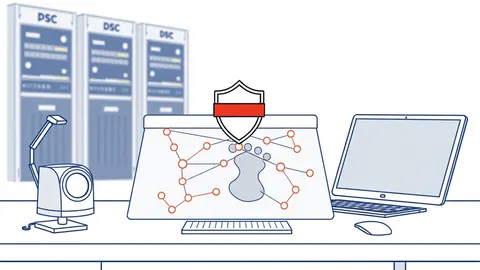
7 Mistakes That Expose You to Dark Web Search Engines
Your configuration errors and leaked credentials allow dark web search engines to index your infrastructure, turning internal assets into public hunting grounds.

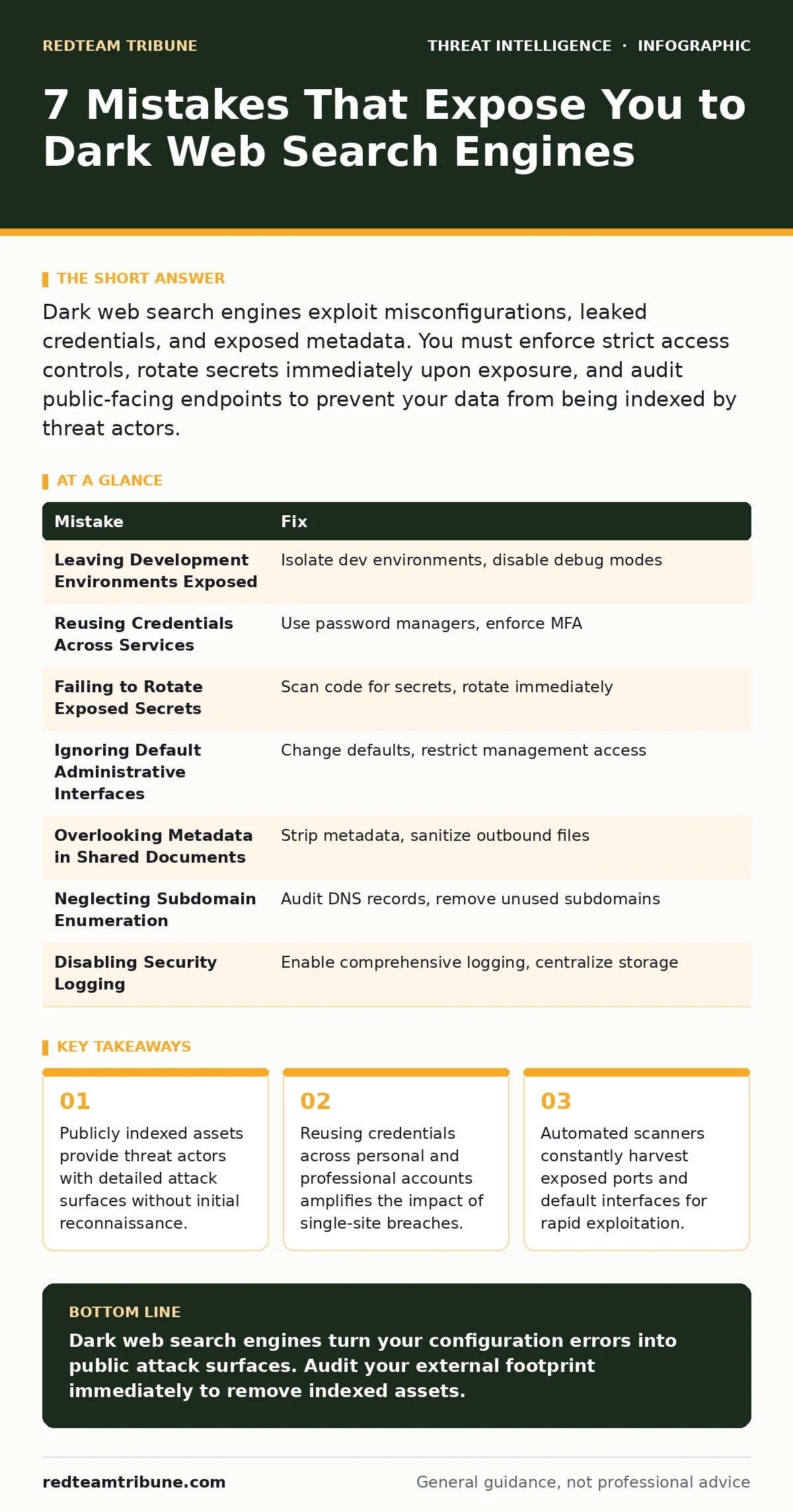
Dark web search engines exploit misconfigurations, leaked credentials, and exposed metadata. You must enforce strict access controls, rotate secrets immediately upon exposure, and audit public-facing endpoints to prevent your data from being indexed by threat actors.
Mistake 1: Leaving Development Environments Exposed
Development and staging servers often lack the rigorous security controls applied to production systems. Attackers scan for these environments because they frequently contain debug interfaces, test credentials, and unpatched software.
Why it hurts:
Dark web search engines index these exposed endpoints, providing threat actors with a low-friction entry point. These systems often have direct database access and verbose error messages that reveal underlying architecture.
The fix:
Implement network segmentation that isolates development environments from the public internet. Use private subnets for staging servers and require bastion hosts or jump servers for administrative access. Disable debug modes and verbose error reporting before any deployment.
Mistake 2: Reusing Credentials Across Services
Using the same username and password combination for email, cloud storage, and corporate portals creates a single point of failure. When one service suffers a breach, the credentials often appear on dark web marketplaces and search indices.
Why it hurts:
Threat actors perform credential stuffing attacks using these leaked pairs. If your corporate account uses the same password as a compromised personal account, attackers gain immediate access without needing to crack the password.
The fix:
Enforce unique passwords for every service using a password manager. Deploy multi-factor authentication on all accounts that store sensitive data. Monitor for credential exposure using dark web threat intelligence services to detect reuse early.
Mistake 3: Failing to Rotate Exposed Secrets
API keys, private SSH keys, and database connection strings are often committed to public code repositories or exposed in log files. Once these secrets appear in a dark web search index, they remain valid until explicitly revoked.
Why it hurts:
Attackers automate the harvesting of these secrets from indexed pages. A single exposed API key can grant unauthorized access to cloud storage, allowing data exfiltration without triggering traditional intrusion detection systems.
The fix:
Integrate secret scanning tools into your development pipeline to detect and block commits containing sensitive data. Rotate all secrets immediately upon discovery of exposure. Implement short-lived tokens where possible to limit the window of exploitation.
Mistake 4: Ignoring Default Administrative Interfaces
Many network devices, IoT cameras, and servers ship with default administrative interfaces that are accessible if not properly configured. These interfaces often use well-known default credentials that are publicly documented.
Why it hurts:
Dark web search engines actively crawl for these default interfaces. Once indexed, they become easy targets for automated botnets that exploit known vulnerabilities or brute-force default passwords to gain network access.
The fix:
Conduct regular network scanning to identify any devices with exposed default interfaces. Change default credentials during initial setup and disable remote management features unless explicitly required. Use firewalls to restrict access to management ports.
Mistake 5: Overlooking Metadata in Shared Documents
Documents shared externally or uploaded to public forums often contain embedded metadata. This metadata can include author names, internal IP addresses, file paths, and software versions that reveal your internal infrastructure.
Why it hurts:
Threat actors use this metadata to map your internal network topology. Knowledge of specific software versions allows them to select targeted exploits, while internal IP ranges help them tailor social engineering attacks.
The fix:
Strip metadata from all documents before external sharing using automated sanitization tools. Educate users on the risks of sharing internal screenshots or files. Implement data loss prevention policies that scan for sensitive metadata in outbound communications.
See also: Network Scanning Myths: Why Common Beliefs Fail in Detection · Difference Between Cyber Espionage and Cyber Warfare: How to Tell
Mistake 6: Neglecting Subdomain Enumeration
Organizations often register numerous subdomains for testing, marketing, and legacy services. Many of these subdomains are forgotten and left pointing to inactive servers or default landing pages that leak server information.
Why it hurts:
Dark web search engines index these forgotten subdomains, revealing the full scope of your digital footprint. Attackers use this information to identify shadow IT assets that lack security monitoring and patch management.
The fix:
Maintain an inventory of all registered domains and subdomains. Regularly audit DNS records to remove unused entries. Implement DNSSEC to protect against domain hijacking and ensure that all subdomains are monitored for unauthorized changes.
Mistake 7: Disabling Security Logging
Some administrators disable security logging to save disk space or reduce performance overhead. This decision creates blind spots that prevent the detection of unauthorized access attempts and data exfiltration events.
Why it hurts:
Without logs, you cannot detect when threat actors are accessing your systems using credentials found on the dark web. This lack of visibility allows adversaries to operate freely, performing defense evasion and data theft without triggering alerts.
The fix:
Enable comprehensive logging on all critical systems and forward logs to a centralized, tamper-proof storage solution. Regularly review logs for anomalies and integrate them with your security information and event management system for automated correlation.
| Mistake | Fix |
|---|---|
| Leaving Development Environments Exposed | Isolate dev environments, disable debug modes |
| Reusing Credentials Across Services | Use password managers, enforce MFA |
| Failing to Rotate Exposed Secrets | Scan code for secrets, rotate immediately |
| Ignoring Default Administrative Interfaces | Change defaults, restrict management access |
| Overlooking Metadata in Shared Documents | Strip metadata, sanitize outbound files |
| Neglecting Subdomain Enumeration | Audit DNS records, remove unused subdomains |
| Disabling Security Logging | Enable comprehensive logging, centralize storage |
Key takeaways
- Publicly indexed assets provide threat actors with detailed attack surfaces without initial reconnaissance.
- Reusing credentials across personal and professional accounts amplifies the impact of single-site breaches.
- Automated scanners constantly harvest exposed ports and default interfaces for rapid exploitation.
Dark web search engines turn your configuration errors into public attack surfaces. Audit your external footprint immediately to remove indexed assets.
Frequently asked questions
How do dark web search engines differ from surface web search engines?
They index hidden services and private marketplaces that require specific software or credentials to access, focusing on illicit content and leaked data.
Can I remove my data from dark web search engines?
You can request de-indexing, but attackers often copy and redistribute data. The only effective remedy is rotating credentials and revoking exposed access.
Do false positives in threat detection affect dark web monitoring?
Yes, noisy alerts can cause teams to ignore genuine exposures. Fine-tune your alerts to focus on high-confidence matches related to your specific assets.
How often should I check for my data on the dark web?
Continuous monitoring is ideal. If manual checks are necessary, perform them weekly and immediately after any suspected breach or insider threat event.
How this guide was produced: written by the RedTeam Tribune editorial team with AI assistance, checked against the public references listed below, and reviewed when the facts change. See our editorial policy or report an error.