Sigma Rules Explained: Platform-Agnostic Detection Logic
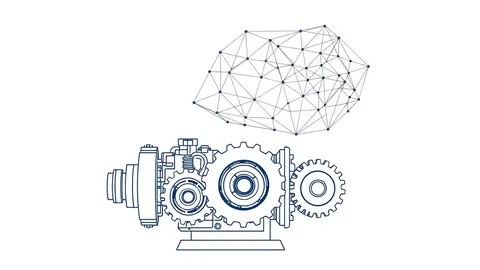
Sigma rules decouple detection logic from specific log formats, allowing you to write once and deploy detection across any security information and event management platform.

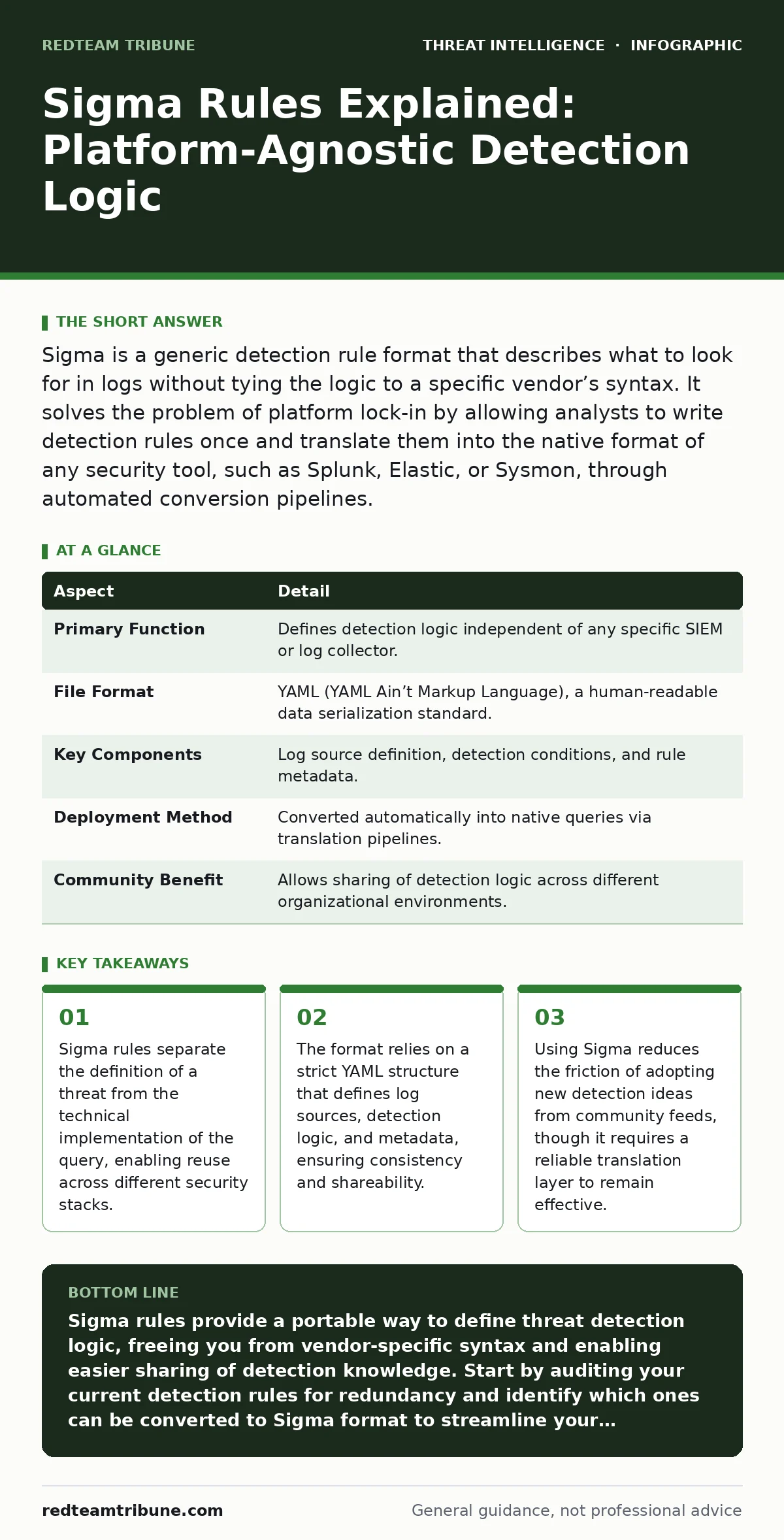
Sigma is a generic detection rule format that describes what to look for in logs without tying the logic to a specific vendor’s syntax. It solves the problem of platform lock-in by allowing analysts to write detection rules once and translate them into the native format of any security tool, such as Splunk, Elastic, or Sysmon, through automated conversion pipelines.
The Universal Translator for Security Logs
Imagine you hire a detective who speaks only English. You want them to investigate crimes in Paris, Tokyo, and Berlin. You need a translator who converts every report into standard English before the detective can read it. Sigma rules act as that standard language for threat detection. They allow you to define what a malicious activity looks like in abstract terms, rather than in the specific query language of one particular security tool.
This abstraction is the core value proposition. Without it, a detection engineer must rewrite the same logic for every platform they support. If your organization uses Microsoft Sentinel for cloud workloads and Elastic Security for on-premises servers, you traditionally need two separate teams or a significant amount of duplicate effort. Sigma eliminates this duplication by providing a common denominator.
| Aspect | Detail |
|---|---|
| Primary Function | Defines detection logic independent of any specific SIEM or log collector. |
| File Format | YAML (YAML Ain’t Markup Language), a human-readable data serialization standard. |
| Key Components | Log source definition, detection conditions, and rule metadata. |
| Deployment Method | Converted automatically into native queries via translation pipelines. |
| Community Benefit | Allows sharing of detection logic across different organizational environments. |
The Problem of Vendor Lock-In
Security tools are proprietary. Their query languages are often unique, complex, and subject to change with every software update. When a vendor releases a new version, your existing detection rules might break because the underlying field names or syntax have shifted. This creates a hidden maintenance tax. You spend less time hunting threats and more time fixing broken queries.
Sigma rules solve this by forcing you to think in terms of generic log attributes. Instead of writing a query that relies on a specific vendor’s internal field name, you map that field to a generic concept. For example, instead of referencing a proprietary field for "process start time," you reference the generic concept of "process creation event." This decoupling means that if you switch security platforms tomorrow, your detection logic remains valid. You only need to update the mapping layer, not the logic itself.
Anatomy of a Sigma Rule
A Sigma rule is a YAML file that follows a strict schema. It consists of three main parts: the title and description, the log source, and the detection logic. The title and description provide context for analysts who need to understand why the rule exists. This metadata is critical for triage. When an alert fires, the analyst needs to know immediately what behavior triggered it.
The log source section defines where the data comes from. Sigma uses a hierarchical structure to categorize logs, such as operating system, product, and event category. This standardization ensures that the rule applies only to the correct type of data. For instance, a rule for Windows process creation will not accidentally run against Linux audit logs.
The detection section contains the actual logic. It uses simple boolean operators to combine conditions. You can define a single condition that must be true, or a combination of conditions that must occur together or separately. This section is where you define the "what" of the threat. It remains agnostic to the "how" of the query execution.
Where Sigma Fits in Your Defense Stack
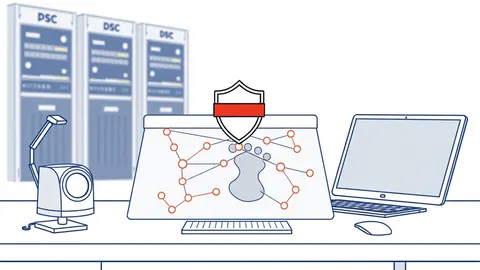
Sigma rules do not replace your security information and event management (SIEM) system. They feed into it. Think of Sigma as the blueprint and your SIEM as the construction site. The blueprint defines the structure, but the construction crew uses local materials and tools to build it.
In a mature detection engineering workflow, analysts write or refine Sigma rules. These rules are then pushed through a translation pipeline. This pipeline converts the generic YAML into the native query format of your SIEM. The SIEM then executes these queries against incoming log data. If the data matches the logic, an alert is generated.
This separation of concerns allows for better detection engineering. Analysts can focus on the quality of the detection logic rather than the syntax of the query language. It also facilitates threat intelligence sharing. When researchers publish new detection ideas, they can share them as Sigma rules. Your team can then import and translate them automatically, rather than manually rewriting them.
The Hidden Cost of Abstraction
The primary trade-off of using Sigma is the reliance on accurate field mapping. Sigma rules use generic field names, such as process or user. Your translation layer must know how to map process to the actual field name in your SIEM. If the mapping is incorrect, the rule will fail silently. It will not throw an error; it will simply return no results.
This is a subtle but dangerous failure mode. You might believe you are protected by a rule, but the mapping error means the rule is effectively blind. This is why regular validation is necessary. You must test that the translated queries actually return data when the expected behavior occurs.
Another hidden cost is the complexity of advanced logic. Sigma supports basic boolean logic, but complex statistical anomalies or machine learning-based detections are difficult to express in Sigma. These advanced detections often require native platform features. Sigma is excellent for rule-based detections but less suited for adaptive or behavioral models that rely on platform-specific algorithms.
See also: OSINT tools for investigators checklist to harden your footprint · 7 Mistakes That Expose You to Dark Web Search Engines
What People Usually Get Wrong
Many teams treat Sigma rules as a set-and-forget solution. They import a large library of community rules and assume they are now protected. This is a mistake. Community rules are written for generic environments. They often trigger on benign activities specific to your organization. Without tuning, you will drown in false positives in threat detection.
Another common error is ignoring the log source definition. A rule might be written for a specific version of a product or a specific configuration. If your environment does not generate the exact logs the rule expects, the detection will fail. You must verify that your data collection strategy aligns with the Sigma rules you deploy.
Finally, teams often neglect the metadata. They focus only on the detection logic and ignore the title, description, and references. This makes triage difficult. When an alert fires, the analyst needs to understand the context quickly. Poor metadata leads to slower response times and increased fatigue.
Integrating with Advanced Techniques
Sigma rules serve as a foundation, but they are not the entire house. They work best when combined with other defensive measures. For example, you can use Sigma to detect initial access vectors, while adversary emulation exercises test whether those detections actually fire in a realistic attack scenario.
You can also use Sigma to monitor for specific indicators of remote desktop abuse or Active Directory attacks. These are high-value targets for attackers. By writing Sigma rules that look for anomalous RDP sessions or unusual LDAP queries, you add a layer of visibility that complements network-level defenses.
However, do not rely on Sigma alone. It is a detection mechanism, not a prevention mechanism. It tells you what happened, but it does not stop it from happening. You must integrate these detections with your incident response procedures. When a Sigma rule fires, there must be a clear process for investigation and remediation.
Key takeaways
- Sigma rules separate the definition of a threat from the technical implementation of the query, enabling reuse across different security stacks.
- The format relies on a strict YAML structure that defines log sources, detection logic, and metadata, ensuring consistency and shareability.
- Using Sigma reduces the friction of adopting new detection ideas from community feeds, though it requires a reliable translation layer to remain effective.
- Misunderstanding the difference between Sigma’s generic fields and native log fields is a common cause of failed detections during deployment.
Sigma rules provide a portable way to define threat detection logic, freeing you from vendor-specific syntax and enabling easier sharing of detection knowledge. Start by auditing your current detection rules for redundancy and identify which ones can be converted to Sigma format to streamline your maintenance workflow.
Frequently asked questions
Do I need to rewrite all my existing detection rules in Sigma?
No. You can adopt Sigma incrementally. Start with new detections or high-priority rules that are difficult to maintain across multiple platforms. Over time, you can migrate older rules as resources allow.
How do I handle Sigma rules that require complex statistical analysis?
Sigma is best suited for rule-based logic. For statistical or machine learning-based detections, you should use the native capabilities of your SIEM or specialized detection platforms. Sigma can still be used to feed data into these systems for preprocessing.
How this guide was produced: written by the RedTeam Tribune editorial team with AI assistance, checked against the public references listed below, and reviewed when the facts change. See our editorial policy or report an error.