API Vulnerabilities: Definition, Mechanics, and Mitigation Strategies
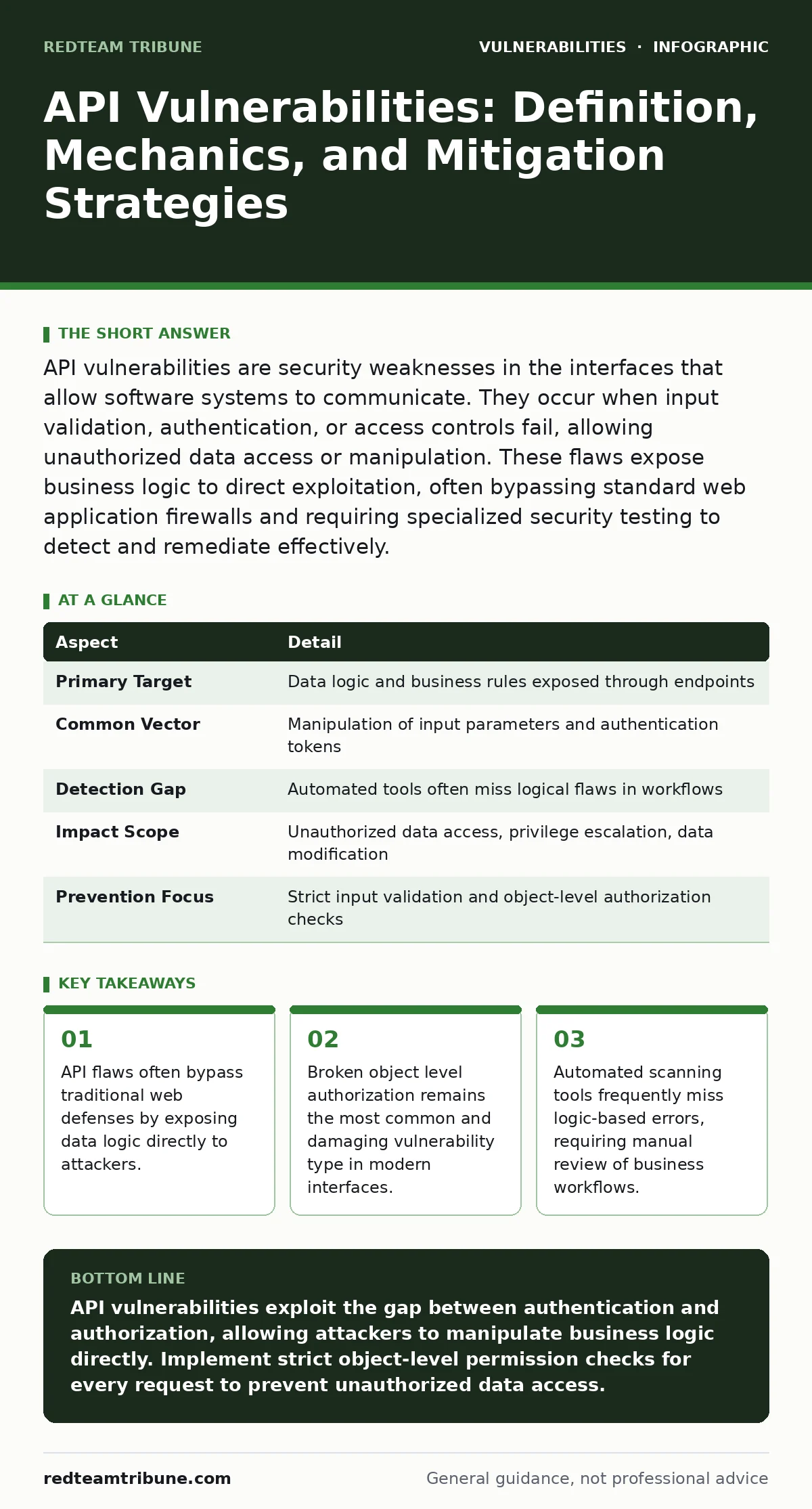
API flaws often bypass traditional web defenses by exposing data logic directly, allowing attackers to manipulate business rules rather than just stealing credentials.
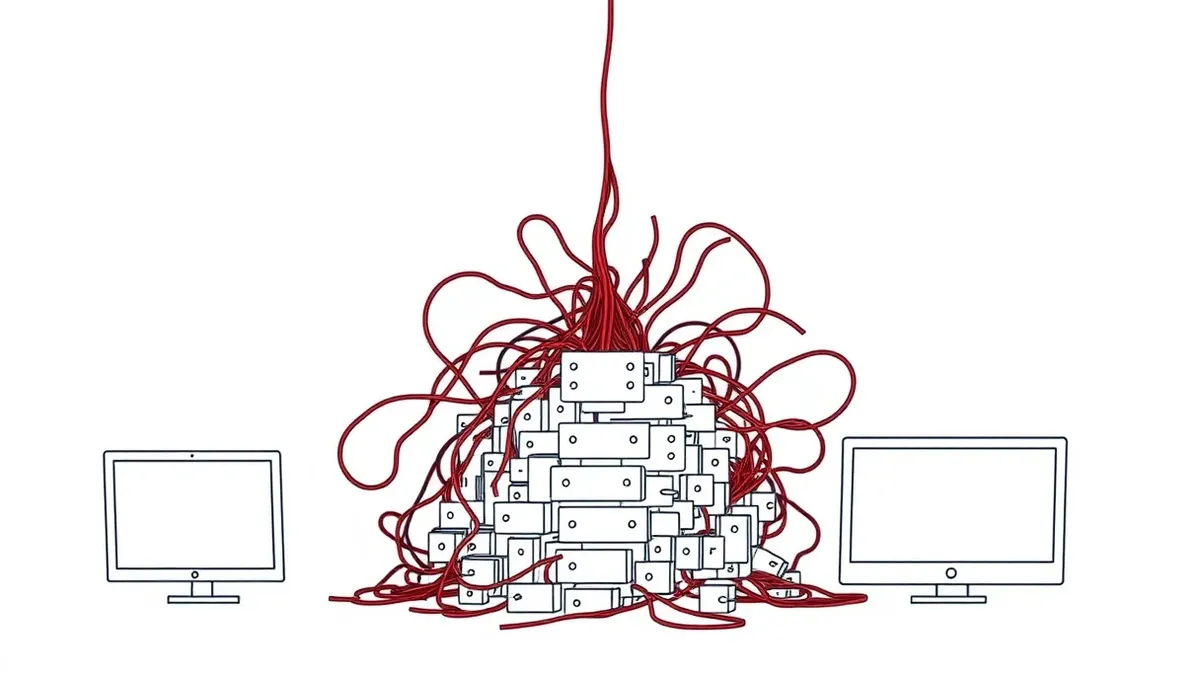
API vulnerabilities are security weaknesses in the interfaces that allow software systems to communicate. They occur when input validation, authentication, or access controls fail, allowing unauthorized data access or manipulation. These flaws expose business logic to direct exploitation, often bypassing standard web application firewalls and requiring specialized security testing to detect and remediate effectively.
Defining API Vulnerabilities
API vulnerabilities are weaknesses in the application programming interfaces that connect different software components. An API defines how two systems exchange data and instructions. When these interfaces lack proper security controls, they become entry points for attackers. Unlike traditional web applications that serve user interfaces, APIs serve data. This distinction changes the attack surface significantly. Attackers target the logic and data flow rather than the visual presentation. A weakness here allows unauthorized access, data leakage, or system manipulation. The core issue is often a failure to enforce strict boundaries on what data can be requested and who can request it.
How Exploitation Occurs
Exploitation happens when an attacker sends crafted requests that the API processes incorrectly. The API expects specific inputs and returns corresponding outputs. If the validation logic is weak, the attacker can modify parameters to access resources they should not see. Suppose a user changes an ID number in a request to retrieve another user's profile. If the API trusts this ID without verifying the requester's permissions, it exposes sensitive data. This is not a glitch in the code execution but a flaw in the security policy enforcement. The system works exactly as programmed, but the programming failed to account for malicious intent.
| Aspect | Detail |
|---|---|
| Primary Target | Data logic and business rules exposed through endpoints |
| Common Vector | Manipulation of input parameters and authentication tokens |
| Detection Gap | Automated tools often miss logical flaws in workflows |
| Impact Scope | Unauthorized data access, privilege escalation, data modification |
| Prevention Focus | Strict input validation and object-level authorization checks |
Who Is Affected
Any organization that exposes data or functionality through APIs is at risk. This includes mobile app backends, third-party integrations, and internal microservices. Developers often assume that because an API is not a public website, it is safe. This assumption is dangerous. Internal APIs frequently lack the same security scrutiny as public-facing web apps. Attackers exploit this blind spot by finding exposed endpoints through documentation leaks or directory traversal. Once inside, they move laterally, accessing databases and other services. The impact extends beyond data theft. Attackers can disrupt business operations by manipulating transaction logic or deleting critical records.
Common Forms of API Flaws
Broken object level authorization is the most prevalent issue. It occurs when the API does not verify that the user owns the resource they are requesting. Excessive data exposure happens when the API returns more data than the client needs, such as internal notes or password hashes. Lack of resources and rate limiting allows attackers to flood the API with requests, causing denial of service. Mass assignment vulnerabilities arise when the API accepts bulk updates to user profiles, allowing attackers to change their own role to administrator. These flaws are often interconnected. A single missing check can cascade into multiple security failures.
What People Usually Get Wrong
Developers often confuse API security with web application security. They assume that fixing SQL injection or cross-site scripting is enough. This view is incomplete. APIs often bypass the browser, so client-side protections like Content Security Policy do not apply. Another common error is relying on authentication alone. Just because a user is logged in does not mean they should access every data point. Authorization must be checked for every single request. Many teams also neglect to secure the API documentation itself. Exposed Swagger or OpenAPI files can reveal the entire attack surface to adversaries.
See also: Mass Assignment Vulnerabilities: How Unchecked Inputs Break Logic · Insecure Deserialization: Step-by-Step Attack Breakdown
The Hidden Cost of Logic Errors
The hidden cost of API vulnerabilities is the failure of automated security tools. Traditional scanners look for known patterns like SQL injection or prototype pollution. They struggle to understand business logic. An API might correctly reject a SQL injection attempt but still allow a user to view another user's data. This logical flaw passes automated tests because the syntax is correct. Manual testing is required to map out the business workflows and identify where authorization breaks down. This makes security testing more expensive and time-consuming. Teams must invest in specialized tools or skilled personnel who can think like an attacker.
Reducing the Risk Effectively
Reducing risk requires a shift in how APIs are designed and tested. Start by implementing strict object level authorization. Every request must verify that the user has permission for the specific resource. Use minimal data responses. Strip out any fields that the client does not explicitly need. Implement rate limiting to prevent abuse and denial of service attacks.
Regularly review API documentation to ensure it is not publicly accessible. Integrate security into the development lifecycle, not as an afterthought. Test for broken access control specifically, as this is the most common failure point. Consider vulnerabilities in self-hosted GitLab if you manage your own code repositories, as misconfigurations there can expose API keys.
Beyond Basic Validation
Input validation is necessary but insufficient. Attackers can use valid inputs in invalid sequences to trigger errors. This is where proof-of-concept exploits become useful for testing. They demonstrate how a sequence of valid actions can lead to an unauthorized state. Also, watch for insecure deserialization if your API processes complex data objects. Malformed serialized data can execute arbitrary code. While directory listing exposure is a web server issue, it can reveal API endpoints that were meant to be hidden. Combining these checks creates a deeper defense layer. Security is not a single control but a series of checks at every stage of the data flow.
Key takeaways
- API flaws often bypass traditional web defenses by exposing data logic directly to attackers.
- Broken object level authorization remains the most common and damaging vulnerability type in modern interfaces.
- Automated scanning tools frequently miss logic-based errors, requiring manual review of business workflows.
API vulnerabilities exploit the gap between authentication and authorization, allowing attackers to manipulate business logic directly. Implement strict object-level permission checks for every request to prevent unauthorized data access.
Frequently asked questions
How are API vulnerabilities different from web application vulnerabilities?
API vulnerabilities focus on data and logic exposure through machine-to-machine communication, often bypassing browser-based security controls and requiring different testing methods.
Can automated tools find all API vulnerabilities?
No, automated tools miss logical flaws like broken authorization. Manual testing is required to verify that business rules are enforced correctly for every user action.
What is the first step in securing an API?
Implement strict object-level authorization to ensure users can only access resources they explicitly own or have permission to view, verifying this on every request.
Do internal APIs need the same security as public APIs?
Yes, internal APIs often have weaker security and are frequently exposed to the internet through misconfigurations, making them prime targets for lateral movement.
How this guide was produced: written by the RedTeam Tribune editorial team with AI assistance, checked against the public references listed below, and reviewed when the facts change. See our editorial policy or report an error.