Why is insecure deserialization dangerous: The hidden execution risk
Insecure deserialization allows attackers to execute arbitrary code by tricking applications into loading crafted data structures as active objects.

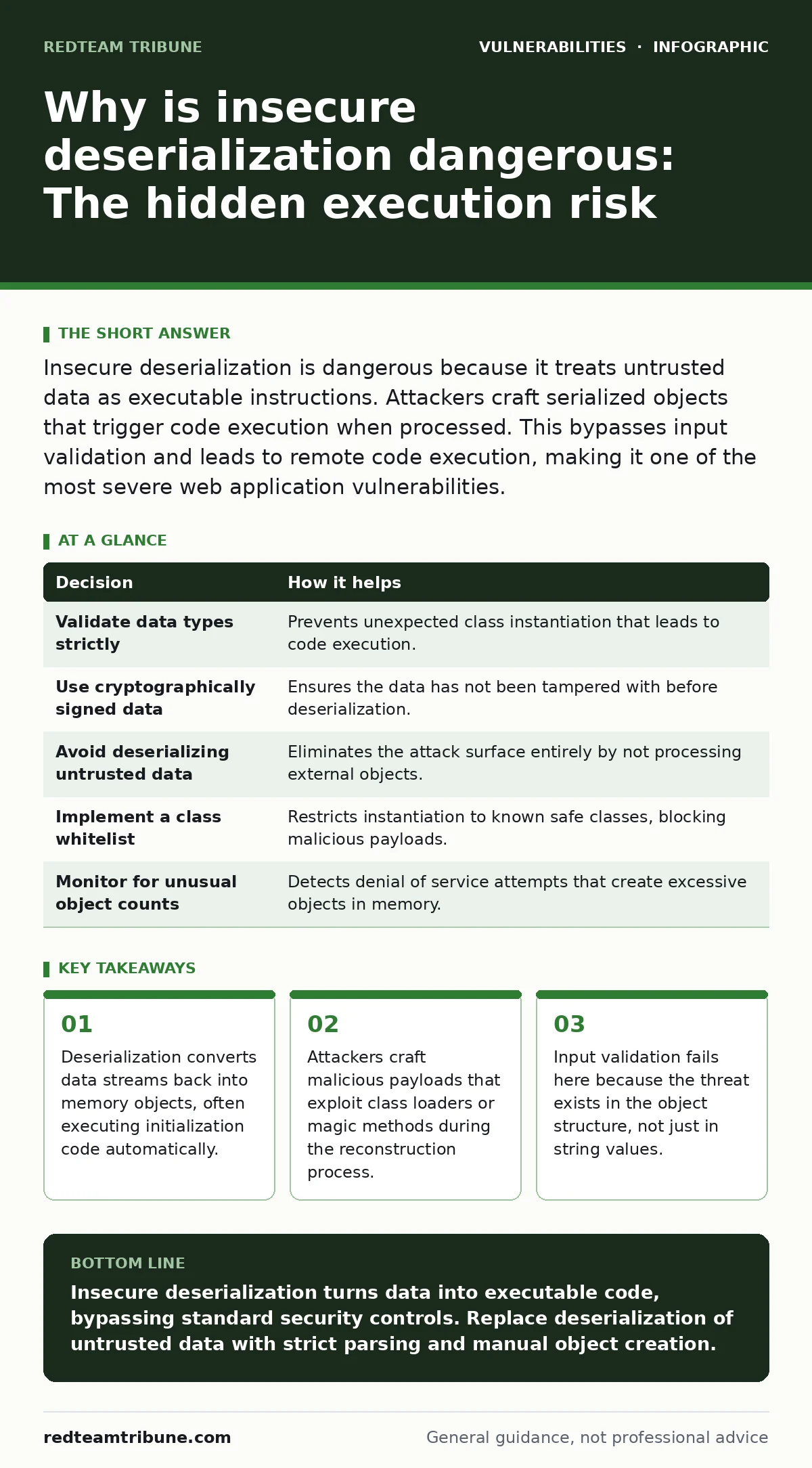
Insecure deserialization is dangerous because it treats untrusted data as executable instructions. Attackers craft serialized objects that trigger code execution when processed. This bypasses input validation and leads to remote code execution, making it one of the most severe web application vulnerabilities.
Why is insecure deserialization dangerous
Insecure deserialization is dangerous because it grants the application the power to execute code embedded within data. When an application accepts serialized data from an untrusted source, it assumes the data structure is safe. The application then reconstructs objects in memory. This reconstruction process often triggers constructors, initializers, or magic methods.
An attacker who controls the serialized stream can craft an object graph that executes arbitrary commands during this rebuild. The danger lies in the implicit trust the application places in the data format. This trust bypasses traditional security controls like input sanitization. The application does not see a command string; it sees a legitimate object. This distinction makes detection difficult and exploitation reliable. The result is often full remote code execution on the server.
How the mechanism fails
Deserialization converts a byte stream or string into a live object in memory. Serialization does the reverse, turning an object into a storable format. Many frameworks automate this process for convenience. The failure occurs when the framework trusts the incoming data too much. It does not verify which classes are allowed to be instantiated. It simply follows the instructions in the stream.
If the stream says "create an instance of Class X," the framework complies. If Class X has a constructor that runs a shell command, that command executes. The application logic never explicitly calls the command. The command runs because the object was created. This indirect execution path is what makes the vulnerability so potent and hard to patch with simple filters.
The weight of the risks
The risks of insecure deserialization vary in impact but share a common root cause. Remote code execution is the highest weight risk. It gives the attacker full control over the server. They can install malware, steal data, or pivot to other systems. This happens when the deserialized object triggers a command execution function. Denial of service is the next significant risk.
Attackers can create objects that consume excessive memory or CPU during reconstruction. This crashes the application or slows it to a halt. Data integrity loss is also common. Attackers can modify object properties to alter business logic. They might change a user role from guest to admin. This bypasses authentication checks without needing to crack passwords.
| Decision | How it helps |
|---|---|
| Validate data types strictly | Prevents unexpected class instantiation that leads to code execution. |
| Use cryptographically signed data | Ensures the data has not been tampered with before deserialization. |
| Avoid deserializing untrusted data | Eliminates the attack surface entirely by not processing external objects. |
| Implement a class whitelist | Restricts instantiation to known safe classes, blocking malicious payloads. |
| Monitor for unusual object counts | Detects denial of service attempts that create excessive objects in memory. |
What goes wrong in practice
Developers often assume that input validation is sufficient. They check for SQL injection patterns or cross-site scripting tags. They do not check for object structures. This assumption fails because the malicious content is not in the value but in the type. A string might look harmless, but the deserializer sees a command to create a dangerous object. Another common failure is using legacy libraries.
Older versions of serialization frameworks often lack modern security features. They may allow unrestricted class loading. Upgrading these libraries is not always straightforward. The data format might change, breaking existing stored data. This technical debt leads teams to keep vulnerable versions running. They patch around the issue instead of fixing the root cause. This creates a fragile security posture that relies on obscurity.
Unexpected consequences and hidden costs
One unexpected consequence is the difficulty of detection. Intrusion detection systems often look for known attack signatures in network traffic. Serialized data is often binary or encoded. It does not look like standard HTTP requests. The malicious payload might appear as random noise to a scanner. The execution happens inside the application memory. Network logs show a normal request and a normal response. The only sign of trouble is the system behavior changing.
This makes forensic analysis challenging. Another hidden cost is the complexity of remediation. Simply disabling deserialization might break core functionality. If the application relies on it for state management, you must redesign the architecture. This requires significant engineering effort. You might need to implement virtual patching as a temporary measure while you refactor the code. This adds operational overhead and maintenance burden.
Applying the knowledge securely
You must treat deserialization as a high-risk operation. Do not deserialize data from untrusted sources. If you must, implement strict validation. Define a whitelist of allowed classes. The deserializer should reject any class not on this list. This prevents the instantiation of dangerous system classes. Use cryptographic signatures to verify data integrity. Sign the serialized data with a secret key known only to the server. Verify the signature before deserializing.
If the signature is missing or invalid, discard the data. This prevents attackers from modifying the object structure. Consider using safer data formats. JSON or XML do not execute code during parsing. They represent data, not objects. If your application logic requires objects, create them explicitly in code after parsing the data. This separates the data ingestion from the object creation. It gives you full control over what gets instantiated.
Integrating with other defenses
Deserialization vulnerabilities often overlap with other security issues. Understanding prototype pollution helps you see how object manipulation can spread. If an attacker can modify object prototypes, they can affect all instances of a class. This amplifies the impact of a deserialization flaw. Similarly, output encoding is critical if the deserialized data is eventually rendered in a web page.
Even if the deserialization itself does not execute code, the resulting data might trigger cross-site scripting. You must encode output regardless of how the data was received. This layered approach ensures that one failure does not lead to total compromise. Do not rely on a single control. Combine strict input validation with safe output handling. This reduces the chance of an attacker chaining vulnerabilities.
Long-term architectural shifts
The most effective fix is to avoid deserialization of untrusted data entirely. Modern architectures favor stateless communication. Use tokens for authentication instead of serialized session objects. Store state on the server side. Send only an identifier to the client. This removes the need to deserialize client data. When you must persist data, use simple data formats. Parse the data manually. Create objects in your application code.
This ensures that only your code controls object creation. It eliminates the risk of the framework executing unintended code. This shift requires changes to how you design APIs and data flows. It increases development time initially. It reduces long-term risk and maintenance costs. Security becomes a property of the design, not a patch applied later. This approach aligns with modern security best practices. It builds resilience against unknown attack vectors.
Key takeaways
- Deserialization converts data streams back into memory objects, often executing initialization code automatically.
- Attackers craft malicious payloads that exploit class loaders or magic methods during the reconstruction process.
- Input validation fails here because the threat exists in the object structure, not just in string values.
Insecure deserialization turns data into executable code, bypassing standard security controls. Replace deserialization of untrusted data with strict parsing and manual object creation.
Frequently asked questions
How do I know if my application uses insecure deserialization?
Search your codebase for functions that deserialize data from external inputs. Look for libraries that automatically convert streams into objects. Check if these libraries allow unrestricted class loading.
Can a firewall prevent insecure deserialization attacks?
A firewall cannot easily detect these attacks. The malicious data often looks like normal application traffic. You need application-level controls like input validation and class whitelisting.
Is JSON serialization safe from this vulnerability?
JSON parsing is generally safer because it does not execute code. However, if your application uses a library that converts JSON to objects automatically, you might still face risks. Ensure the library does not invoke methods during conversion.
What is the difference between serialization and deserialization?
Serialization converts an object into a format for storage or transmission. Deserialization converts that format back into a live object in memory. The vulnerability exists in the deserialization step.
How this guide was produced: written by the RedTeam Tribune editorial team with AI assistance, checked against the public references listed below, and reviewed when the facts change. See our editorial policy or report an error.