Difference Between SQL Injection and Command Injection
SQL injection targets the database interpreter, while command injection targets the operating system shell, creating distinct attack surfaces that require separate mitigation strategies.
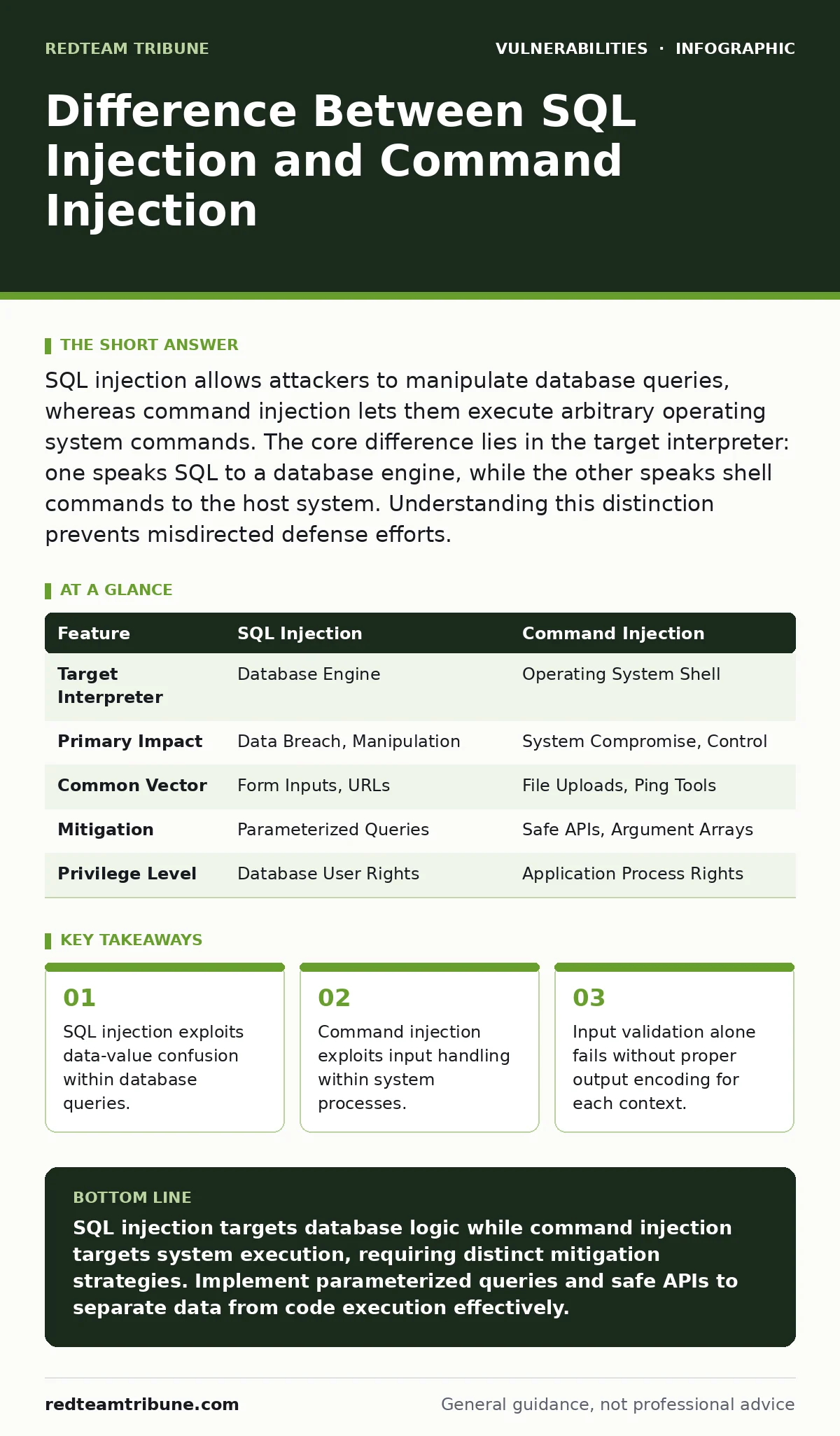
SQL injection allows attackers to manipulate database queries, whereas command injection lets them execute arbitrary operating system commands. The core difference lies in the target interpreter: one speaks SQL to a database engine, while the other speaks shell commands to the host system. Understanding this distinction prevents misdirected defense efforts.
What is the difference between sql injection and command injection?
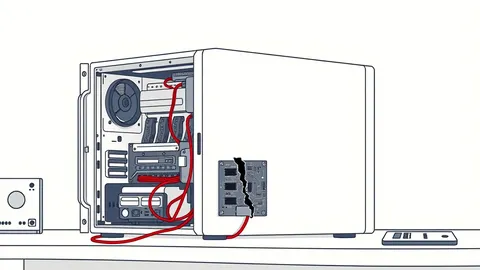
SQL injection and command injection are distinct vulnerabilities that target different software layers. SQL injection occurs when an application passes untrusted data directly into a database query without proper sanitization. An attacker manipulates the structure of the SQL statement to extract, modify, or delete data. Command injection happens when an application passes untrusted data to an operating system shell. The attacker forces the system to execute arbitrary commands, potentially gaining full control of the server. The target interpreter defines the attack vector.
How does SQL injection exploit database logic?
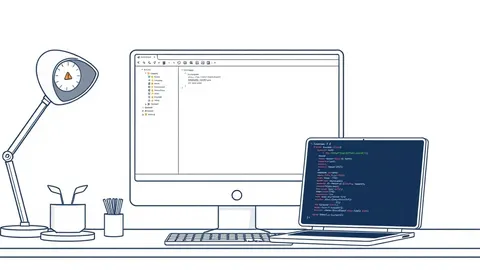
SQL injection exploits the gap between data and code in database queries. Applications often construct queries by concatenating user input with static SQL strings. If an application builds a query like SELECT * FROM users WHERE id = and appends user input, an attacker can inject logic. By submitting 1 OR 1=1, the attacker changes the query’s meaning. The database executes the modified logic, often returning all rows. This bypasses authentication or exposes sensitive data. The vulnerability exists because the application treats user input as part of the command structure.
How does command injection exploit system shells?
Command injection exploits the execution context of the operating system. Applications sometimes need to interact with external tools or system utilities. If an application uses a function to run a system command and includes user input in that command string, it creates a risk. An attacker can inject shell metacharacters, such as semicolons or pipes, to chain additional commands. The shell executes these commands with the privileges of the application process. This can lead to file deletion, reverse shell creation, or lateral movement within the network. The risk depends on the privileges of the running service.
Why is input validation insufficient for both?
Input validation checks if data matches expected patterns, but it often fails against complex attacks. Attackers can use encoding techniques to bypass simple allowlists or blocklists. For SQL injection, an attacker might use hex encoding or wide characters to evade detection. For command injection, they might use variable substitution or environment variables. Relying solely on validation assumes you can predict every possible malicious input. Defense in depth requires treating all input as untrusted. You must also use safe APIs that separate data from code execution.
What are the primary defense mechanisms for SQL injection?
Parameterized queries are the most effective defense against SQL injection. This technique uses placeholders in the SQL statement, separating the code from the data. The database engine treats the input strictly as a value, never as executable code. Even if an attacker injects logic, the database ignores it as part of the command structure. Object-Relational Mappers (ORMs) often handle this automatically, but manual queries require explicit implementation. Stored procedures can also help if they are written to use parameters. Always verify that your ORM is not building dynamic SQL strings internally.
What are the primary defense mechanisms for command injection?
Avoiding system calls is the best defense against command injection. Use higher-level libraries that provide the same functionality without invoking the shell. For example, use a file system library to copy files instead of calling cp via a shell command. If a system call is unavoidable, use APIs that pass arguments as an array, not as a single string. This prevents the shell from interpreting metacharacters. Strict input validation using allowlists is also necessary. Only accept known-good values, such as specific filenames or IP addresses, and reject everything else.
How do these vulnerabilities impact application architecture?
SQL injection primarily compromises data integrity and confidentiality. Attackers can steal credentials, financial records, or intellectual property stored in the database. The impact is contained within the database layer, though lateral movement is possible if credentials are exposed. Command injection compromises the host system’s integrity and availability. Attackers can install malware, create backdoors, or disrupt services. The impact extends beyond the application to the underlying infrastructure. This distinction influences incident response priorities and containment strategies.
| Feature | SQL Injection | Command Injection |
|---|---|---|
| Target Interpreter | Database Engine | Operating System Shell |
| Primary Impact | Data Breach, Manipulation | System Compromise, Control |
| Common Vector | Form Inputs, URLs | File Uploads, Ping Tools |
| Mitigation | Parameterized Queries | Safe APIs, Argument Arrays |
| Privilege Level | Database User Rights | Application Process Rights |
What are the common misconceptions about these attacks?
Many assume that SQL injection only affects web applications. It affects any application that interacts with a database, including mobile apps and internal tools. Similarly, command injection is not limited to web servers. Any application that executes system commands is at risk. Another misconception is that these attacks require complex tools. Simple manual testing can often reveal these vulnerabilities. Developers sometimes believe that using a framework eliminates the risk. Frameworks reduce risk but do not eliminate it if developers bypass safe patterns.
How do these relate to other common vulnerabilities?
Understanding these injection types helps identify related risks. Broken access control often accompanies injection flaws, allowing attackers to target specific data or commands. Insecure deserialization can lead to remote code execution, similar to command injection, but through object reconstruction. Mass assignment vulnerabilities allow attackers to modify internal properties, potentially altering query parameters or command arguments. Prototype pollution in JavaScript environments can manipulate object properties, leading to unexpected behavior in data handling. Each vulnerability exploits a different trust boundary.
What steps should you take to remediate existing code?
Audit your codebase for direct string concatenation in queries and system calls. Replace these with parameterized queries and safe APIs. Implement static application security testing (SAST) to catch these patterns during development. Conduct regular penetration testing to validate defenses. Train developers on secure coding practices, emphasizing the separation of data and code. Monitor logs for unusual query patterns or command executions. Early detection reduces the window of exposure and limits potential damage.
Key takeaways
- SQL injection exploits data-value confusion within database queries.
- Command injection exploits input handling within system processes.
- Input validation alone fails without proper output encoding for each context.
SQL injection targets database logic while command injection targets system execution, requiring distinct mitigation strategies. Implement parameterized queries and safe APIs to separate data from code execution effectively.
Frequently asked questions
Can a firewall stop SQL injection attacks?
Web application firewalls can filter known attack patterns, but they cannot detect all logic flaws. They provide a layer of defense but do not replace secure coding practices.
Is command injection only a server-side issue?
Yes, command injection requires server-side execution. Client-side scripts cannot execute operating system commands on the server due to browser sandboxing.
How do I test for these vulnerabilities safely?
Use isolated test environments with synthetic data. Never test injection attacks on production systems. Use automated scanners combined with manual verification to ensure accuracy.
Do NoSQL databases suffer from SQL injection?
NoSQL databases face similar risks called NoSQL injection. They exploit the difference between data and code in query objects or JSON structures. Mitigation requires similar input validation and parameterization.
How this guide was produced: written by the RedTeam Tribune editorial team with AI assistance, checked against the public references listed below, and reviewed when the facts change. See our editorial policy or report an error.