Mass Assignment Vulnerabilities: How Unchecked Inputs Break Logic
Mass assignment occurs when an application blindly accepts user input and maps it directly to internal data models, allowing attackers to modify hidden fields.

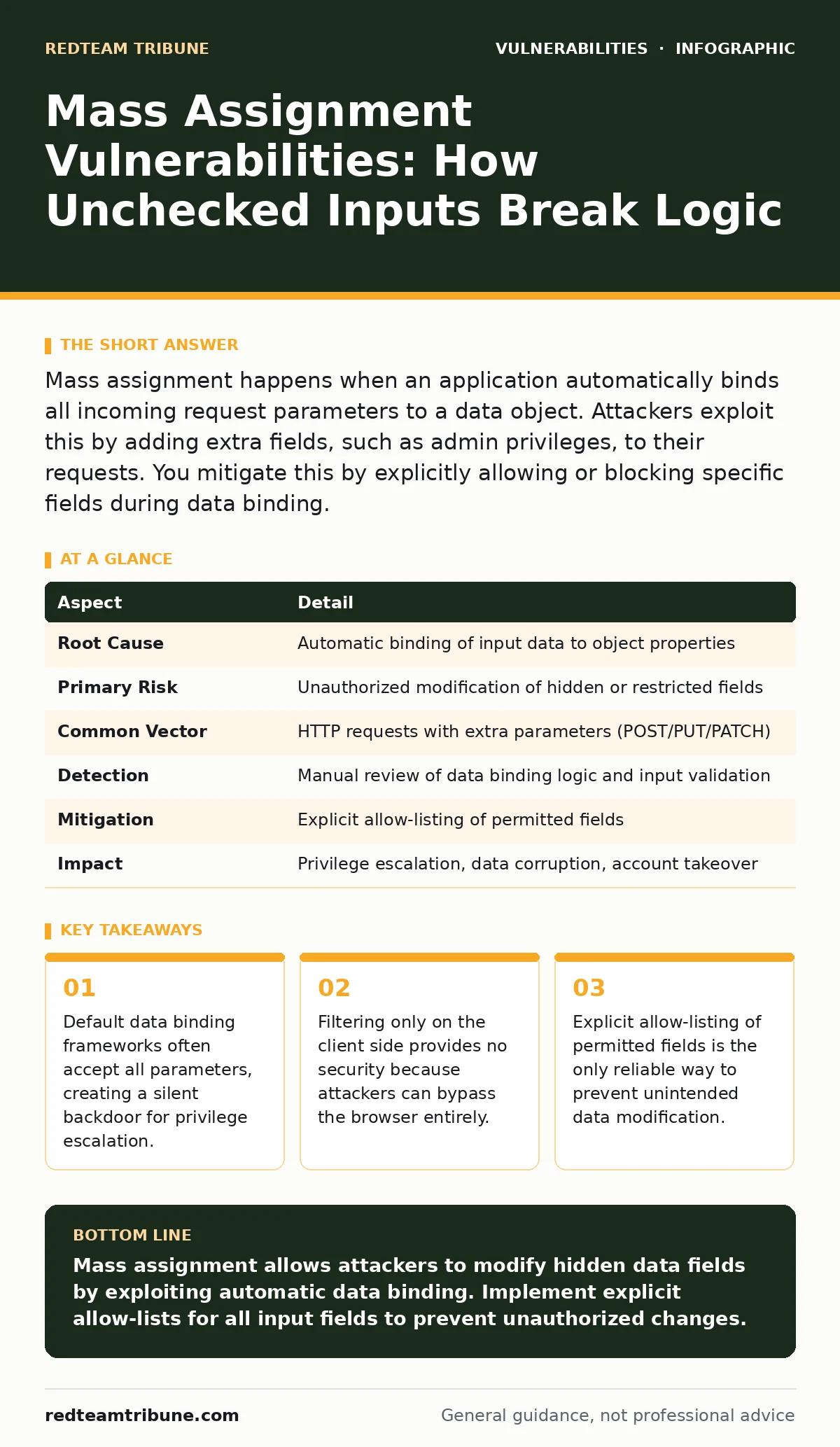
Mass assignment happens when an application automatically binds all incoming request parameters to a data object. Attackers exploit this by adding extra fields, such as admin privileges, to their requests. You mitigate this by explicitly allowing or blocking specific fields during data binding.
The Sticky Note Problem
Imagine you are filling out a form to update your office hours. The form has fields for your name, your start time, and your end time. You fill them in and submit. Behind the scenes, the system takes your input and updates your record. Now, imagine the system is so eager to help that it also updates any other field it finds in your submission, even if you did not see a box for it on the screen. If you secretly add a field called "salary" with a higher value, and the system processes it, you have just changed your pay without asking your manager. This is the core mechanic of mass assignment.
In software terms, this occurs when an application automatically maps user-supplied data to a data model. The application assumes that everything sent by the user is intended for the user to edit. This assumption fails when the data model contains fields that should remain internal, such as account status or access levels.
At a Glance
| Aspect | Detail |
|---|---|
| Root Cause | Automatic binding of input data to object properties |
| Primary Risk | Unauthorized modification of hidden or restricted fields |
| Common Vector | HTTP requests with extra parameters (POST/PUT/PATCH) |
| Detection | Manual review of data binding logic and input validation |
| Mitigation | Explicit allow-listing of permitted fields |
| Impact | Privilege escalation, data corruption, account takeover |
How the Mechanism Fails
Modern web frameworks are designed to reduce boilerplate code. They offer features that automatically map incoming HTTP request parameters to the properties of a data object. This is convenient for developers. It is dangerous when the framework does not distinguish between public and private fields.
Suppose you are building a user profile page. The backend expects a JSON object with "email" and "phone_number". The framework receives this object and updates the user record. An attacker intercepts this request and adds "is_admin": true. If the framework binds all received properties to the user object, the database updates the user's role. The attacker is now an administrator. The application did not crash. It did not show an error. It simply did exactly what the code told it to do, which was to trust all incoming data.
Common Forms and Variations
Mass assignment is not limited to simple text fields. It appears in various forms depending on how the application handles data structures.
- Direct Property Binding: The most common form. The framework maps every key in the input to a property on the object. If the object has a "balance" field, the attacker can set it.
- Nested Object Injection: If the data model contains nested objects, an attacker can inject entire sub-objects. For example, a user profile might contain an "address" object. An attacker could inject a "billing_address" object that triggers unexpected logic or overwrites critical configuration data.
- Type Confusion: Some frameworks attempt to cast input types automatically. An attacker might send a string where an integer is expected, or vice versa, causing the binding logic to behave unpredictably. This can lead to errors that leak information or bypass validation checks.
These variations often overlap with other issues. For instance, if the application accepts complex nested objects, it may also be vulnerable to insecure deserialization, where the structure of the data itself becomes a vector for execution. Understanding the difference helps in prioritizing fixes.
Who Is Affected
Any application that uses data binding frameworks is at risk. This includes most modern web applications built with popular server-side languages. The risk is higher in applications with:
- Complex Data Models: Objects with many fields, including internal flags, status codes, or references to other objects.
- Dynamic Binding: Frameworks that allow binding to all properties by default.
- API-First Architectures: Applications that expose endpoints for creating or updating resources via JSON or XML.
The impact is not just technical. It is business-critical. An attacker who can modify hidden fields can escalate privileges, bypass payment logic, or corrupt data integrity. This makes mass assignment a high-value target for attackers looking for quick wins.
See also: Why is insecure deserialization dangerous: The hidden execution risk · Insecure Deserialization: Step-by-Step Attack Breakdown
What People Usually Get Wrong
There are several misconceptions about how to handle this risk. Addressing them is the first step toward a secure architecture.
Client-Side Validation is Security: Many developers believe that hiding fields in the user interface prevents access. This is false. The browser is controlled by the user. An attacker can use tools like curl or Postman to send requests directly to the server, bypassing the interface entirely. The server must validate and filter input, regardless of what the client shows.
Deny-Listing is Sufficient: Some teams try to block known bad fields, such as "role" or "admin". This is a game of whack-a-mole. Attackers will find other hidden fields. A better approach is allow-listing, where you explicitly define which fields can be updated. If it is not on the list, it is ignored.
It Is Only a Web Issue: Mass assignment can occur in any system that accepts structured input and maps it to an internal model. This includes mobile app backends, desktop applications, and even internal tools. The principle of least privilege applies to data binding just as it does to user accounts.
Reducing the Risk
Mitigating mass assignment requires a shift in how you handle input. You must treat all input as untrusted, regardless of its source.
- Use Allow-Lists: Configure your data binding framework to only accept specific fields. In many frameworks, this is done by specifying a list of permitted properties. Any field not on the list is discarded.
- Implement Input Validation: Validate the type and format of each field. Ensure that an email field contains a valid email address, and a role field contains only allowed values. This adds a layer of defense even if binding is misconfigured.
- Separate Data Models: Use different objects for input and storage. An input object should only contain the fields the user is allowed to edit. A storage object contains all data. Map the input object to the storage object explicitly, ensuring that hidden fields are never overwritten.
- Audit Framework Defaults: Review the documentation of your framework. Understand how it handles data binding by default. Many frameworks have changed their defaults in recent versions to prevent mass assignment. Ensure you are using the secure defaults.
This approach aligns with broader security principles. For example, proper output encoding prevents data from being interpreted as code, while change management for security patches ensures that known vulnerabilities in frameworks are addressed promptly.
Beyond the Basics
Mass assignment is a type of business logic flaw. It exploits the way the application processes data, not a bug in the code itself. This makes it hard to detect with automated tools. Static analysis tools might miss it if they do not understand the framework's binding behavior. Dynamic testing requires specific scenarios where extra fields are added to requests.
When testing, look for endpoints that update or create resources. Try adding common hidden fields like "role", "isAdmin", "status", "price", or "quantity". Observe how the server responds. If the server accepts the field and updates the database, you have found a mass assignment vulnerability.
Understanding mass assignment helps you appreciate the importance of vulnerability severity ratings. A mass assignment flaw that allows privilege escalation is critical. One that allows changing a display name is low. Context matters.
Final Thoughts
Mass assignment is a silent risk. It does not crash the application. It does not produce error logs. It simply allows unintended changes. By understanding how data binding works and enforcing strict allow-lists, you can close this gap. Remember, the server is the gatekeeper. It must decide what data is valid, not the client.
This issue often overlaps with proof-of-concept exploits that demonstrate how easy it is to escalate privileges. Seeing it in action drives home the need for rigorous input handling. It also highlights the value of reducing false positives in threat detection, as legitimate requests with extra metadata can sometimes trigger alarms if the system is not configured correctly.
Key takeaways
- Default data binding frameworks often accept all parameters, creating a silent backdoor for privilege escalation.
- Filtering only on the client side provides no security because attackers can bypass the browser entirely.
- Explicit allow-listing of permitted fields is the only reliable way to prevent unintended data modification.
Mass assignment allows attackers to modify hidden data fields by exploiting automatic data binding. Implement explicit allow-lists for all input fields to prevent unauthorized changes.
Frequently asked questions
Does HTTPS prevent mass assignment vulnerabilities?
No. HTTPS encrypts the data in transit, but it does not validate the content. An attacker can still send malicious fields within an encrypted connection.
Can I use a web application firewall to stop mass assignment?
A WAF can help if it is configured to block requests with unexpected parameters. However, it is not a substitute for application-level validation.
How do I know if my framework is vulnerable?
Check the framework documentation for data binding behavior. If it binds all properties by default, it is vulnerable unless you configure it otherwise.
Is mass assignment the same as SQL injection?
No. SQL injection exploits improper handling of database queries. Mass assignment exploits the automatic mapping of input to data objects.
How this guide was produced: written by the RedTeam Tribune editorial team with AI assistance, checked against the public references listed below, and reviewed when the facts change. See our editorial policy or report an error.