MITRE D3FEND: Map Defenses to Stop Attacks Today
D3FEND turns abstract security concepts into a shared language that lets you verify if your controls actually block known adversary tactics.
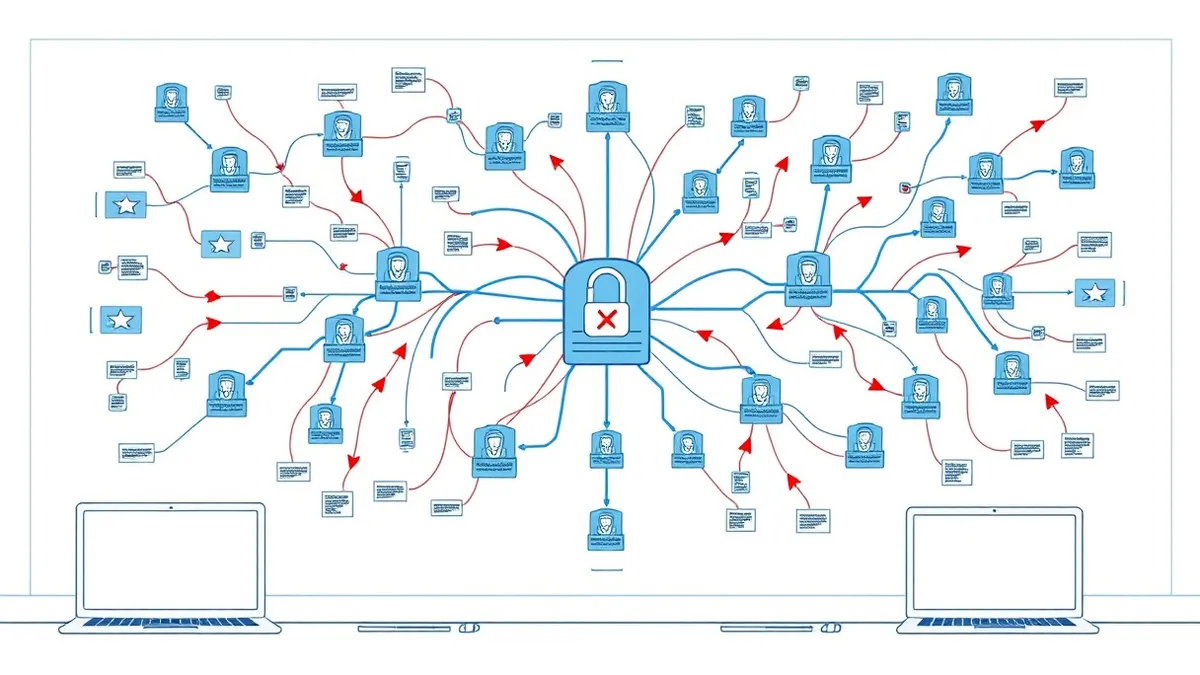
MITRE D3FEND is a matrix of defensive strategies mapped to attacker behaviors. It helps you identify gaps in your security posture by matching specific protections to the techniques adversaries use. You can use this framework to audit your current setup, prioritize upgrades, and verify that your IT provider is implementing effective countermeasures.
Why D3FEND Matters for Small Teams
MITRE D3FEND is a knowledge base that categorizes defensive strategies against cyber threats. It pairs each defensive action with the specific adversary technique it counters. This structure removes guesswork from security planning. You stop buying tools based on marketing claims and start verifying them against known attack methods.
Small organizations often lack dedicated security analysts. They rely on general IT staff or external providers. D3FEND gives these teams a common vocabulary. You can discuss specific protections like "Credential Guard" or "Network Segmentation" in terms of what they stop. This alignment prevents security gaps that arise from misunderstood requirements.
The framework is open and free. It does not require expensive software to use. You can apply its logic to any infrastructure, whether on-premises or cloud-based. The value lies in the mapping. It shows you which defenses are missing for the threats most likely to target your size and sector.
Practical Steps to Map Your Defenses
Start by identifying your critical assets. List the systems that hold sensitive data or enable core business functions. Next, review the MITRE ATT&CK framework to see which techniques adversaries use to compromise similar assets. Then, consult D3FEND to find the corresponding defensive capabilities.
- Select an attacker technique, such as initial access via phishing.
- Find the D3FEND strategy that counters it, such as email filtering or user awareness training.
- Check if your current controls implement that strategy.
- Document any gaps where a countermeasure is missing or weak.
This process reveals hidden weaknesses. You might have an email filter, but do you have detection for compromised accounts? D3FEND shows the full chain of defense. It forces you to consider not just prevention, but detection and response.
Evaluating Your Current Controls
Many organizations think they are protected because they have antivirus and firewalls. D3FEND challenges this assumption. It breaks down defenses into granular capabilities. You might have a firewall, but is it configured to block lateral movement? You might have antivirus, but does it detect fileless malware?
Use the framework to audit your existing tools. Look for the specific D3FEND identifiers associated with your controls. If a control lacks a clear mapping to a defensive strategy, it may be ineffective. This is a hidden cost of legacy security: tools that look good on paper but fail to address modern tactics.
Consider the concept of defense in depth. D3FEND encourages layering defenses. If one layer fails, another should catch the intrusion. Map your controls to multiple layers. Ensure you have prevention at the perimeter, detection in the network, and response capabilities on endpoints.
What to Ask Your IT Provider
Your IT provider may not speak in D3FEND terms. You need to translate the framework into practical questions. Ask them to explain how their services map to specific defensive strategies. Do not accept vague answers about "best practices." Demand specifics.
- Which D3FEND strategies do you implement for identity protection?
- How do you detect lateral movement inside the network?
- What is your process for updating detection rules based on new threats?
- Can you provide a report showing coverage for MITRE ATT&CK techniques?
These questions force transparency. They show whether your provider is using a reactive or proactive approach. If they cannot answer, they may not be providing true security. They might just be maintaining hardware.
Integrating with Detection Engineering
Detection engineering is the practice of creating rules that identify malicious activity. D3FEND provides the blueprint for these rules. It tells you what behavior to look for. You can use this to improve your monitoring capabilities.
For example, if an adversary uses remote desktop abuse, D3FEND points to strategies like restricting RDP access and monitoring for unusual login times. You can create detection rules based on these insights. This makes your monitoring more effective.
You do not need to write all rules yourself. Many providers use open standards like Sigma rules to define detections. Ask if your provider uses these standards. It ensures consistency and allows for easier sharing of detection logic.
See also: Who Is Responsible for Activating the Disaster Recovery Plan? · Compliance Audits Meaning: What They Are and Why They Fail
Cost and Responsibility Matrix
Understanding who pays for and manages each defense is critical. D3FEND helps clarify these roles. It separates the strategy from the implementation. This is useful when negotiating with managed service providers.
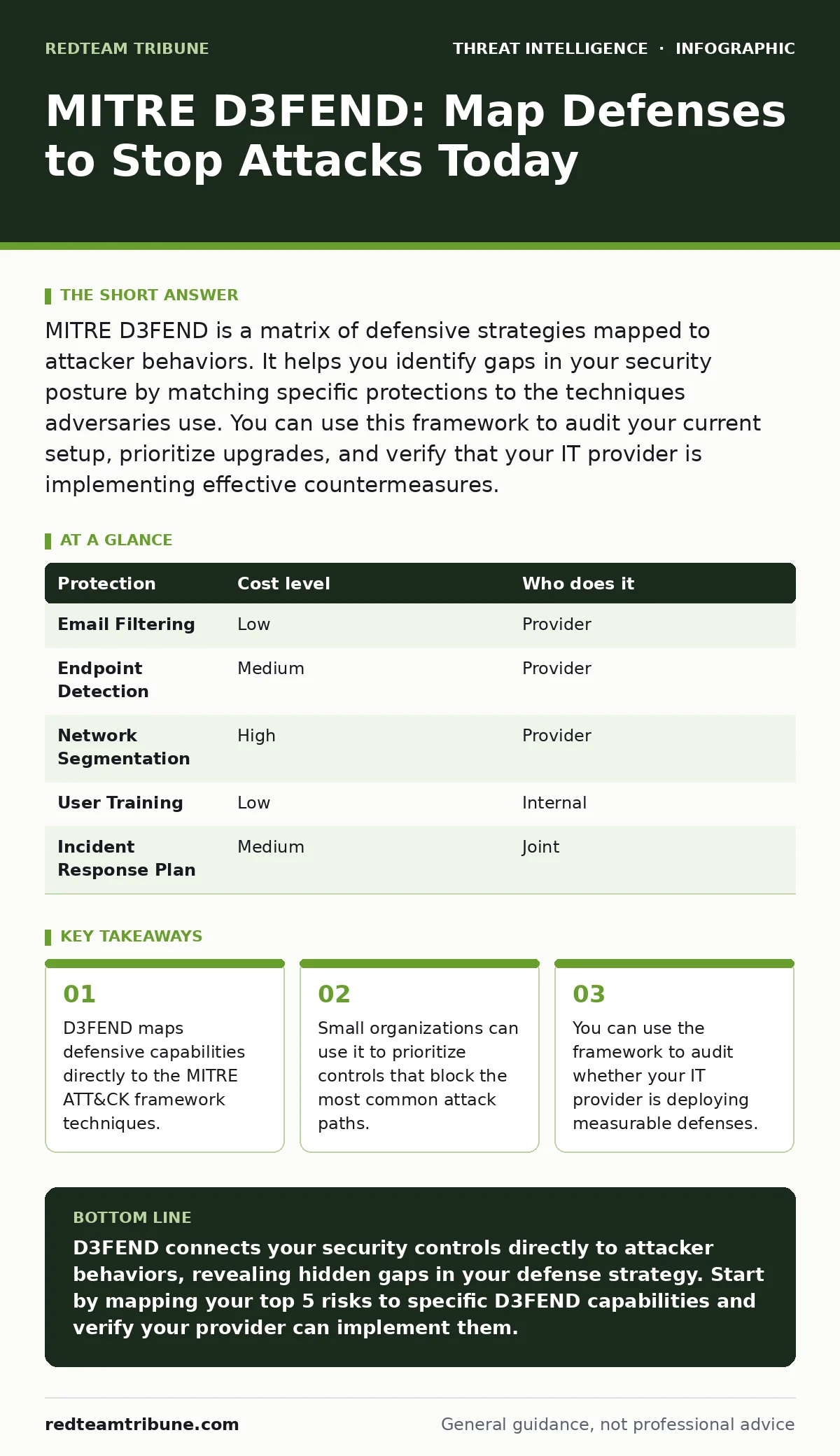
| Protection | Cost level | Who does it |
|---|---|---|
| Email Filtering | Low | Provider |
| Endpoint Detection | Medium | Provider |
| Network Segmentation | High | Provider |
| User Training | Low | Internal |
| Incident Response Plan | Medium | Joint |
This table is hypothetical. Your actual costs and responsibilities will vary. Use it as a starting point for discussion. Ensure there is no overlap or gap in accountability.
Common Pitfalls to Avoid
A common mistake is assuming that having a tool means having the defense. D3FEND distinguishes between the technology and the strategy. You can have a firewall without proper segmentation. You can have logging without analysis.
Another pitfall is ignoring the human element. Technical controls fail if users bypass them. D3FEND includes strategies for user behavior analytics and training. Do not neglect these. They are often the weakest link.
Finally, avoid static mapping. Threats evolve. Defenses must evolve too. Review your D3FEND mapping regularly. Update it as you add new tools or as adversary tactics change. This keeps your security posture relevant.
Building a Resilient Posture
D3FEND is not a silver bullet. It is a framework for thinking about defense. It helps you structure your approach. By mapping your defenses to attacker techniques, you gain clarity. You know what you are protecting against.
This clarity allows for better investment decisions. You can prioritize spending on controls that address the highest risks. You can verify that your providers are delivering value. Over time, this leads to a more resilient organization.
Remember that security is a process, not a product. Use D3FEND to guide that process. Continuously assess, adjust, and improve. This ongoing effort is what keeps you safe.
Key takeaways
- D3FEND maps defensive capabilities directly to the MITRE ATT&CK framework techniques.
- Small organizations can use it to prioritize controls that block the most common attack paths.
- You can use the framework to audit whether your IT provider is deploying measurable defenses.
D3FEND connects your security controls directly to attacker behaviors, revealing hidden gaps in your defense strategy. Start by mapping your top 5 risks to specific D3FEND capabilities and verify your provider can implement them.
Frequently asked questions
Is D3FEND free to use?
Yes, D3FEND is an open framework maintained by MITRE. You can access the knowledge base and its mappings without any licensing fees.
Do I need a security analyst to use D3FEND?
No, you can use it as a checklist. It helps you ask better questions of your IT provider and verify that your existing tools are configured correctly.
How is D3FEND different from MITRE ATT&CK?
ATT&CK describes what attackers do. D3FEND describes how defenders can stop them. They are complementary frameworks that work best together.
Can D3FEND help with cloud security?
Yes, D3FEND includes strategies for cloud environments. It covers identity management, workload protection, and data security in cloud settings.
How this guide was produced: written by the RedTeam Tribune editorial team with AI assistance, checked against the public references listed below, and reviewed when the facts change. See our editorial policy or report an error.