Who Is Responsible for Activating the Disaster Recovery Plan?
Operational authority for recovery activation rests with a designated individual, not a committee, to prevent paralysis during critical system failures.
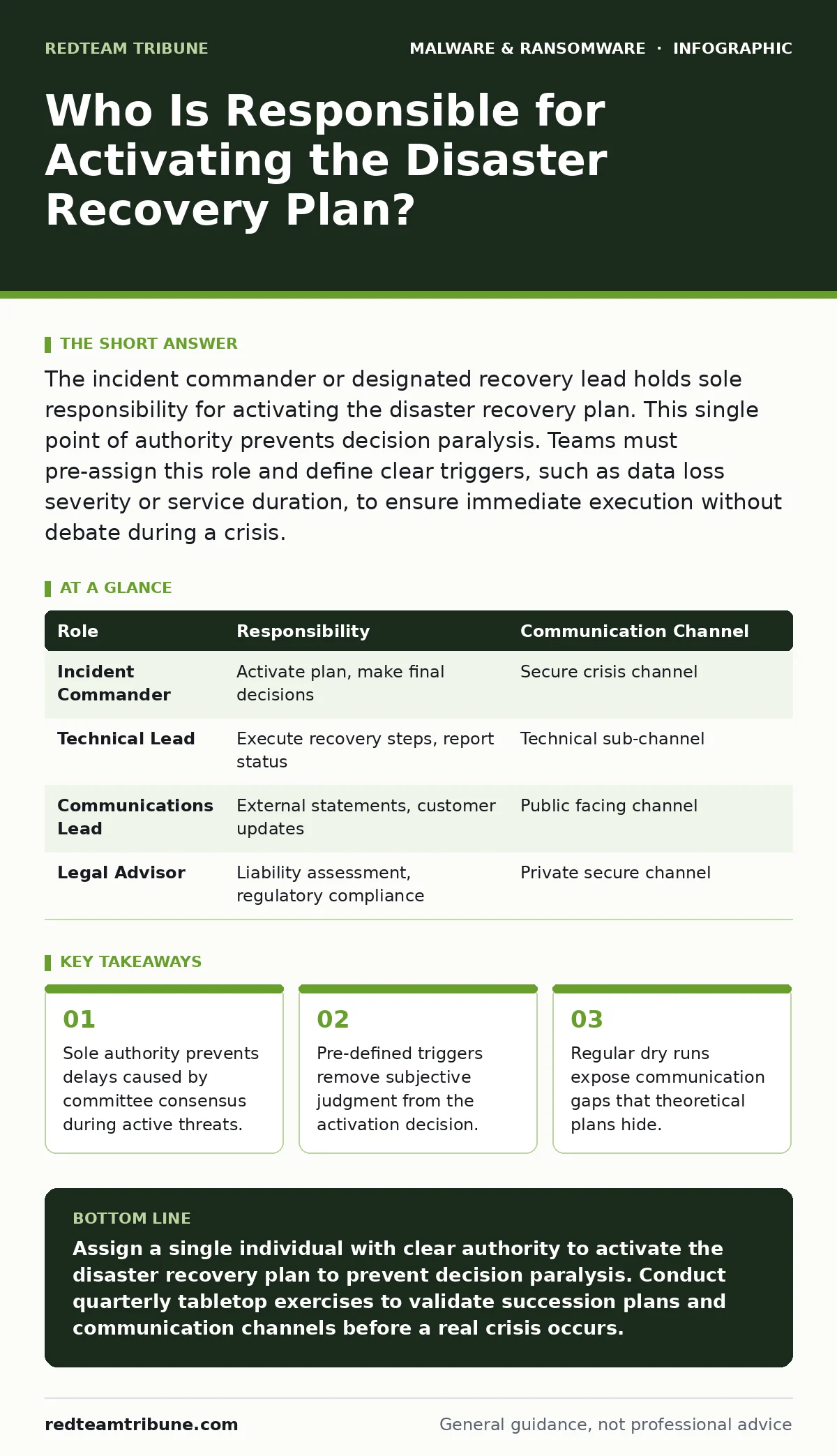
The incident commander or designated recovery lead holds sole responsibility for activating the disaster recovery plan. This single point of authority prevents decision paralysis. Teams must pre-assign this role and define clear triggers, such as data loss severity or service duration, to ensure immediate execution without debate during a crisis.
Who Is Responsible for Activating the Disaster Recovery Plan?
The designated incident commander holds sole responsibility for activating the disaster recovery plan. This role requires pre-assignment to a specific individual, not a group. Committees fail during crises because consensus requires time you do not have. The commander must have explicit authority to bypass normal change control procedures. This authority allows immediate system isolation and restoration actions. Without this clear mandate, technical teams hesitate, fearing unauthorized changes. You must document this authority in writing. Staff must know exactly who holds this power before a breach occurs.
What Triggers the Activation of Recovery Procedures?
Activation triggers must be objective metrics, not subjective feelings. Common triggers include confirmed ransomware encryption, loss of primary data centers, or sustained service outage beyond a defined threshold. You must define these thresholds in advance. This removes the need for debate. If you wait for proof of intent, you lose time. Imagine a scenario where a computer worm spreads silently. Waiting for full confirmation allows the worm to consume resources. Early activation based on anomaly detection saves data.
How Do You Handle Partial System Failures?
Not all failures require full disaster recovery activation. You must distinguish between local incidents and catastrophic events. A single server failure triggers standard maintenance procedures, not the disaster recovery plan. Full activation consumes significant resources and disrupts business operations. Use a tiered response model. Tier 1 handles local issues. Tier 2 handles department-wide outages. Tier 3 triggers the full disaster recovery plan. This structure prevents alert fatigue. Staff ignore warnings if every minor issue triggers a massive response. Clear definitions keep the team focused on true emergencies.
What Happens When the Primary Leader Is Unavailable?
Succession planning is mandatory for the activation role. If the incident commander is unreachable, a predefined deputy must assume authority immediately. You must list at least 3 successors in order of priority. Contact methods must be out-of-band, such as personal phones or secure messaging apps not hosted on corporate servers. Do not rely on internal email or ticketing systems. These systems may be compromised or offline. Test the succession chain quarterly. Rotate the primary and deputy roles annually. This ensures multiple people understand the activation process. It prevents single points of failure in leadership.
How Does Communication Flow During Activation?
Communication must follow a strict hierarchy to prevent misinformation. The incident commander broadcasts the activation status. Technical teams report only to their sub-leaders. Do not allow open discussion in general channels. Use dedicated, secure channels for crisis management. External communication requires a separate spokesperson. Technical staff should not speak to the media or customers. This separation prevents accidental disclosure of sensitive details. Imagine a macro malware outbreak. Technical teams are fixing endpoints. The spokesperson manages customer expectations. Clear roles prevent confusion and legal exposure.
| Role | Responsibility | Communication Channel |
|---|---|---|
| Incident Commander | Activate plan, make final decisions | Secure crisis channel |
| Technical Lead | Execute recovery steps, report status | Technical sub-channel |
| Communications Lead | External statements, customer updates | Public facing channel |
| Legal Advisor | Liability assessment, regulatory compliance | Private secure channel |
See also: Stop Computer Worms: The Network Containment Checklist · Stop Log Tampering: A Defensive Checklist for Integrity
What Are the Hidden Costs of Activation?
Activation costs extend beyond technical recovery. Business continuity suffers during the transition. Staff may be reassigned to recovery duties, leaving other tasks unattended. You must account for productivity loss in your planning. Legal review may be required if customer data was exposed. Insurance claims require detailed documentation of the activation timeline. Delays in logging actions can void coverage. Ensure your plan includes steps for evidence preservation. Do not overwrite logs during recovery. This balance between speed and forensics is difficult. Prioritize based on your industry regulations.
How Do You Validate the Plan Without Breaking Systems?
Tabletop exercises validate the plan without risking production environments. Gather key stakeholders and simulate a breach scenario. Walk through the activation steps verbally. Identify gaps in authority or communication. Do not rely on technical drills alone. Technical teams often assume leadership decisions are instant. Tabletop exercises reveal decision latency. Rotate participants to test different team compositions. Document every delay and confusion point. Update the plan immediately after each exercise. A plan that has never been tested is a theoretical document. It will fail under pressure.
When Does the Plan Fail Due to Human Error?
Human error often stems from unclear authority or fatigue. If multiple people believe they can activate the plan, they may conflict. If no one believes they can act, paralysis occurs. You must train staff to recognize the activation signal. Drills must include the activation moment. Staff should practice responding to the commander's order. Fatigue impairs decision-making during long incidents. Rotate staff during extended recoveries. Ensure replacements are briefed on the current status. Imagine an offline backup restoration taking 48 hours. The initial team may be exhausted. A fresh team needs clear handover notes. Poor handovers cause repeated mistakes.
How Do You Integrate Threat Intelligence into Activation?
Threat intelligence informs the scope of activation. If intelligence indicates a targeted attack, you may need broader isolation. If it is a general outage, standard recovery suffices. Monitor sources for malicious PyPI packages or other supply chain threats. These threats may require specific containment steps. Attack surface reduction rules help limit initial damage. Knowing the threat type helps prioritize recovery. Do not wait for full analysis to activate the plan. Use initial indicators to guide the response. Adjust the plan as more intelligence becomes available. Flexibility within the framework is key.
Key takeaways
- Sole authority prevents delays caused by committee consensus during active threats.
- Pre-defined triggers remove subjective judgment from the activation decision.
- Regular dry runs expose communication gaps that theoretical plans hide.
Assign a single individual with clear authority to activate the disaster recovery plan to prevent decision paralysis. Conduct quarterly tabletop exercises to validate succession plans and communication channels before a real crisis occurs.
Frequently asked questions
Can the IT manager activate the disaster recovery plan?
Only if explicitly designated as the incident commander in the written policy. Otherwise, they must follow the chain of command.
What if the activation trigger is ambiguous?
Err on the side of activation. The cost of unnecessary activation is lower than the cost of delayed recovery.
How often should the activation authority be reviewed?
Review annually and immediately after any personnel changes in the leadership team.
Does automation replace the need for human activation?
Automation can execute steps, but a human must authorize the shift to recovery mode to prevent false positives.
How this guide was produced: written by the RedTeam Tribune editorial team with AI assistance, checked against the public references listed below, and reviewed when the facts change. See our editorial policy or report an error.