DDoS Attack Mechanics: Answers to 10 Critical Questions
Distributed denial-of-service attacks often exploit application logic flaws rather than raw bandwidth, making traditional mitigation strategies ineffective against sophisticated threats.
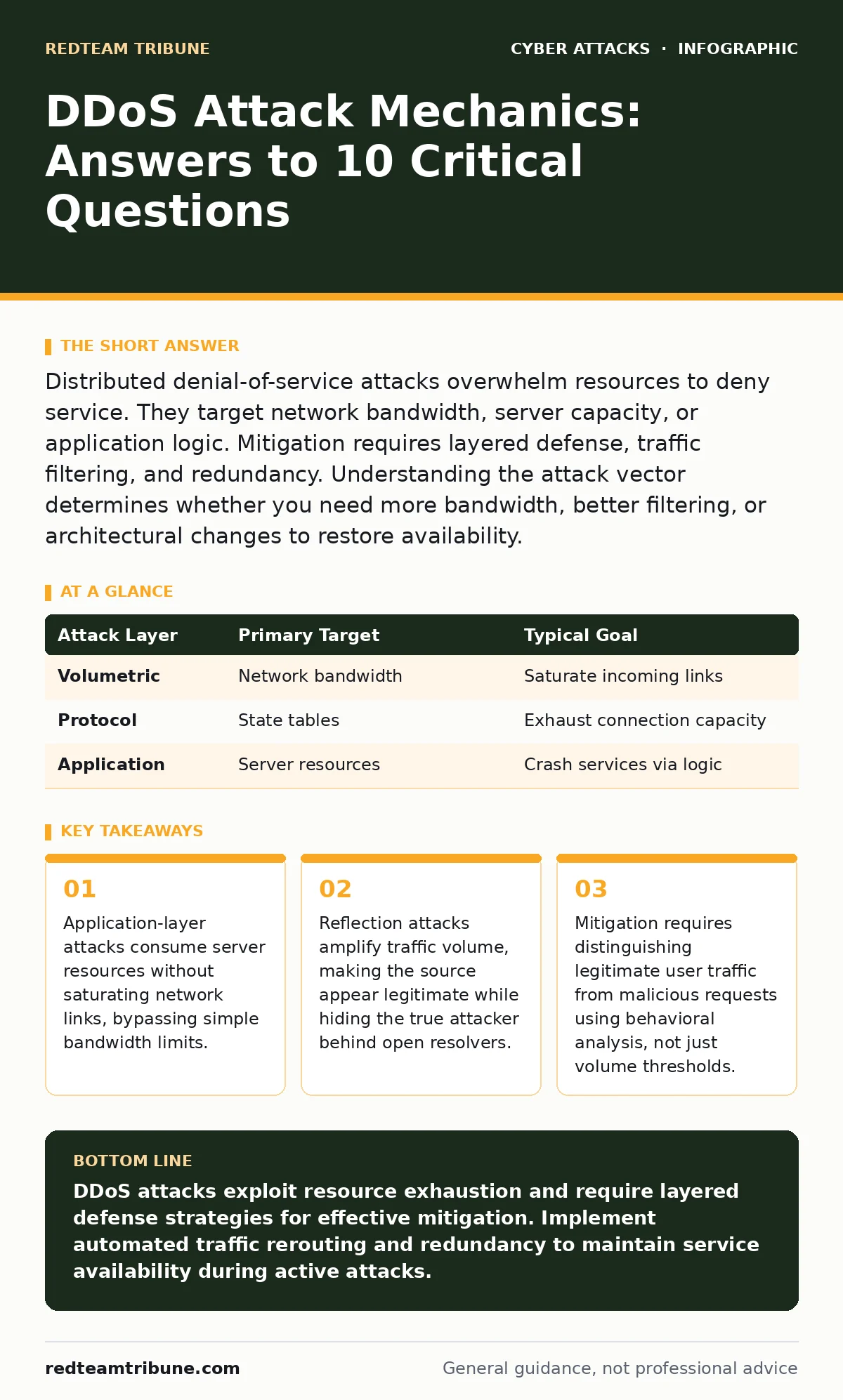
Distributed denial-of-service attacks overwhelm resources to deny service. They target network bandwidth, server capacity, or application logic. Mitigation requires layered defense, traffic filtering, and redundancy. Understanding the attack vector determines whether you need more bandwidth, better filtering, or architectural changes to restore availability.
What is a Distributed Denial-of-Service Attack?
A distributed denial-of-service attack floods a target with excessive traffic from multiple sources to exhaust its resources. The attacker uses a network of compromised devices, known as a botnet, to generate this traffic. The goal is to make a service unavailable to legitimate users. This differs from a single-source attack because the traffic comes from many locations, making it harder to block specific IP addresses. The impact ranges from slowed performance to complete service outage, depending on the attack's intensity and the target's defenses.
How Do DDoS Attacks Actually Work?
DDoS attacks work by sending more requests than the target can process. Attackers send packets that trigger resource-intensive operations on the server. This consumes CPU, memory, or bandwidth. The server spends time processing these fake requests instead of serving real users. Some attacks exploit protocol weaknesses, such as incomplete handshake processes, to tie up connection slots. Others use reflection, where the attacker spoofs the victim's IP address to trick third-party servers into sending large responses to the victim. This amplifies the attack traffic significantly.
What Are the Most Common DDoS Attack Types?
The most common DDoS attack types are volumetric, protocol, and application-layer attacks. Volumetric attacks aim to clog the target's bandwidth with massive amounts of traffic. Protocol attacks target network layer resources, such as firewalls or load balancers, by exploiting protocol processing limits. Application-layer attacks mimic legitimate user behavior to exhaust server resources, such as database connections or CPU cycles. Each type requires different mitigation strategies. Volumetric attacks need bandwidth scrubbing, while application attacks require deep packet inspection to identify malicious patterns.
| Attack Layer | Primary Target | Typical Goal |
|---|---|---|
| Volumetric | Network bandwidth | Saturate incoming links |
| Protocol | State tables | Exhaust connection capacity |
| Application | Server resources | Crash services via logic |
Can a Firewall Stop a DDoS Attack?
A standard firewall cannot stop a large DDoS attack on its own. Firewalls filter traffic based on rules, but DDoS traffic often mimics legitimate requests. If the attack volume exceeds the firewall's processing capacity, the device itself becomes a bottleneck. Advanced firewalls with application-aware filtering can help identify malicious patterns. However, they must be combined with upstream mitigation services. These services absorb the attack traffic before it reaches your network. Without this layered approach, even sophisticated firewalls will fail under sustained, high-volume attacks.
How Do You Detect a DDoS Attack Early?
You detect a DDoS attack early by monitoring for anomalies in traffic patterns. Look for sudden spikes in request rates from unusual geographic locations. Watch for an increase in failed connection attempts or slow response times. Baseline your normal traffic to identify deviations. Automated monitoring tools can alert you when traffic exceeds predefined thresholds. Early detection allows you to activate mitigation services before the service degrades significantly. Delayed detection often results in prolonged downtime and increased damage to user trust and revenue streams.
See also: Implement Network Traffic Analysis: A Step-by-Step Operational Guide · Network Segmentation Mistakes That Leave Your Data Exposed
Why Do Application-Layer Attacks Bypass Traditional Defenses?
Application-layer attacks bypass traditional defenses because they look like legitimate user traffic. These attacks send valid HTTP requests that require significant server resources to process. Traditional defenses focus on volume and protocol anomalies. They do not analyze the content or behavior of individual requests. An attacker can send a few requests per second that each trigger a complex database query. This slowly drains server resources without triggering volume-based alerts. Mitigation requires behavioral analysis to distinguish between human users and automated scripts. This involves examining request patterns, session duration, and resource consumption per user.
What Is Reflection and Amplification in DDoS Attacks?
Reflection and amplification use third-party servers to hide the attacker and increase traffic volume. The attacker sends small requests with the victim's IP address as the source. These requests go to open resolvers or servers that respond with large amounts of data. The victim receives these large responses, creating a flood of traffic. The amplification factor can be significant, turning a small attack into a massive flood. This technique exploits the trust relationships in the internet's infrastructure. Closing open resolvers and implementing strict ingress filtering reduces the effectiveness of these attacks.
How Do You Mitigate an Active DDoS Attack?
Mitigating an active DDoS attack involves redirecting traffic to a scrubbing center. This service filters out malicious packets and forwards clean traffic to your servers. You must have this service pre-configured and ready to activate. Manual intervention is too slow during a live attack. Implement automatic traffic rerouting using DNS-based methods or BGP announcements. This ensures that mitigation begins within seconds of detection. Simultaneously, scale up your infrastructure to handle the filtered traffic. Redundancy and load balancing help distribute the load and prevent single points of failure during the mitigation process.
What Is the Role of Redundancy in DDoS Defense?
Redundancy ensures service availability even when parts of your infrastructure are overwhelmed. Distribute your services across multiple geographic locations and data centers. Use load balancers to distribute traffic evenly. If one location is targeted, traffic can be routed to others. This geographical distribution makes it harder for an attacker to saturate all paths to your service. Redundancy also allows you to take components offline for maintenance or mitigation without affecting users. It is a critical component of a resilient architecture that can withstand sustained attacks.
How Do DDoS Attacks Impact Business Operations?
DDoS attacks impact business operations by causing service downtime and revenue loss. Users cannot access services, leading to frustration and churn. Reputation damage occurs as customers lose trust in your reliability. Operational costs rise due to emergency mitigation efforts and infrastructure scaling. Legal and compliance risks may arise if service level agreements are violated. The financial impact extends beyond immediate losses to long-term brand damage. Proactive defense investments reduce these risks by minimizing downtime and maintaining service continuity. Understanding the business impact helps justify the necessary security expenditures.
Key takeaways
- Application-layer attacks consume server resources without saturating network links, bypassing simple bandwidth limits.
- Reflection attacks amplify traffic volume, making the source appear legitimate while hiding the true attacker behind open resolvers.
- Mitigation requires distinguishing legitimate user traffic from malicious requests using behavioral analysis, not just volume thresholds.
DDoS attacks exploit resource exhaustion and require layered defense strategies for effective mitigation. Implement automated traffic rerouting and redundancy to maintain service availability during active attacks.
Frequently asked questions
How do I know if I am under a DDoS attack?
Check for sudden traffic spikes, unusual geographic sources, and increased error rates or slow response times.
Can a VPN protect against DDoS attacks?
A VPN encrypts traffic but does not filter volume-based attacks. It may even exacerbate issues by adding overhead to limited bandwidth.
What is the difference between DDoS and DoS?
DoS comes from a single source, while DDoS uses many distributed sources, making it harder to block.
Should I block IP addresses during an attack?
Blocking IPs is ineffective for large DDoS attacks due to the volume and distributed nature of the sources. Use specialized mitigation services instead.
How this guide was produced: written by the RedTeam Tribune editorial team with AI assistance, checked against the public references listed below, and reviewed when the facts change. See our editorial policy or report an error.