Diamond Model of Intrusion Analysis: Fix Common Misreadings
Treating the Diamond Model as a static checklist fails because it is a dynamic framework for linking adversary capabilities to infrastructure and victim context.
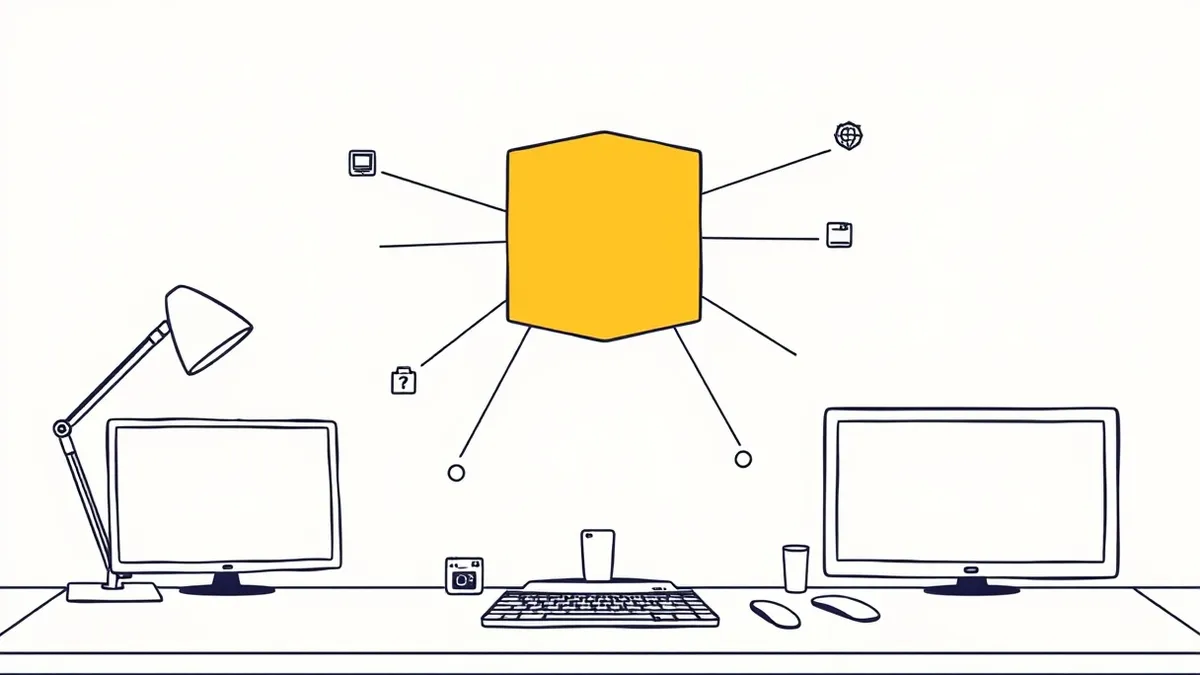
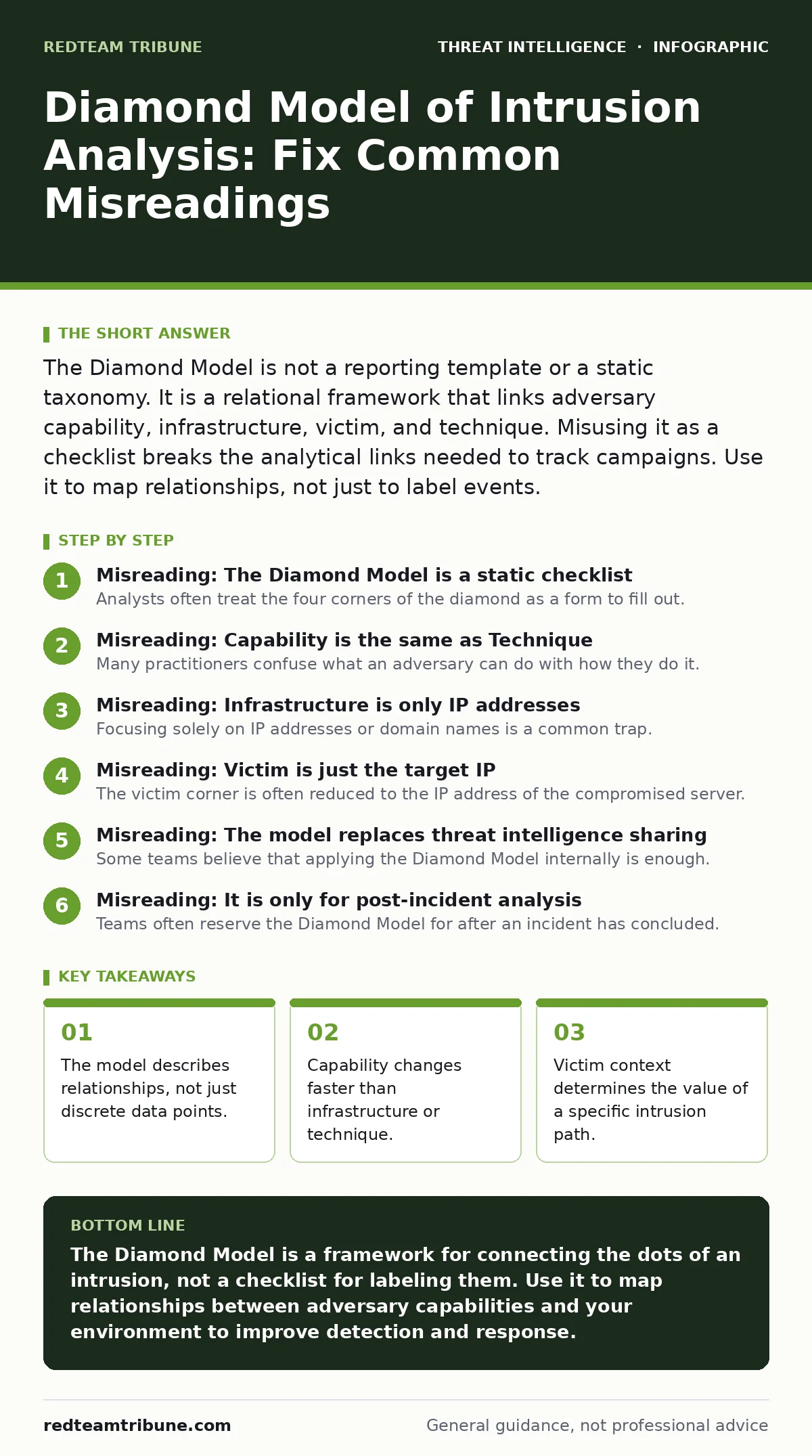
The Diamond Model is not a reporting template or a static taxonomy. It is a relational framework that links adversary capability, infrastructure, victim, and technique. Misusing it as a checklist breaks the analytical links needed to track campaigns. Use it to map relationships, not just to label events.
Misreading: The Diamond Model is a static checklist
Analysts often treat the four corners of the diamond as a form to fill out. You see an IP address, you write it under Infrastructure. You see a phishing email, you write it under Technique. This approach turns a dynamic analytical framework into a rigid data entry task. The model is designed to show how these elements connect, not just to list them. When you treat it as a checklist, you lose the narrative of how the adversary moved.
Correct reading: The Diamond Model is a relational map. Each corner represents a variable that influences the others. Changing one element, such as the victim’s environment, forces a change in the technique or infrastructure used. You use the model to trace the logic of the intrusion, not to catalog artifacts. This shifts your focus from "what happened" to "why it happened this way."
Misreading: Capability is the same as Technique
Many practitioners confuse what an adversary can do with how they do it. Technique is the specific method, such as using a known exploit kit. Capability is the underlying skill or resource that allows that technique to work. An adversary might have the capability to bypass multi-factor authentication, but they may use different techniques to achieve it over time. Conflating the two leads to brittle detection rules.
Correct reading: Capability is the stable asset; technique is the transient expression. If you detect a specific command-line argument, you are seeing a technique. If you observe the adversary’s ability to persist across reboots, you are observing a capability. Detection engineering benefits from this distinction. You can build Sigma rules that target the persistent capability rather than the fleeting technique. This makes your defenses harder to evade.
Misreading: Infrastructure is only IP addresses
Focusing solely on IP addresses or domain names is a common trap. Infrastructure includes the full chain of command and control, proxy servers, and even the hosting providers used. An adversary might rotate IP addresses daily, but the underlying infrastructure, such as a specific cloud region or a unique TLS certificate fingerprint, remains constant. Ignoring these deeper layers blinds you to the campaign’s continuity.
Correct reading: Infrastructure is the persistent layer of the attack. It includes digital footprints that are harder to change than an IP address. Look for patterns in network traffic analysis that reveal the same infrastructure across different incidents. This might involve consistent user-agent strings or specific beacon intervals. By mapping infrastructure broadly, you can link seemingly unrelated alerts into a single campaign.
Misreading: Victim is just the target IP
The victim corner is often reduced to the IP address of the compromised server. This ignores the broader context of the target’s value and exposure. A victim is defined by their network architecture, security posture, and business function. An adversary targets a specific department because it holds sensitive data, not just because it is on the network. Understanding the victim helps you predict the next move.
Correct reading: Victim context drives the adversary’s choices. If you understand that the target uses remote desktop abuse to move laterally, you can anticipate where they will go next. This is especially relevant when analyzing Active Directory attacks, where the victim’s group policy settings dictate the path of least resistance. You must map the victim’s internal topology to understand the risk. This depth transforms raw alerts into actionable intelligence.
Misreading: The model replaces threat intelligence sharing
Some teams believe that applying the Diamond Model internally is enough. They ignore the value of external data. The model is a language for structuring intelligence, but it does not generate new data. Without input from threat intelligence sharing communities, your internal view is limited to your own perimeter. Adversaries operate across many victims, and their patterns only become clear when you combine data sources.
Correct reading: The model standardizes how you consume and share data. It allows you to align your internal findings with external reports. When you see a similar capability in a public report, you can map it to your own infrastructure and victim context. This alignment speeds up detection and response. You are not replacing sharing; you are making it more precise and actionable.
See also: 7 Mistakes That Expose You to Dark Web Search Engines · Network Scanning Myths: Why Common Beliefs Fail in Detection
Misreading: It is only for post-incident analysis
Teams often reserve the Diamond Model for after an incident has concluded. They use it to write reports rather than to guide real-time investigation. This delays the identification of related activity. The model is most powerful when applied during the initial triage. It helps you ask the right questions about the adversary’s intent and resources before the breach expands.
Correct reading: Use the model to drive adversary emulation and proactive hunting. By mapping known capabilities to your environment, you can simulate how an adversary would move. This helps you identify gaps in your monitoring before an attack occurs. You can test your detection engineering against specific capability-technique pairs. This proactive use turns the model into a planning tool, not just a retrospective one.
Key takeaways
- The model describes relationships, not just discrete data points.
- Capability changes faster than infrastructure or technique.
- Victim context determines the value of a specific intrusion path.
- Static application misses the evolution of adversary tactics.
The Diamond Model is a framework for connecting the dots of an intrusion, not a checklist for labeling them. Use it to map relationships between adversary capabilities and your environment to improve detection and response.
Frequently asked questions
How is the Diamond Model different from MITRE ATT&CK?
MITRE ATT&CK is a comprehensive taxonomy of techniques. The Diamond Model is a framework for analyzing specific incidents by linking adversary elements. They are complementary; ATT&CK helps you name the technique, while the Diamond Model helps you understand the context.
Can I use the Diamond Model for insider threats?
Yes. The model applies to any intrusion, including insiders. You map the insider’s capability, their access infrastructure, the specific victim assets they target, and the techniques they use. The relationships remain the same, even if the adversary is internal.
Does the Diamond Model help with attribution?
It aids attribution by linking infrastructure and capability across incidents. While it does not definitively name the actor, it helps group activities into campaigns. This clustering makes it easier to identify patterns that point to a specific group’s modus operandi.
How do I start using the Diamond Model today?
Start by mapping your next incident. Identify the four corners and draw lines between them to show how they influenced each other. Look for gaps in your knowledge. Use those gaps to guide your investigation and improve your monitoring.
How this guide was produced: written by the RedTeam Tribune editorial team with AI assistance, checked against the public references listed below, and reviewed when the facts change. See our editorial policy or report an error.