Threat Intelligence Sharing Mistakes and How to Fix Them
Most intelligence sharing fails not because of bad data, but because context is stripped away during automated ingestion, creating noise that hides real threats.
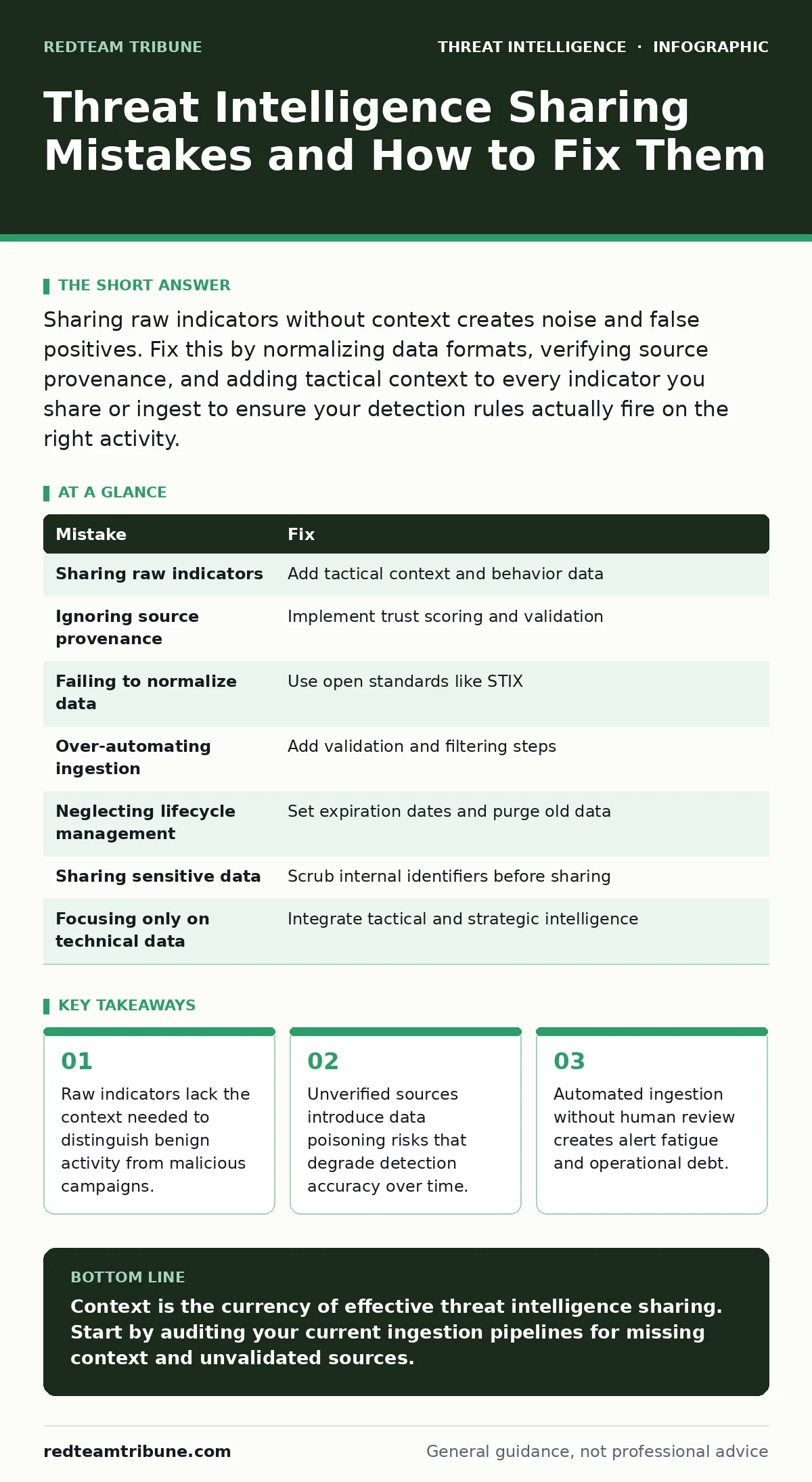
Sharing raw indicators without context creates noise and false positives. Fix this by normalizing data formats, verifying source provenance, and adding tactical context to every indicator you share or ingest to ensure your detection rules actually fire on the right activity.
Mistake 1: Sharing raw indicators without tactical context
Organizations often share IP addresses, domains, or hashes as standalone data points. This strips away the narrative of how these indicators are used in an attack chain. An IP address alone tells you nothing about whether it was used for command and control or legitimate cloud hosting.
Why it hurts: Your analysts receive alerts that look like threats but are actually benign. This creates noise that buries real incidents. You waste hours investigating false positives in threat detection because the indicator lacked the surrounding behavior that defines its malicious intent.
The fix: Always attach context to indicators. Include the attack technique, the malware family, and the observed behavior. Use structured formats that support metadata fields. This allows your detection engineering team to write rules that look for behavior, not just static strings.
Mistake 2: Ignoring source provenance and trust levels
Not all intelligence sources are equal. Some are automated scrapers that may include false positives, while others are human-curated feeds with high fidelity. Treating a low-confidence source the same as a high-confidence one dilutes your security posture.
Why it hurts: You inherit the errors of the source. If a source misclassifies a benign domain as malicious, your system blocks legitimate traffic. This disrupts business operations and erodes trust in your security tools. You also risk data poisoning if a source is compromised or biased.
The fix: Implement a trust scoring system for each source. Validate indicators against multiple independent sources before actioning them. Document the origin of each piece of intelligence. This allows you to tune your detection sensitivity based on the reliability of the source.
Mistake 3: Failing to normalize data formats
Intelligence comes in many formats: STIX, TAXII, CSV, JSON, and proprietary schemas. Ingesting these without normalization leads to inconsistent data structures. Your systems may struggle to correlate events across different data types.
Why it hurts: You create silos of information. An alert from one system may not match an indicator from another because the format differs. This breaks automation and forces manual correlation. It slows down incident response and increases the chance of missing cross-platform attacks.
The fix: Standardize on open standards like STIX for sharing and internal processing. Use a normalization layer to convert incoming data into a common schema. This ensures your network traffic analysis tools can correlate data from diverse sources without custom adapters for each feed.
Mistake 4: Over-automating ingestion without validation
Automated pipelines ingest thousands of indicators daily. Without validation, these pipelines accept every entry. This includes expired indicators, duplicates, and irrelevant data. The volume overwhelms your security information and event management system.
Why it hurts: Alert fatigue sets in. Your analysts ignore alerts because too many are irrelevant. You miss critical incidents because they are buried in a sea of noise. The cost of reviewing false alerts exceeds the value of the intelligence itself.
The fix: Add validation steps to your ingestion pipeline. Check for expiry dates, duplicates, and relevance to your environment. Use Sigma rules to test indicators against known benign traffic before full deployment. This ensures only high-quality intelligence reaches your analysts.
Mistake 5: Neglecting lifecycle management of indicators
Indicators decay over time. An IP address used for malware distribution today may be reassigned to a bank tomorrow. Keeping old indicators active creates false positives. Failing to remove expired indicators clutters your threat intelligence platform.
Why it hurts: Your detection rules fire on legitimate traffic. This causes outages and user complaints. It also wastes analyst time investigating incidents that are not real. The accuracy of your threat detection degrades as the ratio of expired to active indicators grows.
The fix: Implement a lifecycle policy for indicators. Set expiration dates based on the type of indicator. Regularly purge expired data from your systems. Monitor for changes in the reputation of indicators to adjust their status dynamically.
See also: Detection Engineering Checklist: Build Resilient Monitoring Logic · Dark web threat intelligence implementation steps for early warnings
Mistake 6: Sharing sensitive internal data inadvertently
When sharing intelligence, organizations sometimes include internal network details, hostnames, or user information. This can reveal vulnerabilities in your own infrastructure. It helps adversaries tailor attacks against your specific environment.
Why it hurts: You expose your attack surface. Adversaries can use your shared data to plan more effective intrusions. This undermines the purpose of sharing, which is to improve collective defense. It also violates privacy regulations and trust agreements.
The fix: Scrub all internal identifiers before sharing. Use external references instead of internal hostnames. Ensure your sharing platform enforces data loss prevention policies. Review shared artifacts for sensitive information before distribution.
Mistake 7: Focusing only on technical indicators
Many programs focus exclusively on IPs, hashes, and domains. They ignore tactical and strategic intelligence. This limits your ability to understand adversary behavior and intent. You see the "what" but not the "why" or "how".
Why it hurts: You react to symptoms rather than causes. You block an IP but fail to detect the underlying attack technique. This allows adversaries to pivot to new infrastructure without changing their methods. You miss opportunities for proactive defense.
The fix: Integrate tactical and strategic intelligence into your program. Understand the adversary’s goals, capabilities, and preferences. Use this context to improve your adversary emulation exercises. This helps you detect novel attacks that do not rely on known indicators.
| Mistake | Fix |
|---|---|
| Sharing raw indicators | Add tactical context and behavior data |
| Ignoring source provenance | Implement trust scoring and validation |
| Failing to normalize data | Use open standards like STIX |
| Over-automating ingestion | Add validation and filtering steps |
| Neglecting lifecycle management | Set expiration dates and purge old data |
| Sharing sensitive data | Scrub internal identifiers before sharing |
| Focusing only on technical data | Integrate tactical and strategic intelligence |
Key takeaways
- Raw indicators lack the context needed to distinguish benign activity from malicious campaigns.
- Unverified sources introduce data poisoning risks that degrade detection accuracy over time.
- Automated ingestion without human review creates alert fatigue and operational debt.
Context is the currency of effective threat intelligence sharing. Start by auditing your current ingestion pipelines for missing context and unvalidated sources.
Frequently asked questions
How do I validate a threat intelligence source before trusting it?
Check for transparency in their methodology, look for independent audits, and test their indicators against your own benign traffic to measure false positive rates.
What is the difference between tactical and strategic intelligence?
Tactical intelligence provides actionable data like indicators of compromise, while strategic intelligence offers insights into adversary behavior and long-term trends.
Can I share threat intelligence with competitors safely?
Yes, using industry ISACs or trusted third-party platforms that enforce strict data handling and privacy policies allows safe sharing without exposing sensitive details.
How often should I update my threat intelligence feeds?
Update feeds continuously if possible, but at least daily for high-confidence sources to ensure you have the most current data on emerging threats.
How this guide was produced: written by the RedTeam Tribune editorial team with AI assistance, checked against the public references listed below, and reviewed when the facts change. See our editorial policy or report an error.