OSINT tools for investigators checklist to harden your footprint
Defenders often leak more sensitive network architecture data through open source intelligence queries than attackers discover through active reconnaissance.
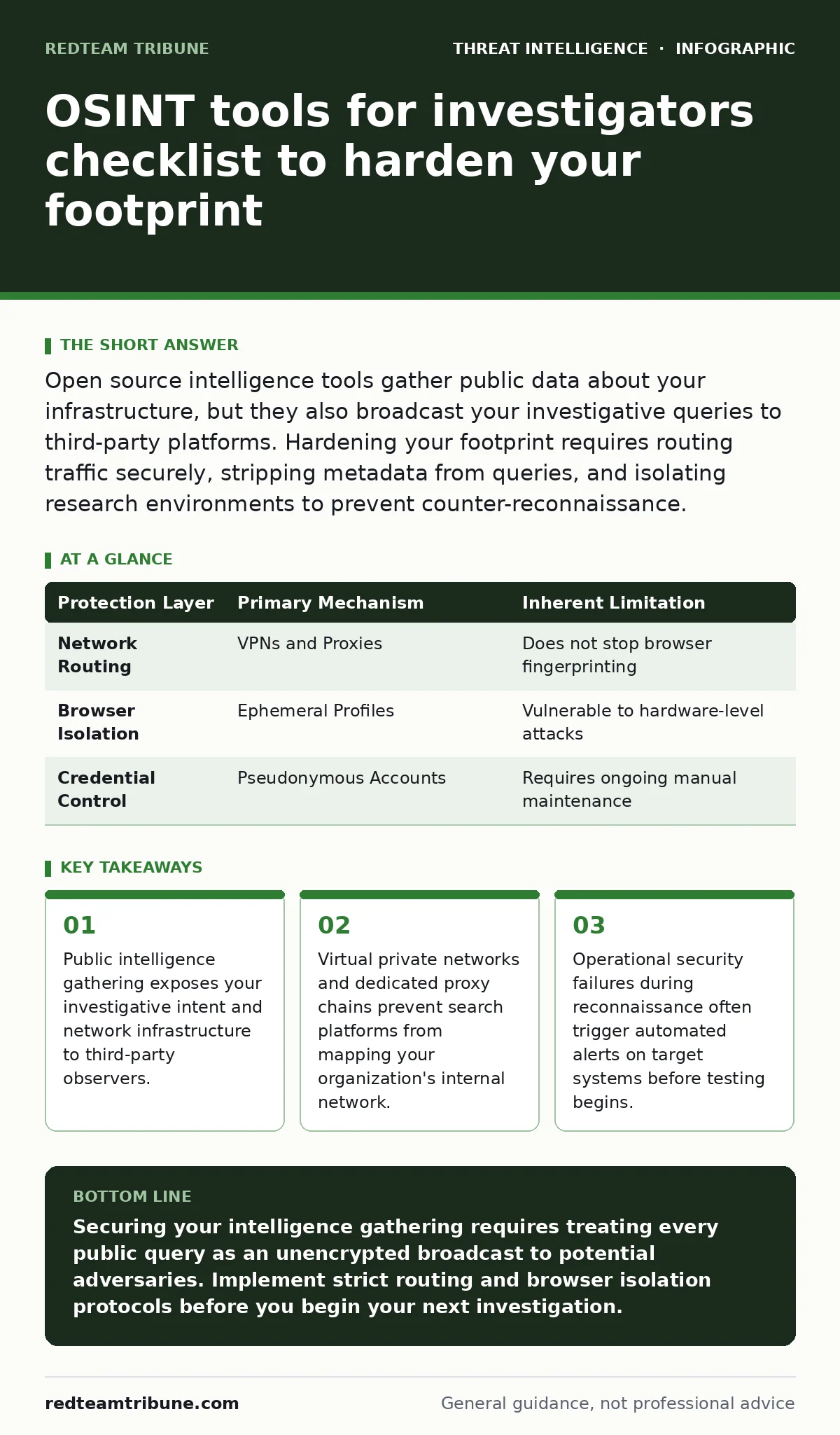
Open source intelligence tools gather public data about your infrastructure, but they also broadcast your investigative queries to third-party platforms. Hardening your footprint requires routing traffic securely, stripping metadata from queries, and isolating research environments to prevent counter-reconnaissance.
Who should use this operational security checklist
Defenders conducting technical reconnaissance and threat hunters researching hostile infrastructure use this checklist to protect their own networks. Investigators frequently expose their real organizational identity, internal IP ranges, and proprietary research interests while querying public databases. Protecting your operational footprint requires deliberate configuration choices before you run a single query.
Using this checklist properly means applying the controls before launching any discovery phase. You must review each item systematically to ensure your research infrastructure remains completely decoupled from your production environment. Skipping a single step can leak your corporate identity to hostile entities watching the same public records.
Network and Routing Protections
Network security during intelligence gathering prevents targets from logging your real IP address or corporate autonomous system number. Investigators often rely on default internet connections, which immediately reveal their physical office locations and service providers. Masking your origin requires strict routing disciplines that isolate your traffic from standard corporate paths.
Proper network isolation stops passive telemetry gathering from linking your analysts to specific investigative targets. Attackers frequently monitor public query logs to identify who is researching their infrastructure. Implementing robust routing controls does not guarantee anonymity, but it significantly raises the cost of counter-reconnaissance against your team.
- VPN routing: tunnel all research traffic through commercial virtual private networks to obscure your physical office location.
- Dedicated egress points: utilize residential proxy networks to blend your intelligence queries with standard consumer internet traffic.
- DNS leak prevention: configure browser environments to resolve domain name system requests strictly through encrypted tunnels without local fallback.
- IPv6 disabling: turn off IPv6 protocols on research machines to prevent accidental routing leaks outside your encrypted tunnels.
Browser and Session Isolation
Browser hygiene prevents tracking mechanisms, cookies, and local storage scripts from leaking your analyst identity across multiple independent searches. Investigators often use standard desktop browsers logged into personal accounts, creating immediate correlation vectors for external observers. Separating your research sessions requires sterile browser profiles that discard state upon closure.
Isolating your sessions stops web analytics platforms from building behavioral profiles of your research habits. Sophisticated targets embed tracking pixels and unique identifiers in public documents to unmask investigators. Browser isolation measures reduce your digital fingerprint, though advanced browser fingerprinting techniques can still identify hardware characteristics.
- Profile sanitization: purge all cookies, cache entries, and local storage objects immediately after completing an investigative session.
- Extension auditing: restrict browser extensions to essential privacy tools to prevent telemetry leakage through unauthorized third-party code.
- JavaScript restriction: disable active scripts by default on unfamiliar websites to block automated browser exploitation and fingerprinting.
- User agent rotation: randomize browser headers to mimic diverse operating systems and device types across different research sessions.
Credential and Identity Management
Identity management ensures that the accounts you use for public research cannot be tied back to your real name or corporate registry. Investigators frequently create research accounts using corporate email addresses or personal phone numbers, destroying their operational cover instantly. Managing discrete identities requires burner credentials and dedicated payment mechanisms that lack corporate associations.
Malicious actors frequently cross-reference public registration records to unmask researchers and expose their physical locations. Credential hygiene mitigates this exposure, though persistent behavioral patterns can still betray an analyst over time.
- Burner email usage: register public research accounts exclusively with privacy-focused email providers using cryptographic pseudonyms.
- Virtual payment cards: fund subscription-based intelligence platforms with prepaid financial instruments that omit corporate billing details.
- Phone verification: utilize temporary voice-over-ip numbers for mandatory two-factor authentication steps during account creation.
- Profile separation: maintain strict boundaries between professional social media profiles and research personas to prevent cross-contamination.
Data Handling and Artifact Scrubbing
Data handling practices dictate how you store, process, and transmit the intelligence artifacts you gather from public sources. Investigators often download malicious binaries, unverified documents, and tracking-laden PDFs directly to local workstations without sanitization. Scrubbing your downloads prevents local system compromise and eliminates hidden metadata that might identify your analysis environment.
Managing artifacts safely stops lateral movement if an analyst inadvertently downloads an active exploit disguised as public data. Files obtained during open source research frequently contain embedded hyperlinks or malicious macros designed to phone home. Artifact controls contain these risks, though zero-day exploits in document parsers can still bypass basic isolation layers.
- Sandbox execution: open unverified documents and media files strictly inside isolated virtual machines lacking network connectivity.
- Metadata stripping: remove author tags, creation timestamps, and editing software signatures before sharing gathered reports internally.
- Hash verification: compute cryptographic checksums of downloaded files to ensure integrity before transferring them to central repositories.
- Storage encryption: encrypt all local research archives with strong disk encryption to protect sensitive intelligence if hardware is lost.
| Protection Layer | Primary Mechanism | Inherent Limitation |
|---|---|---|
| Network Routing | VPNs and Proxies | Does not stop browser fingerprinting |
| Browser Isolation | Ephemeral Profiles | Vulnerable to hardware-level attacks |
| Credential Control | Pseudonymous Accounts | Requires ongoing manual maintenance |
See also: Network Scanning Myths: Why Common Beliefs Fail in Detection · Difference Between Cyber Espionage and Cyber Warfare: How to Tell
Environmental Hardening and Telemetry Control
Environmental hardening involves stripping unique hardware and software identifiers from the physical or virtual machines used for intelligence collection. Investigators often perform research on systems configured with standard corporate software loads, default fonts, and unique screen resolutions. Controlling your environmental telemetry ensures that your machines appear indistinguishable from millions of other standard devices.
Hardening your environment prevents advanced tracking systems from profiling your specific hardware configuration across multiple distinct visits. When organizations fail to control telemetry, their analysts leave a distinct digital signature wherever they browse. These measures reduce predictability, though state-sponsored adversaries can still analyze timing anomalies to infer operational hours.
- Clock synchronization: lock system clocks to coordinated universal time to prevent timezone-based location leaks in request headers.
- Resolution standardization: enforce uniform window sizes and screen resolutions across all research virtual machines to defeat canvas fingerprinting.
- Font restriction: limit installed system fonts to standard operating system defaults to prevent unique browser rendering identification.
- Telemetry blocking: disable operating system telemetry, diagnostic reporting, and cloud synchronization services on all research endpoints.
Key takeaways
- Public intelligence gathering exposes your investigative intent and network infrastructure to third-party observers.
- Virtual private networks and dedicated proxy chains prevent search platforms from mapping your organization's internal network.
- Operational security failures during reconnaissance often trigger automated alerts on target systems before testing begins.
Securing your intelligence gathering requires treating every public query as an unencrypted broadcast to potential adversaries. Implement strict routing and browser isolation protocols before you begin your next investigation.
Frequently asked questions
Can attackers see my real IP address when I use public search engines?
Standard search engines and third-party websites log your connecting IP address and network provider unless you route traffic through proxy networks or virtual private networks.
Why should I avoid using corporate email addresses for open source research?
Corporate email addresses instantly link your research activity to your organization, allowing targets to map your investigative interests and mount retaliatory actions.
Do privacy-focused browsers completely prevent tracking during investigations?
Privacy browsers reduce tracking by blocking third-party cookies, but they do not hide your network route or stop advanced browser fingerprinting techniques.
How often should I clear my research browser profiles?
You should clear all cookies, cache, and session storage immediately after finishing each distinct research task to prevent cross-session correlation.
How this guide was produced: written by the RedTeam Tribune editorial team with AI assistance, checked against the public references listed below, and reviewed when the facts change. See our editorial policy or report an error.