Malware Obfuscation FAQs: How Attackers Hide Code and How You Spot It
Obfuscation transforms malicious code into unreadable structures, forcing defenders to rely on behavioral analysis rather than static signature matching to detect threats.

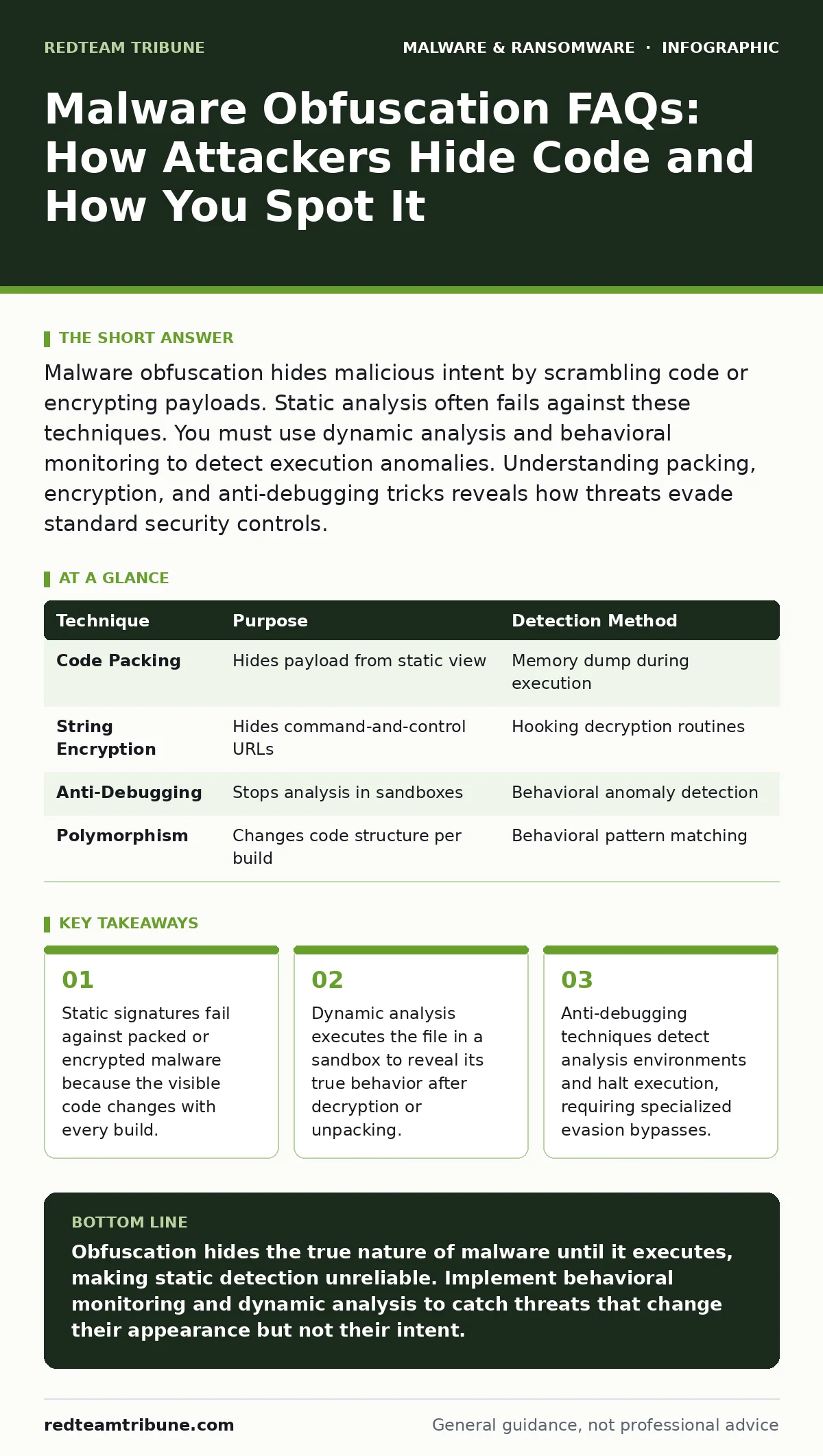
Malware obfuscation hides malicious intent by scrambling code or encrypting payloads. Static analysis often fails against these techniques. You must use dynamic analysis and behavioral monitoring to detect execution anomalies. Understanding packing, encryption, and anti-debugging tricks reveals how threats evade standard security controls.
What is malware obfuscation and why do attackers use it?
Malware obfuscation is the process of altering malicious code to make it difficult for humans and automated systems to understand its purpose. Attackers use these techniques to evade signature-based detection and reverse engineering. By scrambling the logic, they buy time to execute their payload before security tools can respond. This delay is often the difference between a contained incident and a full-scale compromise.
How does code packing differ from encryption?
Packing compresses or encrypts the executable payload and includes a small stub that unpacks it in memory at runtime. The stub is often benign-looking, while the true malicious code remains hidden until execution. Encryption protects data at rest, whereas packing is specifically designed to hide code structure from static analysis. You cannot distinguish the two easily without observing the file in action.
Why do static antivirus signatures fail against obfuscated malware?
Static signatures rely on unique byte sequences or hashes that identify known threats. Obfuscation changes these sequences every time the malware is compiled or packed. A simple variable rename or code reordering generates a new hash, rendering old signatures useless. This is why relying solely on file reputation or hash matching leaves significant gaps in your defense.
How does dynamic malware analysis reveal hidden threats?
Dynamic analysis executes the suspicious file in a controlled environment to observe its behavior. This method captures API calls, registry modifications, and network connections that static analysis misses. When a packed file runs, it must unpack itself, revealing the true malicious code in memory. This approach is critical for detecting threats that change their appearance but keep their behavior consistent.
What are anti-debugging tricks and how do they stop analysis?
Anti-debugging tricks are code structures that detect the presence of analysis tools like debuggers or sandboxes. If the malware senses it is being watched, it may alter its behavior or terminate entirely. Common methods include checking for specific process names or measuring execution time differences. These tricks force analysts to use advanced evasion techniques to study the threat safely.
| Technique | Purpose | Detection Method |
|---|---|---|
| Code Packing | Hides payload from static view | Memory dump during execution |
| String Encryption | Hides command-and-control URLs | Hooking decryption routines |
| Anti-Debugging | Stops analysis in sandboxes | Behavioral anomaly detection |
| Polymorphism | Changes code structure per build | Behavioral pattern matching |
See also: Why Is Spear Phishing Difficult to Detect: The Hidden Mechanics · How Sigma Rules Detect Threats: The Translation Mechanism Explained
How does polymorphic malware evade detection?
Polymorphic malware changes its code structure with every infection while keeping the core functionality identical. It uses different encryption keys and variable names to generate unique samples. This prevents signature databases from keeping up with the volume of variants. You must focus on the malware’s intent and actions rather than its specific code appearance.
Why is email attachment scanning insufficient against obfuscation?
Email attachment scanning often relies on static analysis to block known malicious files. Obfuscated macros or packed executables may pass initial checks because their signatures are unknown. Once opened, the attachment executes in the user’s environment, bypassing perimeter defenses. This is why understanding macro malware risks is critical for endpoint protection strategies.
How do packing tools like UPX affect detection?
UPX and similar packers compress executables to reduce file size, but attackers also use them to hide malicious code. The compressed payload looks like random data to static scanners. When executed, the UPX stub decompresses the code in memory, where it runs undetected. Security tools must be configured to unpack common compressors or monitor for unpacking behavior.
What role does behavioral monitoring play in detection?
Behavioral monitoring watches for unusual actions rather than specific file signatures. It looks for processes accessing sensitive files, injecting code into other processes, or communicating with unknown servers. This method detects obfuscated malware because the behavior remains consistent even if the code changes. Extended detection and response (XDR) platforms excel at correlating these behavioral signals across endpoints.
How can you remove obfuscated malware from a system?
Removing obfuscated malware requires identifying the persistence mechanisms it established during execution. You must check for scheduled tasks, registry run keys, and new user accounts. Standard removal tools may miss components that were unpacked and written to disk during runtime. Following a structured process for removing malware from an Android phone or Windows systems ensures complete eradication.
Why is business continuity planning relevant to obfuscation?
Obfuscation increases the time to detect and respond to threats, raising the risk of prolonged breaches. Business continuity planning ensures that operations can continue even during an active incident. It includes procedures for isolating affected systems and restoring data from clean backups. Without a plan, the hidden nature of obfuscated threats can cause extended downtime and data loss.
How do attack surface reduction rules help against obfuscation?
Attack surface reduction rules limit what applications can do, such as blocking scripts from running in unexpected locations. These rules reduce the effectiveness of obfuscated payloads by preventing them from executing their intended actions. Even if the malware bypasses initial detection, it may be stopped by restrictive application control policies. This layer of defense adds friction for attackers relying on automated execution.
What is the hidden cost of advanced obfuscation for defenders?
Advanced obfuscation increases the complexity and cost of threat analysis. Analysts must spend more time reverse-engineering packed or encrypted samples to understand their purpose. This delays incident response and requires specialized skills that are in high demand. Organizations must invest in better tools and training to keep pace with evolving obfuscation techniques.
How do keyloggers use obfuscation to avoid detection?
Keyloggers often use obfuscation to hide their code within legitimate-looking processes. They may inject themselves into system utilities to avoid standing out in process lists. Static analysis may not flag the file if it uses standard libraries and packing. Behavioral monitoring that detects keyboard input logging or unusual memory access is more effective.
Key takeaways
- Static signatures fail against packed or encrypted malware because the visible code changes with every build.
- Dynamic analysis executes the file in a sandbox to reveal its true behavior after decryption or unpacking.
- Anti-debugging techniques detect analysis environments and halt execution, requiring specialized evasion bypasses.
Obfuscation hides the true nature of malware until it executes, making static detection unreliable. Implement behavioral monitoring and dynamic analysis to catch threats that change their appearance but not their intent.
Frequently asked questions
Can obfuscated malware be detected by firewall rules?
Firewalls inspect network traffic and may miss obfuscated malware if it uses standard protocols or encrypted channels. Behavioral monitoring at the endpoint is more effective for detecting execution anomalies.
Is obfuscated malware always more dangerous than standard malware?
Obfuscation increases the difficulty of detection and analysis, giving attackers more time to operate. This extended dwell time can lead to greater damage, even if the core payload is simple.
How often should I update my anti-malware signatures?
Signatures should be updated continuously to catch known threats. However, signatures alone are insufficient against obfuscation, so you must also rely on behavioral detection methods.
Can I safely analyze obfuscated malware on my work computer?
No, analyzing malware on a production system risks infection and data loss. Always use isolated, disposable virtual machines with no network access to safely examine suspicious files.
How this guide was produced: written by the RedTeam Tribune editorial team with AI assistance, checked against the public references listed below, and reviewed when the facts change. See our editorial policy or report an error.