Why Is Spear Phishing Difficult to Detect: The Hidden Mechanics
Spear phishing evades detection by exploiting human trust and precise reconnaissance, making technical controls insufficient without behavioral analysis and strict verification protocols.
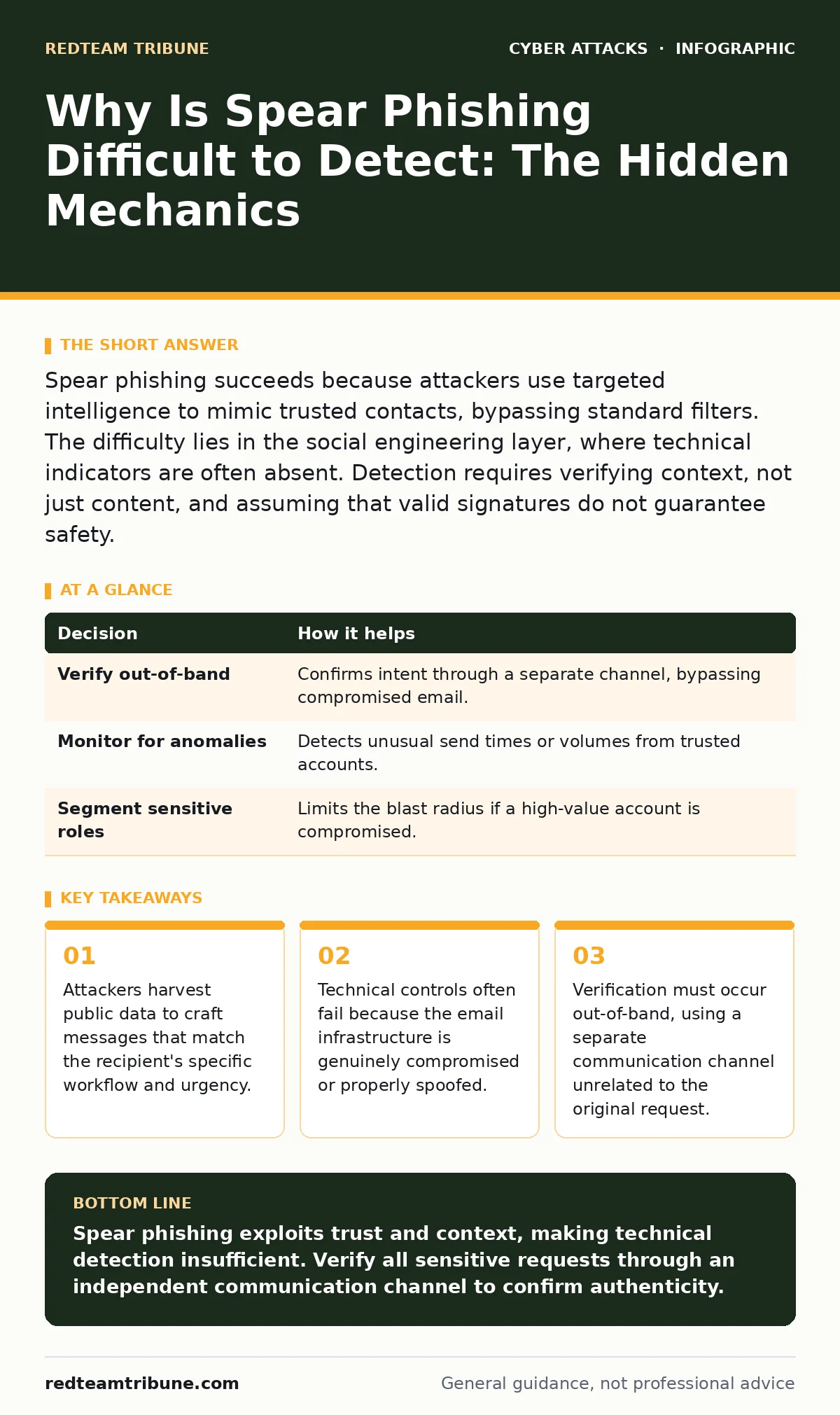
Spear phishing succeeds because attackers use targeted intelligence to mimic trusted contacts, bypassing standard filters. The difficulty lies in the social engineering layer, where technical indicators are often absent. Detection requires verifying context, not just content, and assuming that valid signatures do not guarantee safety.
Why Is Spear Phishing Difficult to Detect
Spear phishing is difficult to detect because it relies on contextual accuracy rather than generic errors. Generic spam triggers filters through poor grammar, mismatched domains, or suspicious links. Spear phishing avoids these traps by using correct language, legitimate infrastructure, and plausible narratives. The attacker researches the target to understand their role, responsibilities, and current projects.
This preparation allows the message to bypass automated screening tools that look for obvious anomalies. The threat feels natural because it is tailored to the recipient's daily reality. You cannot filter out a message that looks exactly like normal business correspondence. The detection challenge shifts from technical analysis to behavioral recognition.
The Reconnaissance Advantage
Attackers use open-source intelligence to build detailed profiles of their targets. They scan social media, company websites, and public records to identify key personnel and their relationships. This data reveals who reports to whom, what projects are active, and when key personnel are unavailable. An attacker can send a message that references a real project meeting or a known vendor.
The recipient sees specific details that only someone inside the organization would know. This creates a false sense of security. The message passes the initial sanity check because the context is undeniably real. You are reacting to information that appears verified by your own environment. The attacker uses your own digital footprint against you.
Compromised Infrastructure and Spoofing
Standard email filters rely on domain authentication protocols to verify sender identity. Attackers circumvent these checks by compromising legitimate accounts or using sophisticated domain spoofing techniques. When an attacker controls a real user’s account, the email originates from a trusted source. Technical headers show a valid origin.
There is no external IP address to block. The message passes through firewalls and security operations centers without raising alerts. Even with advanced filtering, a message from your CEO’s account looks legitimate. You cannot distinguish between a real executive and an attacker using their credentials. The trust relationship inherent in the organization becomes the attack vector.
| Decision | How it helps |
|---|---|
| Verify out-of-band | Confirms intent through a separate channel, bypassing compromised email. |
| Monitor for anomalies | Detects unusual send times or volumes from trusted accounts. |
| Segment sensitive roles | Limits the blast radius if a high-value account is compromised. |
The Human Element and Urgency
Urgency overrides critical thinking. Attackers craft messages that demand immediate action, such as a pending payment or a urgent legal matter. The recipient feels pressure to respond quickly to avoid professional embarrassment or financial loss. This pressure short-circuits the verification process. You skip the steps you normally take because the clock is ticking.
The attacker knows that a delayed response might trigger suspicion, so they create a scenario where delay is costly. This psychological manipulation is the core of the attack. Technical controls cannot measure intent or urgency. You must train yourself to recognize that legitimate business rarely requires instant, unverified action.
Technical Blending and Payload Delivery
Modern spear phishing campaigns often avoid traditional attachments. Instead, they link to legitimate-looking documents hosted on trusted platforms. These platforms are widely used for collaboration and are often whitelisted by security tools. The link appears safe because it points to a reputable service. The danger lies in the document itself, which may contain macros or exploit kits.
Alternatively, attackers use adversary-in-the-middle phishing techniques to intercept communications in real-time. This method allows them to relay messages between the victim and the legitimate sender. The victim sees no signs of tampering. The communication flows normally, but the attacker has full visibility and control. This makes detection nearly impossible using standard network monitoring.
See also: How Email Attachment Scanning Works: The Hidden Mechanics
What Goes Wrong Otherwise
Without proper safeguards, organizations suffer from alert fatigue. Security teams receive thousands of alerts daily, most of which are false positives. When a spear phishing attempt mimics normal traffic, it blends into the noise. Analysts may dismiss it as a benign anomaly. The lack of clear technical indicators means the threat goes unnoticed until it is too late.
The attacker gains access, installs malware, or exfiltrates data. The breach occurs not because the technology failed, but because the detection strategy was too narrow. Focusing solely on technical signatures leaves the human element vulnerable. You need a holistic approach that combines technical monitoring with human verification.
Actionable Defense Strategies
Defense requires a shift from reactive filtering to proactive verification. Implement strict account lockout policies to limit the damage of credential theft. Use network segmentation to isolate critical systems from general user access. This prevents lateral movement if an endpoint is compromised. Train staff to recognize the signs of MFA fatigue attacks, where attackers bombard users with approval requests. Encourage a culture of skepticism, where verifying unusual requests is standard procedure. Do not rely on technology alone. Establish clear protocols for handling sensitive transactions. Require secondary confirmation for any request involving money or data transfer.
Key takeaways
- Attackers harvest public data to craft messages that match the recipient's specific workflow and urgency.
- Technical controls often fail because the email infrastructure is genuinely compromised or properly spoofed.
- Verification must occur out-of-band, using a separate communication channel unrelated to the original request.
Spear phishing exploits trust and context, making technical detection insufficient. Verify all sensitive requests through an independent communication channel to confirm authenticity.
Frequently asked questions
How do I verify an email from my boss?
Call the sender using a known, trusted phone number. Do not use the contact information provided in the suspicious email. Confirm the request verbally before taking any action.
Can firewalls stop spear phishing?
Firewalls filter network traffic but cannot analyze the content or intent of an email. They may block malicious links, but they cannot prevent social engineering or messages from compromised accounts.
What is the difference between spam and spear phishing?
Spam is generic and sent to many recipients. Spear phishing is targeted, personalized, and uses specific details about the recipient to appear legitimate and trustworthy.
Should I report internal insider threats?
Yes. Insider threats can mimic spear phishing by using legitimate credentials to access sensitive data. Report any unusual behavior, such as accessing files outside of normal duties.
How this guide was produced: written by the RedTeam Tribune editorial team with AI assistance, checked against the public references listed below, and reviewed when the facts change. See our editorial policy or report an error.