Medical Identity Theft: Risks and Protection for Small Businesses
Small firms face unique risks because attackers exploit weak links in vendor chains, turning minor data leaks into costly medical fraud schemes that bypass traditional security.
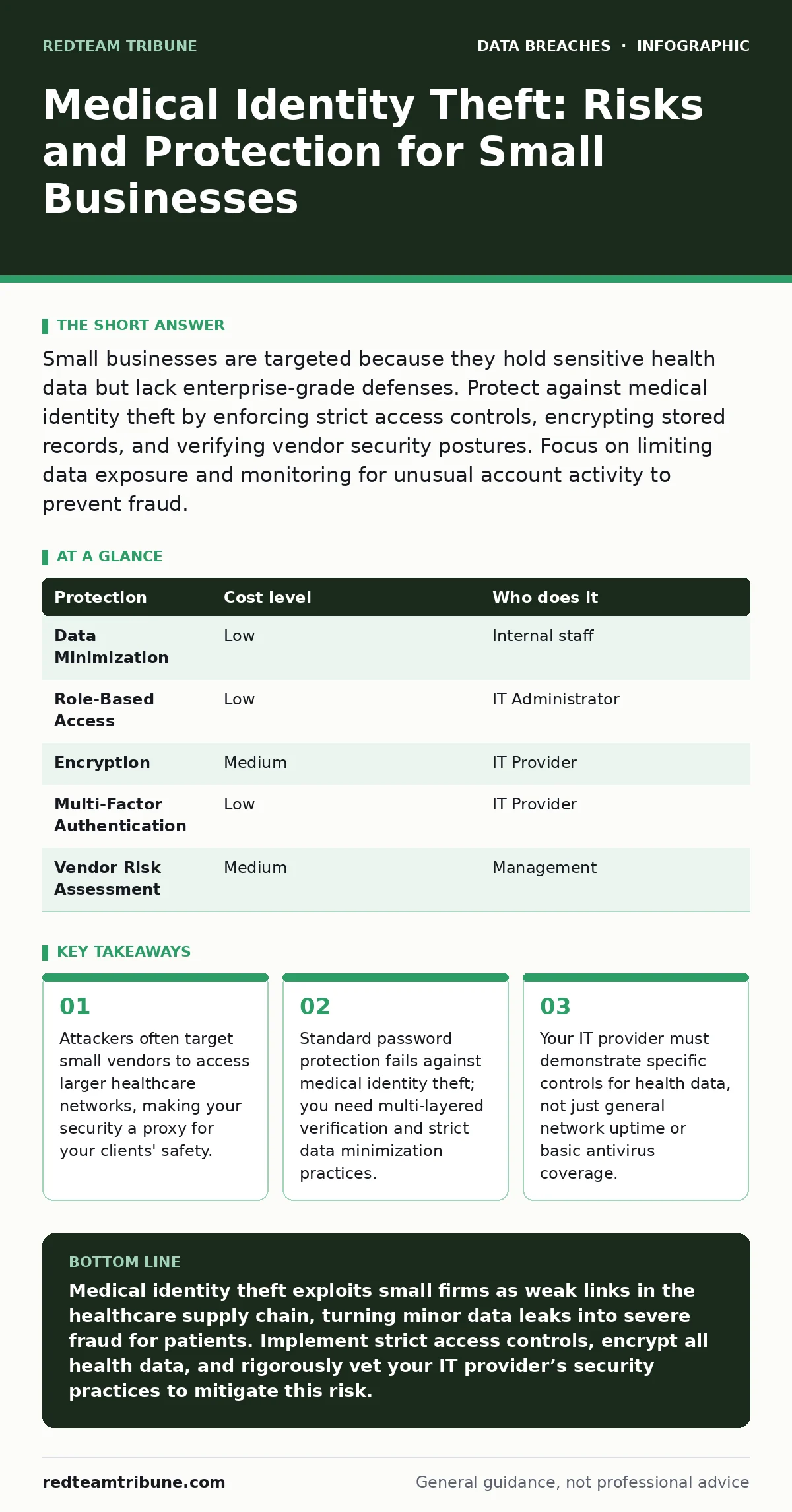
Small businesses are targeted because they hold sensitive health data but lack enterprise-grade defenses. Protect against medical identity theft by enforcing strict access controls, encrypting stored records, and verifying vendor security postures. Focus on limiting data exposure and monitoring for unusual account activity to prevent fraud.
The Hidden Value of Minor Data
Medical identity theft differs from financial fraud because the damage accumulates slowly. Attackers do not need your entire database. They need enough identifying information to mimic a patient. This includes names, dates of birth, insurance policy numbers, and partial medical histories.
Small organizations often believe they are too small to target. This assumption is dangerous. Criminals automate their attacks. They scan for vulnerabilities across thousands of small servers simultaneously. Your firm is not an individual target; you are a node in a large network of potential entry points.
The value of your data lies in its completeness. When a small firm holds both demographic data and treatment codes, it creates a high-value profile. This allows fraudsters to build a credible medical history for a stolen identity. This history makes the fraud harder to detect for months or even years.
Why Small Firms Are Exposed
You lack the resources to maintain a dedicated security operations center. You likely rely on generalist IT staff who manage everything from email servers to printer queues. This breadth of responsibility leaves gaps in specialized health data protection.
Attackers exploit these gaps through phishing and weak remote access protocols. They do not need to hack your firewall directly. They often trick an employee into revealing credentials. Once inside, they move laterally to find health records.
Another exposure is the supply chain. You may share data with larger healthcare providers. If your security posture is weak, you become the weakest link in their compliance chain. Regulators and partners look at your controls when assessing overall risk. A breach at your firm can trigger audits for every client you serve.
The Mechanics of Medical Fraud
Medical identity theft begins with data aggregation. Attackers combine small leaks from various sources. They might get a name from a public record and an insurance number from a weakly protected server.
Once they have a profile, they submit false claims. These claims might be for expensive equipment or unnecessary procedures. The provider receives payment from the insurance company. The patient’s deductible is maxed out. Their medical records now contain treatments they never received.
This creates a long-tail risk. The fraud may not be discovered until the patient applies for life insurance or seeks emergency care. By then, the false records are entrenched. Correcting them requires legal intervention and extensive paperwork. Your firm faces reputational damage and potential litigation.
Low-Cost Protection Strategies
You do not need expensive software to reduce risk. Start with data minimization. Store only the data you strictly need to perform your function. Delete records that are no longer required for billing or legal compliance. Less data means less value to attackers.
Implement role-based access control. This ensures employees can only see the data necessary for their specific job. A receptionist does not need access to full medical histories. A billing clerk needs policy numbers but not diagnostic details.
Encrypt data at rest and in transit. Encryption scrambles data so it is unreadable without a key. If attackers steal your hard drives or intercept network traffic, they get useless gibberish. This is a standard, low-cost control that provides high value.
| Protection | Cost level | Who does it |
|---|---|---|
| Data Minimization | Low | Internal staff |
| Role-Based Access | Low | IT Administrator |
| Encryption | Medium | IT Provider |
| Multi-Factor Authentication | Low | IT Provider |
| Vendor Risk Assessment | Medium | Management |
What to Ask Your IT Provider
Your IT provider manages the technical controls. You must verify they understand the specific risks of health data. Do not accept generic answers about "good security." Ask for specifics.
First, ask how they monitor for unauthorized access. They should use logging and alerting systems that detect unusual behavior. For example, accessing patient records at 3 AM from a foreign country should trigger an alert.
Second, inquire about their incident response plan. How quickly can they isolate a compromised system? Do they have a process for notifying affected parties? Speed matters in containing data leaks.
Third, ask about their own security posture. Do they use multi-factor authentication for their remote access tools? If your provider is breached, attackers get keys to your kingdom.
- Does the provider encrypt all health data stored on their servers?
- Can they demonstrate regular penetration testing results?
- Do they have a clear process for patching vulnerabilities within a set timeframe?
- How do they handle the secure deletion of data when a contract ends?
See also: Prevent Cloud Storage Leaks: Configuration Hardening Steps · 7 Common CASB Mistakes That Create Blind Spots
Integrating Broader Security Practices
Protecting against medical identity theft requires a holistic approach. You must align your practices with established frameworks. This ensures you are not missing critical controls.
Consider how you handle file transfers. Secure file sharing prevents data interception during transmission. Do not use standard email for sending health records. Use encrypted channels that require authentication.
Your user access provisioning process must be tight. When an employee leaves, their access should be revoked immediately. Delayed revocation is a common cause of data leaks. Ensure your provider automates this process.
Regular privacy impact assessments help you identify risks before they become breaches. These assessments evaluate how you collect, store, and share data. They highlight gaps in your current controls.
Monitor for personal data sold on the dark web. While you cannot control the market, you can set up alerts for your employees' identities. If credentials appear online, reset them immediately.
Monitoring and Response
Detection is as important as prevention. You must monitor for signs of compromise. Look for unusual login attempts or large data exports.
If you suspect a breach, act quickly. Isolate affected systems. Preserve evidence for investigation. Notify affected individuals and regulators as required by law. Breach notification laws have strict timelines. Missing them increases penalties.
Ensure your backup data exposure is controlled. Backups often contain the same sensitive data as live systems. They are sometimes less protected. Encrypt your backups and store them securely.
Database security is critical. Ensure your databases are patched and access is logged. Attackers often target databases directly to harvest large volumes of records.
Password rotation alone is not enough. Combine it with multi-factor authentication. This adds a layer of security that passwords alone cannot provide.
The Long-Term View
Medical identity theft is a persistent threat. Attackers adapt their methods as defenses improve. You must continually update your controls.
Regular training for staff is necessary. They are your first line of defense. Teach them to recognize phishing attempts and social engineering tactics.
Maintain an inventory of all data you hold. Know where it lives, who accesses it, and how long you keep it. This clarity simplifies security management and compliance.
Remember that security is a shared responsibility. Your IT provider, your employees, and your management team all play a role. Align your efforts to create a cohesive defense.
Key takeaways
- Attackers often target small vendors to access larger healthcare networks, making your security a proxy for your clients' safety.
- Standard password protection fails against medical identity theft; you need multi-layered verification and strict data minimization practices.
- Your IT provider must demonstrate specific controls for health data, not just general network uptime or basic antivirus coverage.
Medical identity theft exploits small firms as weak links in the healthcare supply chain, turning minor data leaks into severe fraud for patients. Implement strict access controls, encrypt all health data, and rigorously vet your IT provider’s security practices to mitigate this risk.
Frequently asked questions
How do I know if my small business is a target for medical identity theft?
If you handle any health-related data, including insurance numbers or billing codes, you are a potential target. Attackers automate scans, so size does not guarantee safety.
Is encryption enough to protect against medical identity theft?
Encryption protects data if it is stolen, but it does not prevent unauthorized access. You need a combination of encryption, access controls, and monitoring to effectively reduce risk.
What should I do if an employee leaves and I suspect they stole data?
Immediately revoke all access credentials. Monitor network logs for unusual activity. Notify your IT provider to investigate and preserve evidence for potential legal action.
Do I need a dedicated security officer for a small team?
You do not need a full-time officer, but you must assign security responsibilities to existing staff. Ensure they receive regular training and have the authority to enforce security policies.
How this guide was produced: written by the RedTeam Tribune editorial team with AI assistance, checked against the public references listed below, and reviewed when the facts change. See our editorial policy or report an error.