Personal Data Sold on Dark Web: Immediate Response Steps
Your reaction in the first hour dictates whether attackers monetize your identity or simply discard your stolen credentials as low-value noise.
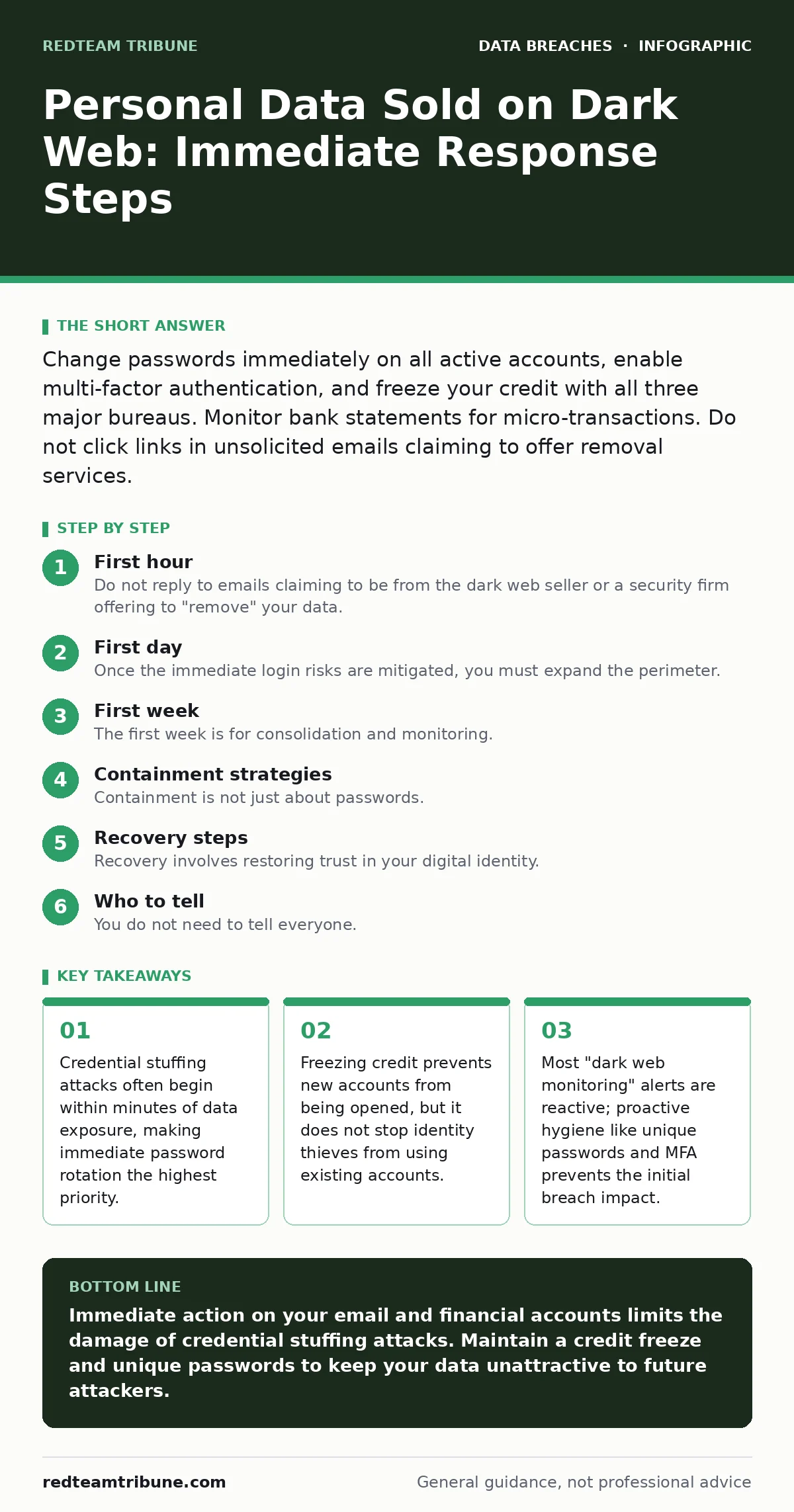
Change passwords immediately on all active accounts, enable multi-factor authentication, and freeze your credit with all three major bureaus. Monitor bank statements for micro-transactions. Do not click links in unsolicited emails claiming to offer removal services.
First hour
When you discover your personal data is for sale, the clock starts ticking on credential stuffing. Attackers use automated bots to test your email and password combination against hundreds of other services. You must assume your login credentials are compromised immediately.
- Change the password for your primary email account. This is the master key to resetting passwords for every other service.
- Enable multi-factor authentication (MFA) on that email account. Use an authenticator app, not SMS text messages, which can be intercepted.
- Change passwords for financial accounts, banking apps, and payment processors. Use a password manager to generate unique, complex strings for each.
- Freeze your credit with Equifax, Experian, and TransUnion. This blocks new credit applications in your name.
Imagine an attacker buys your data for a few dollars. They do not care about your home address yet. They care about your email password. If they access your inbox, they can reset passwords for your bank, social media, and work accounts. By securing the email first, you cut off their primary leverage.
First day
Once the immediate login risks are mitigated, you must expand the perimeter. Attackers often sell data in bundles. If your data was part of a large breach, your information likely includes phone numbers, dates of birth, and possibly fragments of financial data.
You need to verify the scope of the exposure. Check haveibeenpwned or similar reputable breach notification services to see which specific databases contained your data. This helps you determine if sensitive identifiers like Social Security numbers were exposed. If they were, the risk shifts from account takeover to identity theft.
Contact your bank and credit card issuers to report the exposure. Ask them to place a fraud alert on your accounts. This is different from a credit freeze. A fraud alert requires the lender to verify your identity before issuing new credit, adding a friction layer that slows down automated attacks.
If your medical data was exposed, the consequences are more severe. Medical identity theft can alter your health records, leading to denied insurance claims or incorrect treatments. You may need to contact your healthcare providers directly to flag your records. See our guide on medical identity theft for specific steps on correcting medical records.
First week
The first week is for consolidation and monitoring. You have stopped the bleeding, but the attackers still have your data. They may try different angles, such as phishing attacks tailored to your specific information.
Monitor your financial statements daily. Look for small, one-dollar transactions. These are often test charges to see if a card number is active. If you see one, cancel the card immediately. Do not wait for a large charge to appear.
Review your user access provisioning for any work or professional accounts. If your personal data was leaked, attackers may try to access your professional life. Check who has access to your shared drives and cloud storage. Remove any unused accounts or old employees. See our guide on user access provisioning for best practices in managing digital identities.
If you use secure file sharing for work or personal documents, ensure those services have strong encryption and MFA enabled. Attackers target these platforms to harvest more sensitive data. See our guide on secure file sharing to audit your current setup.
Containment strategies
Containment is not just about passwords. It is about limiting the damage your data can cause. Attackers use personal data to build a profile of you. They know your name, your address, and your phone number. They use this to answer security questions.
Change your security questions on critical accounts. Do not use questions that can be answered with public information, such as "What is your mother's maiden name?" or "What was the name of your first pet?" Use random answers and store them in your password manager. This defeats attackers who have your public profile.
If your data included your home address, be wary of physical phishing. Attackers may send fake bills or government notices to your home. Do not click links or call numbers on unsolicited mail. Verify the source independently.
Recovery steps
Recovery involves restoring trust in your digital identity. This takes time. You must remain vigilant for several months. Attackers often sit on data for weeks or months before using it, waiting for you to relax your guard.
Continue to monitor your credit reports. Look for unfamiliar accounts or inquiries. Dispute any errors immediately.
If you suspect your tax identity was stolen, contact the IRS. They offer an Identity Protection PIN that you must include with your tax return. This prevents others from filing taxes in your name.
See our guide on database security to understand how organizations protect data. While you cannot control the breach, understanding the mechanisms helps you appreciate why unique passwords matter. If an attacker hashes your password, they need to crack it. A unique, complex password makes cracking computationally expensive and often not worth the effort.
See also: Why Is Principle of Least Privilege Important for Security
Who to tell
You do not need to tell everyone. Focus on institutions that hold your financial or legal identity.
- Banks and Credit Unions: Inform them of the breach. They may offer enhanced fraud monitoring.
- Credit Bureaus: You have already frozen your credit. Keep this active.
- Employer: If your work email was compromised, inform IT immediately. They may need to reset your corporate access.
- Family Members: If you share finances or accounts with family, ensure they are also protected. Attackers often target one member to access shared resources.
Do not post about the breach on social media. This alerts attackers that you are aware and may prompt them to act faster or target you with social engineering.
Preventing repeat exposure
The goal is to make your data less valuable to attackers. This requires a shift in how you manage your digital life.
Use a password manager. This allows you to have unique, long passwords for every account. If one site is breached, your other accounts remain safe. See our guide on password rotation for details on when and how to update credentials.
Enable MFA everywhere it is offered. This adds a second layer of security that attackers cannot steal from a database breach. Even if they have your password, they cannot log in without the second factor.
Be cautious with privacy impact assessments. If you work for an organization, ensure they conduct these assessments regularly. They identify where data is stored and how it is protected. See our guide on privacy impact assessments for a framework to evaluate data risks.
Finally, be mindful of backup data exposure. If your cloud backups are accessible, attackers may harvest more data from them. Ensure your backup services are encrypted and access-controlled. See our guide on backup data exposure to secure your stored data.
Key takeaways
- Credential stuffing attacks often begin within minutes of data exposure, making immediate password rotation the highest priority.
- Freezing credit prevents new accounts from being opened, but it does not stop identity thieves from using existing accounts.
- Most "dark web monitoring" alerts are reactive; proactive hygiene like unique passwords and MFA prevents the initial breach impact.
Immediate action on your email and financial accounts limits the damage of credential stuffing attacks. Maintain a credit freeze and unique passwords to keep your data unattractive to future attackers.
Frequently asked questions
How long should I keep my credit frozen?
Keep it frozen indefinitely until you actively need to apply for new credit. You can temporarily unfreeze it when needed and refreeze it immediately after.
Should I close my bank accounts?
No. Closing accounts does not erase your history. Instead, monitor them closely and replace card numbers if suspicious activity occurs.
Can I remove my data from the dark web?
No. Once data is sold, it is distributed. You cannot delete it. You can only mitigate the risk by securing your accounts and monitoring for misuse.
Is MFA over SMS safe?
It is better than nothing, but SIM swapping attacks can intercept SMS codes. Use an authenticator app or hardware key for higher security.
How this guide was produced: written by the RedTeam Tribune editorial team with AI assistance, checked against the public references listed below, and reviewed when the facts change. See our editorial policy or report an error.