7 Common CASB Mistakes That Create Blind Spots
Many organizations deploy cloud access security brokers without configuring shadow IT discovery, leaving critical data exposed to unauthorized applications and weak identity controls.

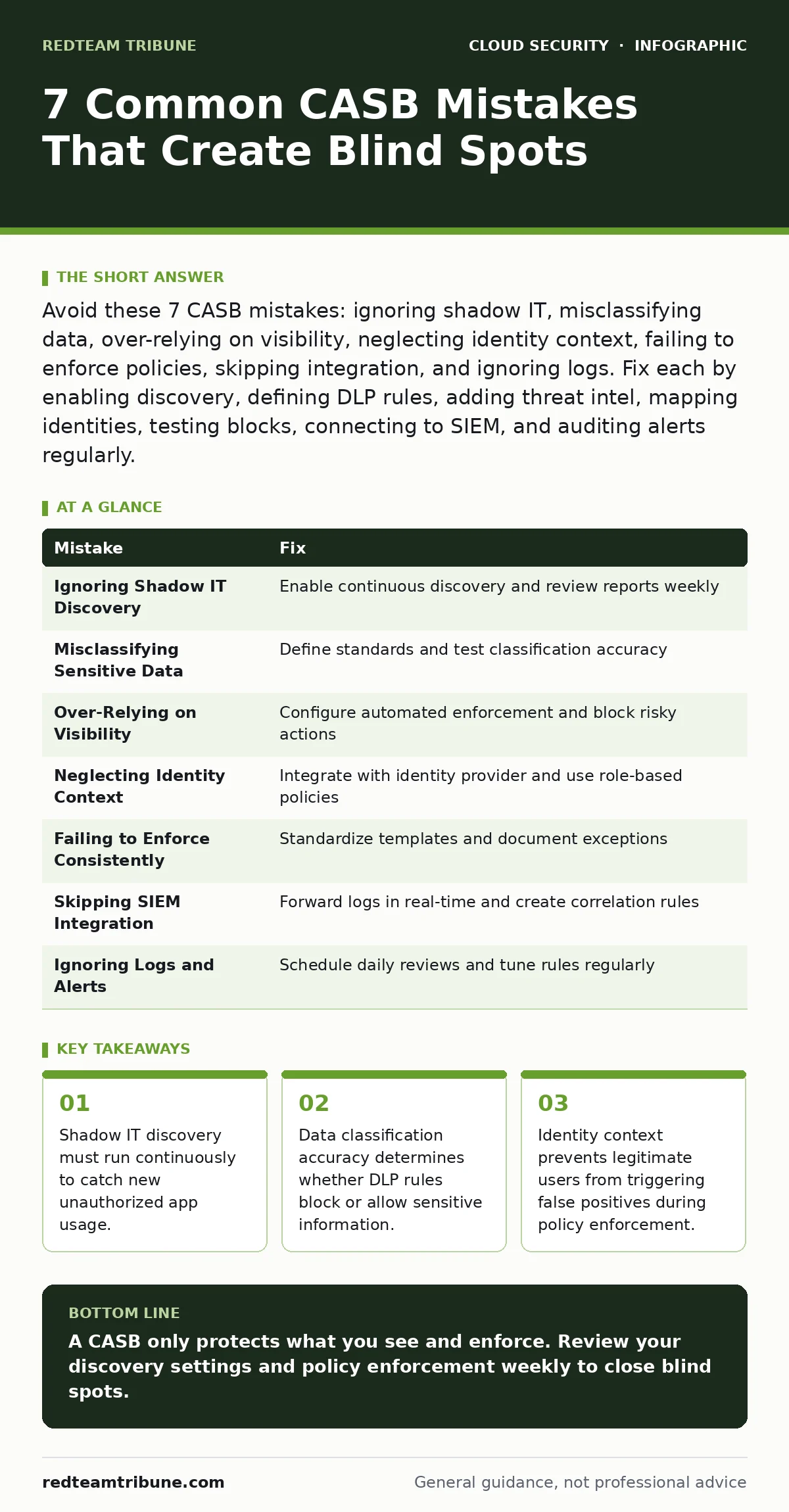
Avoid these 7 CASB mistakes: ignoring shadow IT, misclassifying data, over-relying on visibility, neglecting identity context, failing to enforce policies, skipping integration, and ignoring logs. Fix each by enabling discovery, defining DLP rules, adding threat intel, mapping identities, testing blocks, connecting to SIEM, and auditing alerts regularly.
Mistake 1: Ignoring Shadow IT Discovery
Cloud access security brokers (CASB) must identify applications your users access outside approved channels. Shadow IT refers to software used by employees without IT department knowledge or approval. Many teams configure CASB only for known services like Salesforce or Office 365. This leaves a blind spot where sensitive data moves through unvetted platforms.
Why it hurts:
Data leakage often occurs through these unknown channels. You cannot protect what you cannot see. Unmonitored applications may lack basic security controls, making them easy targets for credential theft or data exfiltration. The risk grows as employees adopt new tools for collaboration or storage.
The fix:
Enable continuous shadow IT discovery features in your CASB. Configure the tool to scan DNS logs, proxy traffic, and cloud API activity for unknown SaaS applications. Review the discovery reports weekly to decide which apps to block, allow, or monitor. Read our guide on cloud data exfiltration to understand how data leaves through these hidden paths.
Mistake 2: Misclassifying Sensitive Data
Data loss prevention (DLP) rules depend on accurate data classification. Classification labels data as public, internal, confidential, or restricted based on content. If your CASB cannot distinguish a customer name from a public blog post, it cannot enforce correct policies. Poor classification leads to either excessive blocking or insufficient protection.
Why it hurts:
False positives frustrate users and cause them to bypass security controls. False negatives allow sensitive data to leave the organization unnoticed. Without precise classification, your DLP rules are essentially guessing. This undermines trust in the security team and increases operational overhead as staff manually review alerts.
The fix:
Define clear data classification standards before configuring DLP rules. Use pattern matching, regular expressions, and machine learning models to identify sensitive content. Test classification accuracy with sample datasets before enabling enforcement. Regularly update classification rules to match new data types or business processes.
Mistake 3: Over-Relying on Visibility Alone
Visibility is the first step in CASB deployment, but it is not the end goal. Many teams stop after enabling logging and monitoring. They assume seeing traffic is enough to secure it. This passive approach provides no defense against active threats or policy violations. You are watching the door without locking it.
Why it hurts:
Threat actors operate quickly. Waiting for human analysts to review logs and take action allows damage to occur. Automated threats like malware or ransomware do not wait for manual approval. Passive visibility also fails to enforce compliance requirements that mandate immediate blocking of certain activities.
The fix:
Move from monitoring to enforcement. Configure automated policies to block risky actions, such as downloading sensitive files to personal devices. Use adaptive policies that adjust based on user behavior and context. Integrate with cloud detection and response platforms to automate incident response workflows.
Mistake 4: Neglecting Identity Context
CASB policies often focus on IP addresses or device types. This ignores the identity of the user performing the action. Identity context includes user role, department, tenure, and privilege level. A contractor accessing HR records is different from an HR manager doing the same. Treating them equally creates security gaps.
Why it hurts:
Compromised credentials become dangerous when the CASB does not verify identity strength. An attacker with a valid password can act like a legitimate user. If the CASB only checks IP location, it may miss lateral movement by an insider. Identity-aware policies are necessary to enforce least privilege access.
The fix:
Integrate your CASB with your identity provider. Use SAML or OIDC tokens to pass identity attributes to the CASB. Create policies that restrict access based on user group membership or role. Review overprivileged cloud identities to ensure users have only the permissions they need for their jobs.
Mistake 5: Failing to Enforce Policies Consistently
Policies must apply uniformly across all cloud services and user groups. Inconsistent enforcement creates confusion and security holes. Some teams enable strict blocking for one department but allow loose monitoring for another. This inconsistency undermines the security posture and complicates audits.
Why it hurts:
Attackers exploit the path of least resistance. If one department has weaker controls, they become the entry point. Auditors will flag inconsistent policies as non-compliant. Users may move sensitive data to departments with laxer rules, defeating the purpose of the CASB.
The fix:
Standardize policy templates across the organization. Apply baseline rules to all users and services. Customize only where business necessity requires. Document every exception and review it quarterly. Ensure all cloud services connect to the same CASB instance for unified policy management.
See also: Stop Cloud Data Exfiltration: Small Business Risks and Low-Cost Fixes · Federated Identity vs SSO: The Architectural Difference That Matters
Mistake 6: Skipping Integration with SIEM
CASB logs contain valuable security events. Sending these logs to a Security Information and Event Management (SIEM) system enables correlation with other data sources. Without integration, CASB alerts exist in isolation. Analysts miss the bigger picture of an attack campaign.
Why it hurts:
Isolated alerts are harder to prioritize. An unusual login in the CASB might seem minor. Correlated with failed login attempts in the firewall, it indicates a brute force attack. Lack of integration delays detection and response. It also increases alert fatigue as analysts triage low-value notifications.
The fix:
Forward CASB logs to your SIEM in real-time. Map CASB event types to SIEM schemas for easier analysis. Create correlation rules that combine CASB data with network and endpoint logs. Use this integrated view to detect multi-stage attacks.
Mistake 7: Ignoring CASB Logs and Alerts
Deploying a CASB is not a set-and-forget task. Logs and alerts require regular review. Many teams enable the tool and ignore the output. This wasted investment provides no security value. Unreviewed alerts hide emerging threats and policy violations.
Why it hurts:
Threat patterns evolve. New attack techniques may trigger different alerts. Without review, you miss trends that indicate a larger campaign. Policy tuning also requires feedback from logs. Ignoring alerts leads to stale rules that no longer match the threat environment.
The fix:
Schedule daily reviews of high-severity alerts. Assign ownership of CASB monitoring to specific analysts. Tune rules based on false positive feedback. Use automated dashboards to track key metrics like blocked attempts and shadow IT discovery rates. Refer to cloud security assessments to validate your CASB configuration periodically.
| Mistake | Fix |
|---|---|
| Ignoring Shadow IT Discovery | Enable continuous discovery and review reports weekly |
| Misclassifying Sensitive Data | Define standards and test classification accuracy |
| Over-Relying on Visibility | Configure automated enforcement and block risky actions |
| Neglecting Identity Context | Integrate with identity provider and use role-based policies |
| Failing to Enforce Consistently | Standardize templates and document exceptions |
| Skipping SIEM Integration | Forward logs in real-time and create correlation rules |
| Ignoring Logs and Alerts | Schedule daily reviews and tune rules regularly |
Key takeaways
- Shadow IT discovery must run continuously to catch new unauthorized app usage.
- Data classification accuracy determines whether DLP rules block or allow sensitive information.
- Identity context prevents legitimate users from triggering false positives during policy enforcement.
A CASB only protects what you see and enforce. Review your discovery settings and policy enforcement weekly to close blind spots.
Frequently asked questions
How do I prioritize CASB policy enforcement?
Start with high-risk data and privileged users. Block high-impact actions like mass downloads or sharing outside the organization. Gradually expand to other users and data types.
Can CASB replace endpoint security?
No. CASB focuses on cloud applications and data. Endpoint security protects devices. Both are needed for layered defense.
How often should I review CASB policies?
Review quarterly for standard policies. Review immediately after major incidents or changes in business processes.
How this guide was produced: written by the RedTeam Tribune editorial team with AI assistance, checked against the public references listed below, and reviewed when the facts change. See our editorial policy or report an error.