How False Positives Work in Threat Detection and How to Fix Them
False positives arise from the inherent conflict between signature matching and behavioral heuristics, requiring continuous tuning rather than a one-time configuration fix.

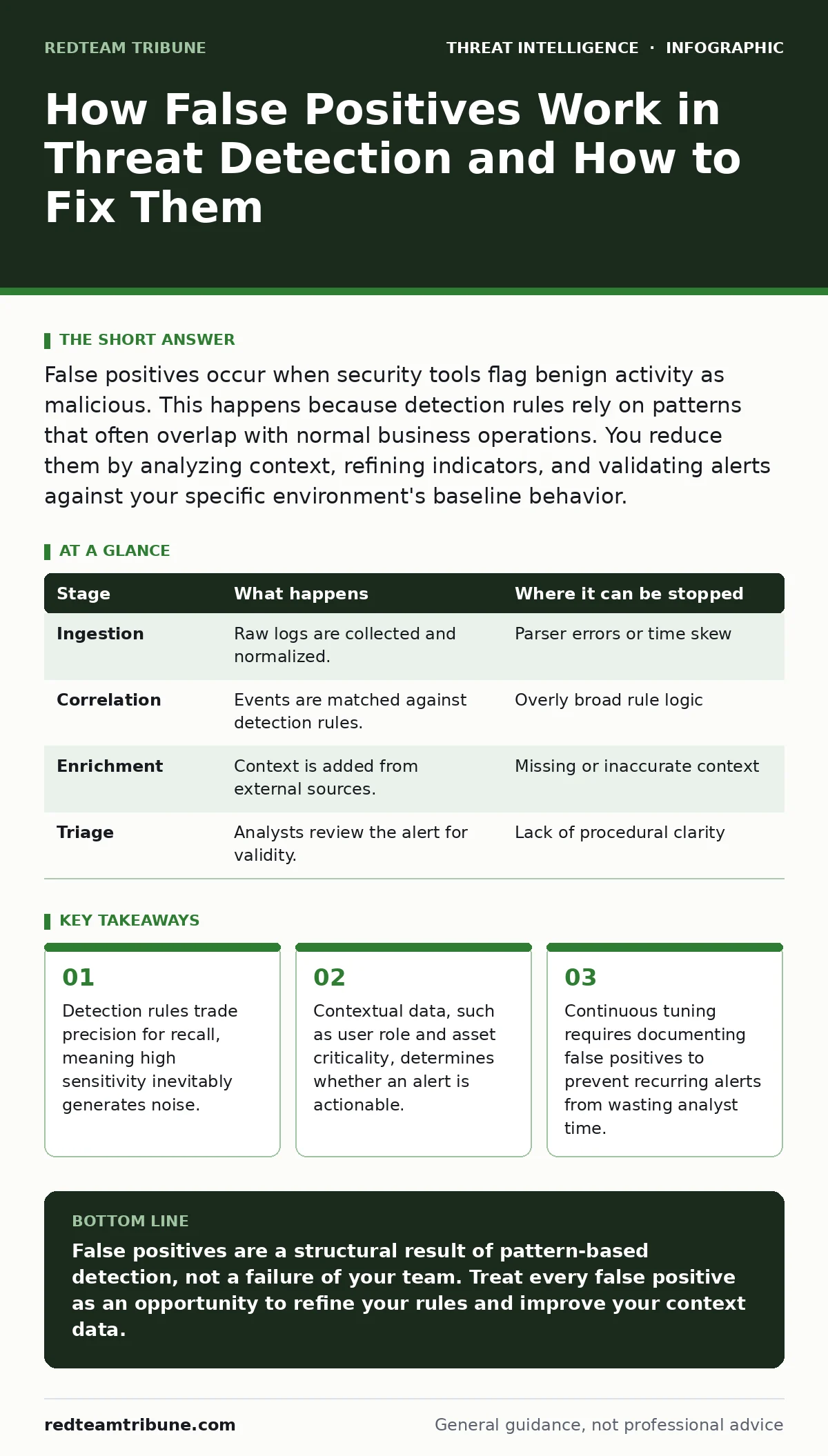
False positives occur when security tools flag benign activity as malicious. This happens because detection rules rely on patterns that often overlap with normal business operations. You reduce them by analyzing context, refining indicators, and validating alerts against your specific environment's baseline behavior.
The Mechanics of Alert Generation
Threat detection systems do not see reality; they see data points mapped against predefined rules. When a security information and event management (SIEM) system or an endpoint detection and response (EDR) agent observes an event, it compares that event to a library of known malicious patterns. If the event matches a pattern, the system generates an alert. This process is fundamentally statistical, not deterministic. The system cannot know intent, only correlation.
Consider a rule that flags any outbound connection to an unknown IP address. This rule catches data exfiltration attempts but also flags a developer deploying code to a new server. The detection engine sees both events as identical violations of policy. This indistinguishability is the root cause of false positives. The system lacks the nuance to separate malicious novelty from legitimate operational change.
The Role of Heuristics and Signatures
Detection methods fall into two primary categories: signatures and heuristics. Signatures look for exact matches of known bad artifacts, such as a specific file hash or network string. Heuristics, by contrast, analyze behavior to identify suspicious characteristics, such as a process injecting code into another process. Heuristics are necessary for finding new threats, but they are inherently prone to error.
Heuristic rules often rely on thresholds. For example, a rule might trigger if a user logs in from three different countries within an hour. While this suggests credential theft, it could also be a traveler using multiple devices. The heuristic assumes that the observed behavior is abnormal for the user. If your baseline for "normal" is too narrow, every minor deviation becomes an alert. This creates a high volume of noise that analysts must sift through.
Stage 1: Data Ingestion and Normalization
The detection pipeline begins with raw data collection. Sensors gather logs from servers, workstations, and network devices. This data is unstructured and varies in format. The first processing step is normalization, where disparate log formats are converted into a common schema. This allows the detection engine to compare events across different data sources.
If normalization fails, the detection logic cannot function correctly. A timestamp mismatch might make a login appear to occur before the user’s computer started. This temporal error can trigger alerts for impossible events. Ensuring accurate time synchronization and consistent log parsing is the first line of defense against structural false positives. Without clean data, even perfect rules will generate incorrect alerts.
| Stage | What happens | Where it can be stopped |
|---|---|---|
| Ingestion | Raw logs are collected and normalized. | Parser errors or time skew |
| Correlation | Events are matched against detection rules. | Overly broad rule logic |
| Enrichment | Context is added from external sources. | Missing or inaccurate context |
| Triage | Analysts review the alert for validity. | Lack of procedural clarity |
Stage 2: Rule Correlation and Matching
Once data is normalized, the system applies detection rules. These rules are logical statements that define what constitutes a threat. A simple rule might be "if event type equals login failure and count exceeds ten, alert." A complex rule might involve multiple stages, such as identifying a process creation followed by network connection and file modification.
The complexity of the rule directly impacts the false positive rate. Simple rules are easy to tune but miss sophisticated attacks. Complex rules are more precise but harder to maintain. As you add conditions to a rule to reduce noise, you risk missing variations of the attack. This trade-off is central to detection engineering. You must balance the need to catch threats with the capacity to investigate alerts.
Stage 3: Contextual Enrichment
Raw alerts lack context. An alert saying "suspicious process executed" is useless without knowing who ran it, what computer it was on, and what other events occurred nearby. Contextual enrichment adds this missing information. Systems query user directories, asset management databases, and threat intelligence feeds to label the alert.
This stage is where many false positives can be filtered automatically. If the "suspicious process" ran on a server that is known to run that software, the system can suppress the alert. If the user is a member of the IT administration group, the alert might be downgraded. Enrichment turns a generic signal into a specific narrative. Without it, analysts must manually investigate every alert, leading to burnout and missed threats.
See also: How Sigma Rules Detect Threats: The Translation Mechanism Explained · Implement Network Traffic Analysis: A Step-by-Step Operational Guide
Stage 4: Analyst Triage and Verification
The final stage involves human review. An analyst receives the enriched alert and determines if it represents a genuine threat. They examine the evidence, check for lateral movement, and verify the impact. If the alert is a false positive, they close it and document the reason. This documentation is critical for future tuning.
Many organizations skip the documentation step. They close the alert and move on. This means the same false positive will trigger again next week. Proper triage includes updating the detection rule to exclude the benign pattern. This iterative process is how detection systems improve. It turns noise into refined intelligence. For deeper understanding of how attackers move, see Active Directory attacks. Understanding the adversary's path helps analysts distinguish between normal admin tasks and actual compromise.
The Hidden Cost of Alert Fatigue
False positives consume time and attention. When analysts receive hundreds of alerts, they develop alert fatigue. They begin to skip details, assuming most alerts are noise. This increases the risk of missing a true positive buried in the noise. The cost is not just labor; it is security posture.
There is also a hidden financial cost. Every minute spent investigating a false positive is a minute not spent on proactive defense or system hardening. Over time, this drift reduces the effectiveness of your security operations. You must treat false positives as a defect in your detection logic, not just an annoyance. Fixing them improves the overall reliability of your security stack.
Refining Your Detection Logic
Reducing false positives requires a structured approach. Start by categorizing your alerts by source and type. Identify the top ten rules that generate the most noise. For each rule, ask what legitimate activity it is catching. Modify the rule to exclude that activity, or create a separate rule for the benign pattern.
Collaborate with other teams. Network engineers can explain why certain traffic spikes occur. Application developers can clarify unusual API calls. This cross-functional knowledge provides the context needed to refine rules. See network traffic analysis for methods to distinguish normal traffic patterns from anomalies. Integrating these insights into your detection logic makes your system smarter and less noisy.
The Balance of Precision and Recall
You cannot eliminate false positives entirely. Doing so would require rules so specific that they would miss most attacks. This is the trade-off between precision and recall. High precision means few false positives but potentially missed threats. High recall means catching most threats but generating many false positives.
Your goal is to find the optimal balance for your environment. This balance shifts over time as your infrastructure changes and attacker tactics evolve. Regularly review your detection performance. Measure the ratio of true positives to false positives. Adjust your rules to maintain a level of noise that your team can handle effectively. For frameworks on analyzing intrusion attempts, see Diamond Model of intrusion analysis. This model helps structure your investigation and identify gaps in your detection logic.
Key takeaways
- Detection rules trade precision for recall, meaning high sensitivity inevitably generates noise.
- Contextual data, such as user role and asset criticality, determines whether an alert is actionable.
- Continuous tuning requires documenting false positives to prevent recurring alerts from wasting analyst time.
False positives are a structural result of pattern-based detection, not a failure of your team. Treat every false positive as an opportunity to refine your rules and improve your context data.
Frequently asked questions
How do I know if an alert is a false positive?
Compare the alert details against your known baseline of normal operations. If the activity aligns with a documented business process or approved tool, it is likely a false positive.
Should I disable rules that generate too many false positives?
No. Disabling rules creates blind spots. Instead, refine the rule logic to exclude the benign activity while retaining the malicious detection criteria.
How often should I tune my detection rules?
Tune rules continuously. Review the top noise sources weekly and perform deeper analysis monthly to ensure your detection logic remains accurate.
Can automation reduce false positives?
Yes. Automated enrichment and suppression rules can filter out known benign patterns before they reach an analyst, reducing manual triage effort.
How this guide was produced: written by the RedTeam Tribune editorial team with AI assistance, checked against the public references listed below, and reviewed when the facts change. See our editorial policy or report an error.