Breach Notification Protocol: A Step-by-Step Implementation Plan
Most organizations fail not because they lack data, but because they lack a pre-approved decision tree for when to alert regulators versus when to silence the newsroom.

Build a notification protocol by mapping data types to legal thresholds, drafting templates in advance, and assigning clear ownership. Test the workflow with simulated incidents to ensure speed and accuracy. Maintain the plan by updating contact lists and reviewing legal changes quarterly.
Map Regulatory Thresholds to Data Types
You cannot notify anyone if you do not know what you lost. Start by inventorying every data asset your organization holds. Classify each asset by sensitivity. Personal identifiers, financial records, and health information trigger different legal obligations. Some jurisdictions require notification only if the data was unencrypted. Others require notification for any access to personal data, regardless of encryption status.
Create a matrix that links data types to specific notification requirements. This matrix becomes your source of truth. When an incident occurs, you consult the matrix instead of guessing. This removes ambiguity from the response process.
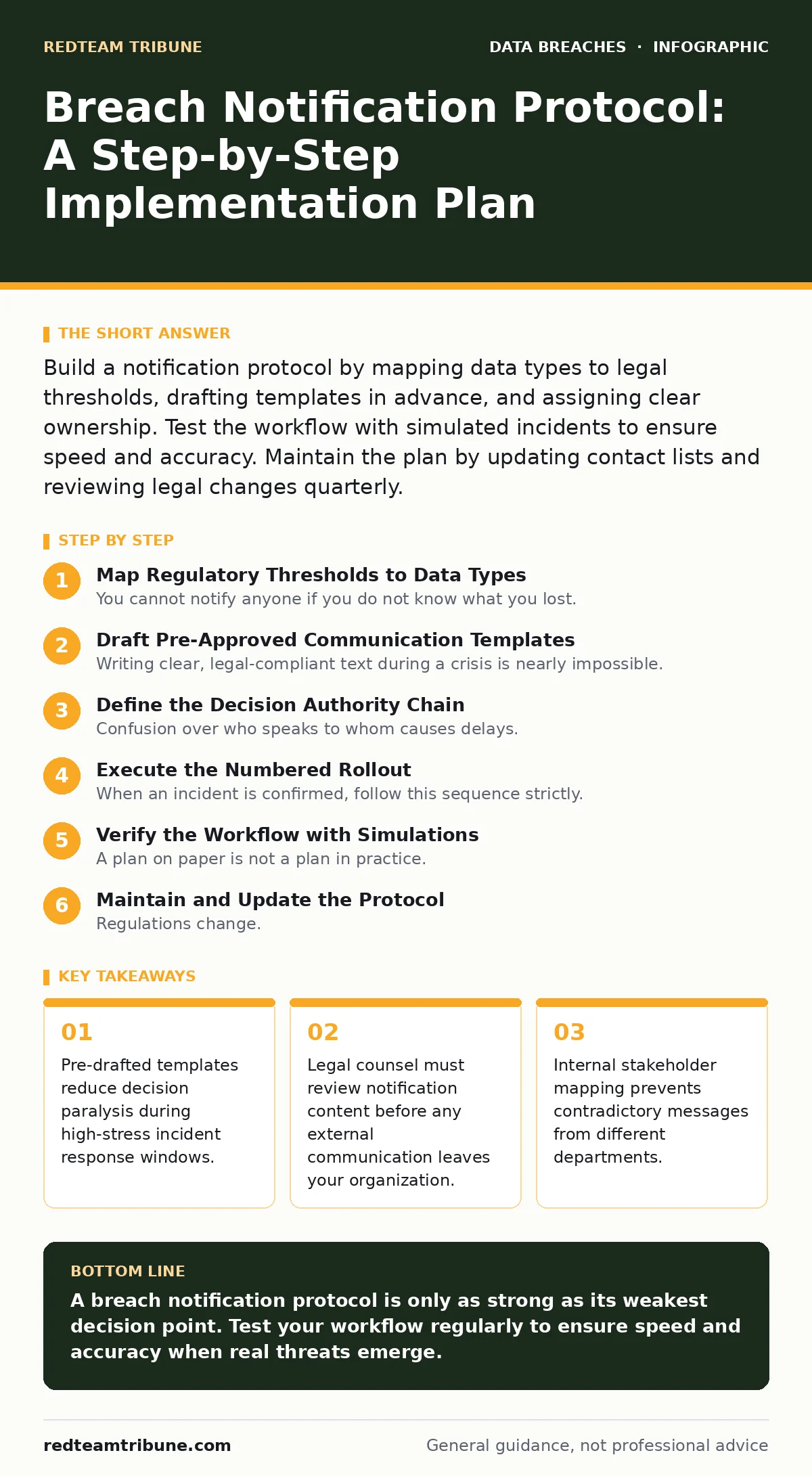
Draft Pre-Approved Communication Templates
Writing clear, legal-compliant text during a crisis is nearly impossible. Draft templates for every likely scenario. Create one template for customers, one for employees, one for regulators, and one for media outlets. Each template must have placeholders for specific facts. Leave blanks for the date of discovery, the type of data involved, and the steps taken to secure the system.
Legal counsel must approve these drafts before an incident ever happens. This approval ensures the language meets regulatory standards. It also prevents marketing teams from injecting tone-deaf phrasing into serious communications. Store these templates in a secure, offline location. Access them only when the incident command structure is active.
Define the Decision Authority Chain
Confusion over who speaks to whom causes delays. Define exactly who has the authority to trigger a notification. Usually, this requires sign-off from legal, compliance, and executive leadership. Document this chain clearly. If the legal director is unavailable, specify who acts as the delegate.
This chain must include external partners if they hold your data. If a cloud provider suffers a breach, you need to know how they will notify you. Ensure their notification contract aligns with your internal timelines. Misalignment here can cause you to miss statutory deadlines while waiting for vendor updates.
Execute the Numbered Rollout
When an incident is confirmed, follow this sequence strictly.
Step 1: Contain and Assess
Stop the bleeding. Isolate affected systems. Determine the scope of the breach. Did attackers exfiltrate data or just access it? This distinction changes the notification requirement in many regions.
Verification: The incident response team confirms the attack vector is closed and the scope is documented.
Step 2: Consult Legal and Compliance
Review the assessment against your regulatory matrix. Determine if a mandatory notification is required. If yes, select the appropriate pre-approved template.
Verification: Legal counsel signs off on the decision to notify and the chosen template.
Step 3: Notify Regulators First
Submit required reports to oversight bodies before public announcement. Many laws require this within a specific window. Failure to prioritize this step can result in significant penalties.
Verification: Receipt confirmation from the regulatory body or proof of submission via their portal.
Step 4: Notify Affected Individuals
Send the customer or employee notification. Use the most secure channel available. Email is common but may be compromised. Consider physical mail or secure portals if email integrity is in doubt.
Verification: Delivery logs show successful transmission. Monitor bounce rates for invalid addresses.
Step 5: Public Statement
Issue a single public statement if the breach is large-scale. Direct all media inquiries to one spokesperson. Do not allow technical staff to speak to the press.
Verification: All public channels display the same message. No conflicting statements appear on social media.
Verify the Workflow with Simulations
A plan on paper is not a plan in practice. Run tabletop exercises quarterly. Simulate a breach scenario. Assign roles to participants. Have them walk through the notification steps using the templates. Time the process. Note where bottlenecks occur.
Did the legal team respond quickly? Did the comms team struggle to fill in the placeholders? Use these results to refine the templates and the decision chain. This rehearsal reveals hidden dependencies. It also trains staff to remain calm under pressure.
See also: Stop Computer Worms: The Network Containment Checklist · Stop Log Tampering: A Defensive Checklist for Integrity
Maintain and Update the Protocol
Regulations change. Your infrastructure changes. Your vendor list changes. Schedule a quarterly review of the entire notification protocol. Update the regulatory matrix if new laws are passed. Update the contact list if staff members leave or change roles.
Ensure your templates reflect current branding and tone guidelines. Check that secure file sharing methods mentioned in the templates are still supported. If you rely on third-party vendors, verify their security posture annually. A breach in their system is effectively your breach.
Monitor for Secondary Risks
Notification does not end the incident. It begins the remediation phase. Monitor for fraud related to the exposed data. If personal data sold on the dark web includes your users, they may face targeted phishing attacks. Advise them to monitor their accounts.
Consider offering identity protection services if the breach involved sensitive identifiers. This is not always legally required, but it preserves trust. Document all post-notification actions. These records may be needed for future audits or legal defense.
Checklist for Readiness
Use this list to verify your preparation.
- Data inventory is current and classified by sensitivity.
- Regulatory matrix maps data types to notification laws.
- Templates are drafted, legally reviewed, and stored securely.
- Decision authority chain is documented and includes delegates.
- Tabletop exercise has been conducted and findings addressed.
- Contact lists for regulators and vendors are up to date.
- Secure communication channels for notifications are tested.
- Staff are trained on their specific roles in the notification process.
Key takeaways
- Pre-drafted templates reduce decision paralysis during high-stress incident response windows.
- Legal counsel must review notification content before any external communication leaves your organization.
- Internal stakeholder mapping prevents contradictory messages from different departments.
A breach notification protocol is only as strong as its weakest decision point. Test your workflow regularly to ensure speed and accuracy when real threats emerge.
Frequently asked questions
How soon must I notify regulators after a breach?
Timelines vary by jurisdiction and data type. Some require notification within days, others within weeks. Your regulatory matrix must specify the exact window for each scenario.
Should I notify customers if the data was encrypted?
It depends on the jurisdiction. Some laws require notification regardless of encryption if access occurred. Others exempt encrypted data. Check your specific legal obligations in the matrix.
Who should write the public statement?
Legal and communications teams should collaborate. Legal ensures compliance. Communications ensures clarity and tone. Never let technical staff draft public facing messages.
How do I handle third-party vendor breaches?
Treat vendor breaches as your own. Your contract should define their notification timeline. Ensure their alert triggers your internal process immediately to meet your deadlines.
How this guide was produced: written by the RedTeam Tribune editorial team with AI assistance, checked against the public references listed below, and reviewed when the facts change. See our editorial policy or report an error.