Cloud Detection and Response CDR: How It Works
Cloud detection and response shifts security from static perimeter checks to continuous behavioral monitoring of dynamic infrastructure.

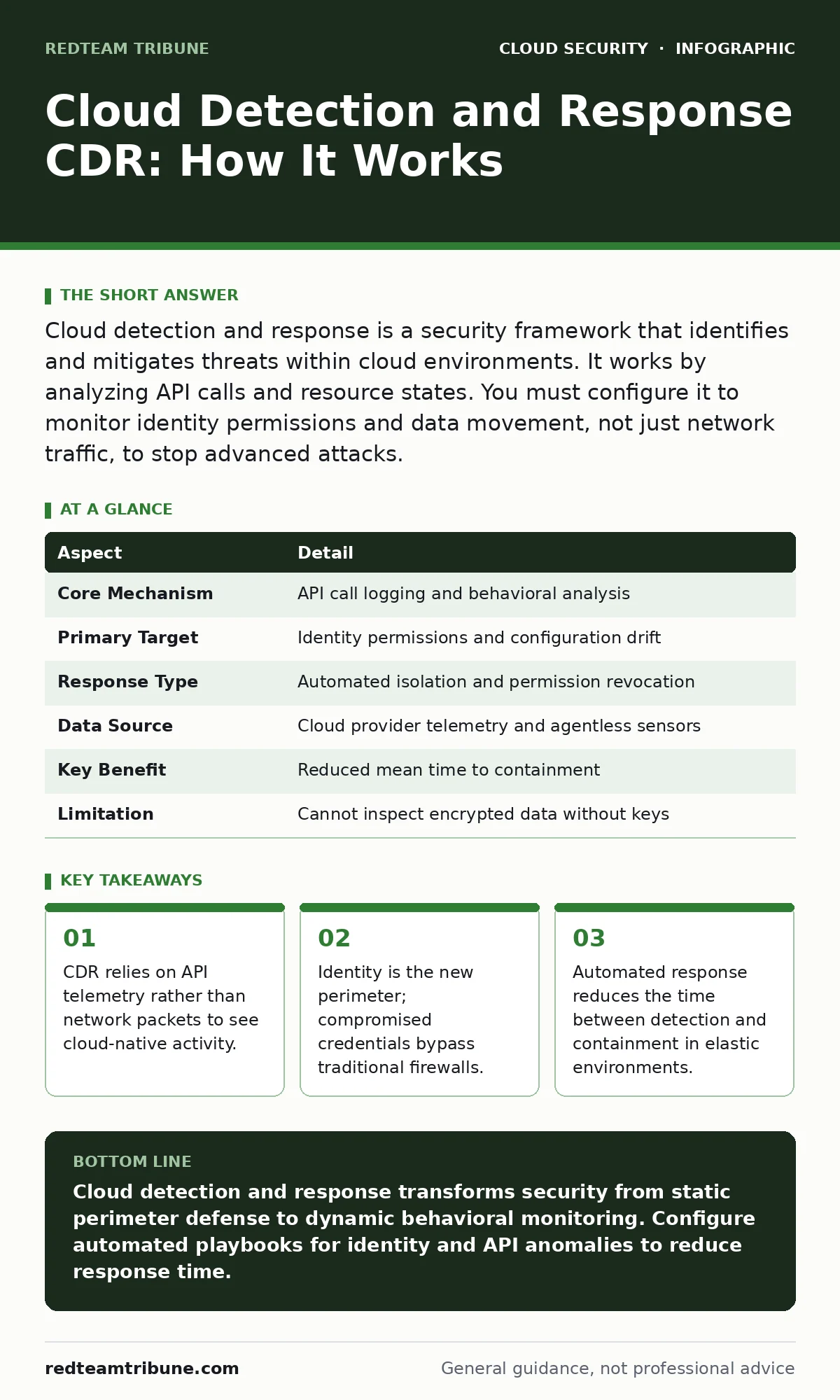
Cloud detection and response is a security framework that identifies and mitigates threats within cloud environments. It works by analyzing API calls and resource states. You must configure it to monitor identity permissions and data movement, not just network traffic, to stop advanced attacks.
Everyday Analogy: The Smart Home Alarm
Imagine a house with windows that open and close automatically based on the weather. A traditional alarm only trips if someone breaks a glass. Cloud detection and response acts like a sensor that notices the window opening at 3 AM when the homeowner is on vacation. It does not wait for a break-in. It detects the anomaly in behavior. The system then locks the window and alerts the owner. This analogy shows how CDR focuses on state changes and unusual activity patterns rather than just physical breaches. It monitors the logic of the environment, not just the walls.
What Is Cloud Detection and Response CDR?
Cloud detection and response is a security capability that monitors cloud environments for suspicious activity and automates remediation steps. It differs from traditional endpoint detection and response because cloud resources are ephemeral and defined by software. Servers spin up and down. Storage buckets change permissions. CDR treats the cloud control plane as the primary source of truth. It ingests logs from identity providers, storage services, and compute engines. The goal is to maintain visibility across a dynamic infrastructure that changes every second.
| Aspect | Detail |
|---|---|
| Core Mechanism | API call logging and behavioral analysis |
| Primary Target | Identity permissions and configuration drift |
| Response Type | Automated isolation and permission revocation |
| Data Source | Cloud provider telemetry and agentless sensors |
| Key Benefit | Reduced mean time to containment |
| Limitation | Cannot inspect encrypted data without keys |
How Cloud Detection and Response Works
The mechanism relies on continuous data ingestion from cloud provider APIs. Agents are rarely needed because the cloud itself emits detailed logs. The system establishes a baseline of normal behavior for each user and service account. It looks for deviations from this baseline. For example, a database that never connects to the internet suddenly initiates an outbound connection.
The system flags this as an anomaly. It then correlates this event with other signals, such as a recent password change or a login from a new country. This correlation reduces false positives. The response engine executes pre-defined playbooks. These playbooks might isolate a virtual machine or revoke a specific token.
Who It Affects and Why It Matters
Every organization using public cloud infrastructure faces this challenge. The shift to cloud has removed the traditional network perimeter. Attackers no longer need to break through a firewall. They compromise a user account or a service identity. Once inside, they move laterally using legitimate API calls. This makes traditional network security tools blind to the attack. CDR affects security teams by shifting their focus from network boundaries to identity and data. It also affects developers who must design applications with security telemetry in mind. Operational efficiency improves because automated responses handle routine threats. This frees analysts to investigate complex incidents.
Common Misconceptions About CDR
Many teams believe that installing a cloud access security broker (CASB) solves all visibility problems. This is incorrect. CASBs focus on data leakage and shadow IT at the edge. They do not monitor internal API calls or compute behavior. Another mistake is assuming that CDR replaces cloud security assessments. Assessments are point-in-time checks. CDR is continuous monitoring. You need both. A third error is neglecting workload identity. If you do not manage the identities of your applications, CDR cannot distinguish between a legitimate automated process and an attacker using that same identity. Proper identity management is the foundation of effective detection.
See also: 7 Common CASB Mistakes That Create Blind Spots · Stop Cloud Data Exfiltration: Small Business Risks and Low-Cost Fixes
Integrating With Related Security Practices
CDR does not operate in a vacuum. It must integrate with broader security frameworks. For instance, cloud compliance rules define what "good" looks like. CDR enforces these rules in real-time. If a configuration violates a compliance standard, CDR can auto-remediate it. This bridges the gap between policy and practice. You should also consider cloud data exfiltration risks.
CDR monitors for large data transfers to unknown destinations. However, it works best when paired with data classification tools. Without knowing which data is sensitive, CDR may miss subtle leaks. Furthermore, federated identity practices reduce the attack surface. By centralizing authentication, you provide CDR with a single, reliable source of identity logs. This improves detection accuracy.
Implementation Steps for Your Environment
Start by enabling comprehensive logging in your cloud console. Ensure that all API calls, management events, and data plane activities are recorded. Next, define your baselines. Identify normal patterns for your workloads. This may take weeks of observation. Then, create response playbooks. Start with low-risk actions like sending alerts or tagging resources. Gradually move to automated isolation.
Test these playbooks in a non-production environment. Verify that they do not disrupt legitimate business operations. Finally, integrate CDR with your existing ticketing and incident management systems. This ensures that human analysts are notified when automated responses fail or when complex investigation is needed. Regularly review and update your baselines as your infrastructure evolves.
What People Usually Get Wrong
Teams often focus too much on external threats and ignore insider risks. CDR is equally effective at detecting compromised internal accounts. Another common error is alert fatigue. If you do not tune your detection rules, you will drown in noise. Prioritize high-fidelity signals over volume. Finally, do not assume that CDR protects against denial-of-wallet attacks. While it can detect unusual spending patterns, it does not prevent the financial impact. You must implement budget alerts and spending limits separately. CDR is a detection and response tool, not a financial control mechanism. Understanding these boundaries helps you build a more resilient security posture.
The Role of Multi-Region Failover
Security incidents often require rapid containment. If an attack compromises a region, you may need to shift operations. CDR helps verify the integrity of the failover target. It ensures that the new region is not already compromised. This is critical for maintaining availability. However, multi-region failover adds complexity to your detection logic. You must ensure that CDR monitors all regions consistently. Inconsistent monitoring creates blind spots. Attackers exploit these gaps. Therefore, standardize your CDR configuration across all regions. Use infrastructure-as-code tools to enforce this consistency. This reduces the risk of configuration drift.
Key takeaways
- CDR relies on API telemetry rather than network packets to see cloud-native activity.
- Identity is the new perimeter; compromised credentials bypass traditional firewalls.
- Automated response reduces the time between detection and containment in elastic environments.
Cloud detection and response transforms security from static perimeter defense to dynamic behavioral monitoring. Configure automated playbooks for identity and API anomalies to reduce response time.
Frequently asked questions
Does CDR replace traditional firewalls?
No, CDR complements firewalls by monitoring internal cloud activity and identity usage that firewalls cannot see.
How long does it take to implement CDR?
Initial setup takes weeks for logging and baselining. Full automation and tuning require months of iterative refinement.
Can CDR detect encrypted data exfiltration?
CDR detects the metadata of data transfers, such as volume and destination, but cannot inspect the content of encrypted streams.
Is CDR suitable for small businesses?
Yes, many cloud providers offer built-in CDR capabilities that are cost-effective for smaller environments.
How this guide was produced: written by the RedTeam Tribune editorial team with AI assistance, checked against the public references listed below, and reviewed when the facts change. See our editorial policy or report an error.