Server-Side Template Injection: Definition, Risks, and Mitigation
Server-side template injection allows attackers to execute arbitrary code by manipulating the data that populates your application’s user interface templates.

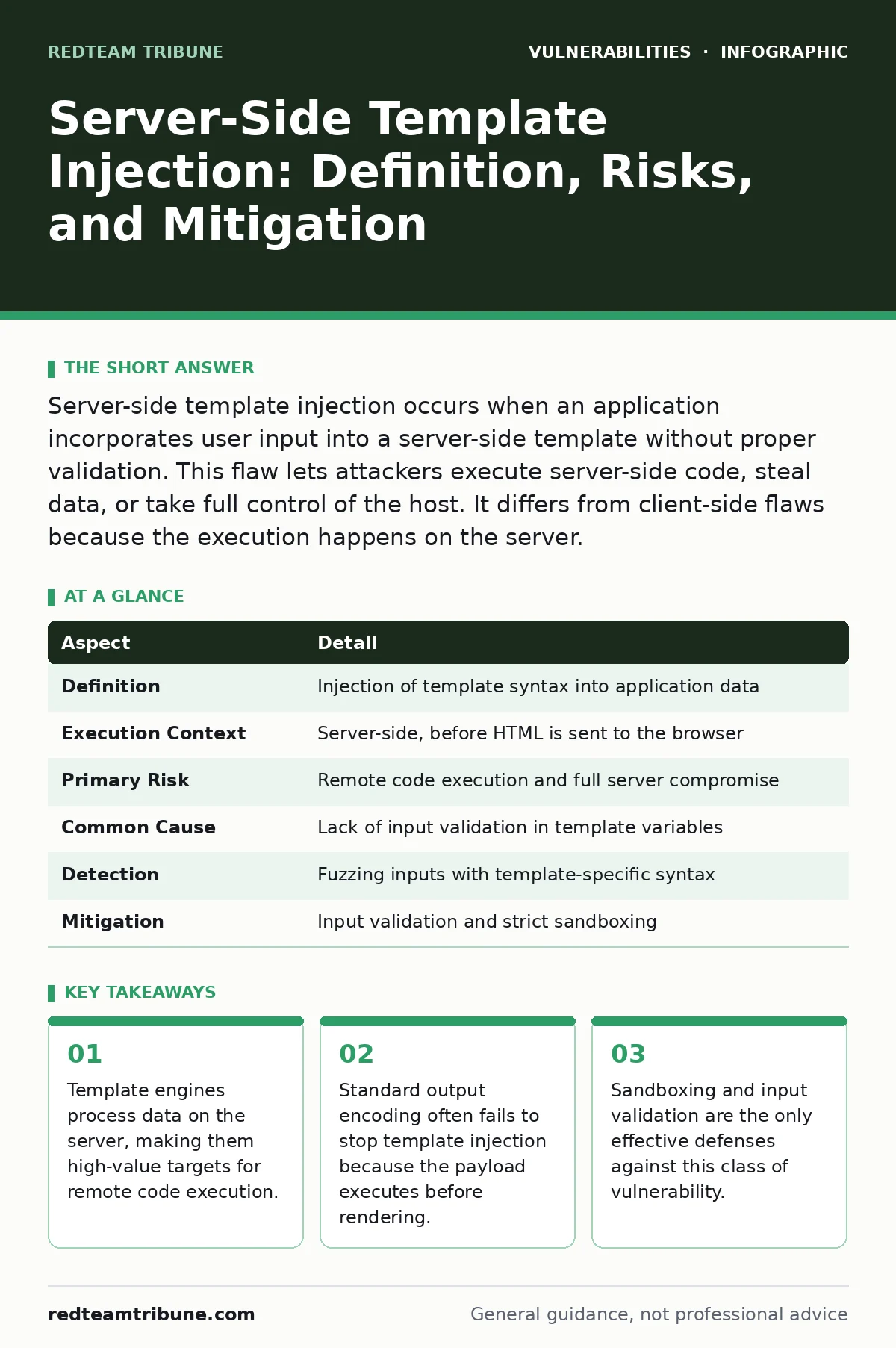
Server-side template injection occurs when an application incorporates user input into a server-side template without proper validation. This flaw lets attackers execute server-side code, steal data, or take full control of the host. It differs from client-side flaws because the execution happens on the server.
The Template Engine Analogy
Imagine a mail-merge system that prints personalized letters. The document contains a static layout with placeholders like {Name} and {Address}. When you run the merge, the system replaces those placeholders with actual data from your spreadsheet. Now suppose a malicious actor puts a command in the {Name} field that instructs the printer to delete its hard drive. If the system trusts the data blindly, it executes the command instead of just printing text.
Server-side template injection works the same way. Your web application uses a template engine to generate HTML pages. The engine merges dynamic data with a static template. If an attacker can inject template syntax into that data, the server executes the injected code. This turns a display bug into a remote code execution vulnerability.
At a Glance: SSTI Basics
| Aspect | Detail |
|---|---|
| Definition | Injection of template syntax into application data |
| Execution Context | Server-side, before HTML is sent to the browser |
| Primary Risk | Remote code execution and full server compromise |
| Common Cause | Lack of input validation in template variables |
| Detection | Fuzzing inputs with template-specific syntax |
| Mitigation | Input validation and strict sandboxing |
How Server-Side Template Injection Happens
Template engines are designed to be flexible. They allow developers to embed logic directly in their views. This flexibility creates a blind spot. Developers often assume that user input is just data. They forget that the template engine treats certain characters as instructions.
When you accept user input, you must treat it as untrusted. The application should validate this input before passing it to the template engine. If the validation is missing, the attacker sends a string that looks like data but contains template commands. The engine parses the string. It sees the command structure. It executes the logic defined in the command.
This process happens on the server. The browser never sees the raw template code. It only sees the result of the execution. This makes detection difficult for standard web application firewalls that look for client-side patterns. The attack payload often looks like harmless text until the server processes it.
Who It Affects
Any application that uses server-side templating is at risk. This includes most modern web frameworks. Python frameworks like Jinja2, Java frameworks like FreeMarker, and PHP frameworks like Twig are common targets. Node.js applications using Handlebars or EJS are also vulnerable.
The risk is not limited to custom-built applications. Many open-source projects use these engines. If a project fails to sanitize inputs, every instance of that project is vulnerable. Managed service providers must audit the frameworks their clients use. You cannot assume that a popular framework is safe by default. Configuration errors are common. Default settings often prioritize convenience over security.
Common Forms of Payloads
Attackers use different syntax depending on the template engine. You must know which engine your application uses to defend against it. The payload structure varies, but the goal remains the same: execute code.
- Variable Access: Attackers try to access internal variables. They use syntax like
{{ variable }}to print values. This helps them map the application’s memory. - Method Invocation: Once they find a variable, they call methods on it. They might call a function that reads files or executes system commands.
- Object Injection: Some engines allow creating new objects. Attackers inject code that creates an object with dangerous capabilities. They then use that object to perform actions.
These payloads are often short. They do not require complex scripts. A simple string like {{ 7*7 }} can confirm the vulnerability. If the server returns 49, you have confirmed that the template engine is executing code. This is a critical finding. It indicates that the server is running attacker-controlled logic.
What People Usually Get Wrong
Many developers believe that output encoding stops template injection. This is a dangerous misconception. Output encoding protects against cross-site scripting. It converts special characters into HTML entities. It does not stop the template engine from executing code.
The template engine executes the code before the HTML is generated. By the time output encoding happens, the damage is done. The code has already run. The server has already accessed the file system or executed the command. Encoding the result only changes how the output looks in the browser. It does not undo the execution.
Another common mistake is relying on blacklists. Developers try to block known dangerous characters. Attackers quickly find ways to bypass these filters. They use alternative syntax or encoding techniques. Blacklists are incomplete. They create a false sense of security. You must validate input against a whitelist of allowed characters. This is harder to implement but much more effective.
How to Reduce the Risk
You must implement defense-in-depth. No single measure is sufficient. Combine input validation, sandboxing, and least privilege.
- Validate Input: Reject any input that contains template syntax. If your application expects a name, allow only letters and spaces. Reject anything else. This stops the attack at the entry point.
- Use Sandboxing: Run the template engine in a restricted environment. Limit the functions and variables available to the template. This reduces the impact if an injection occurs.
- Least Privilege: Run the web server with minimal permissions. If the attacker executes code, they should not have admin rights. They should not be able to read sensitive files.
You should also consider virtual patching. This technique filters traffic before it reaches the application. It can block known attack patterns. This provides immediate protection while you fix the code. However, it is not a permanent solution. You must still patch the underlying vulnerability.
Related vulnerabilities often share similar root causes. For instance, SQL injection also results from trusting user input. The principles of validation apply to both. Similarly, API vulnerabilities often arise when endpoints accept unvalidated data. Understanding these patterns helps you build better defenses.
The Hidden Cost of Complexity
Template engines add complexity to your application. This complexity increases the attack surface. Every feature you add is a potential entry point. You must balance functionality with security.
Sandboxing adds overhead. It slows down rendering. You must accept this trade-off. Security is more important than speed. The cost of a breach far exceeds the cost of slower page loads. You must also manage dependencies. Template engines have dependencies. If a dependency has a vulnerability, your application is at risk.
End-of-life software management is critical here. If you use an outdated template engine, you miss security patches. You must update regularly. This requires planning and testing. But it is necessary. Ignoring updates leaves you exposed to known exploits.
Conclusion of Technical Analysis
Server-side template injection is a severe vulnerability. It allows full server compromise. You must treat it with urgency. Implement strict input validation. Use sandboxing. Follow least privilege principles. Do not rely on output encoding. Understand the template engine you use. Test your defenses regularly.
This vulnerability is often overlooked because it requires specific knowledge. Attackers look for it because it is high-value. Defenders often miss it because they focus on client-side issues. You must shift your focus. Look at the server-side logic. Validate all inputs. Protect your templates.
Key takeaways
- Template engines process data on the server, making them high-value targets for remote code execution.
- Standard output encoding often fails to stop template injection because the payload executes before rendering.
- Sandboxing and input validation are the only effective defenses against this class of vulnerability.
Frequently asked questions
Is server-side template injection the same as cross-site scripting?
No. Cross-site scripting executes code in the user’s browser. Server-side template injection executes code on the server. The impact and detection methods are different.
Can a web application firewall stop this attack?
A web application firewall can block some known patterns. It cannot stop all attacks. You must implement server-side defenses. Input validation is the primary defense.
How do I know if my application is vulnerable?
Test inputs with template syntax. If the server returns the result of the calculation, it is vulnerable. Look for output like `49` when submitting `{{ 7*7 }}`.
Does output encoding help with server-side template injection?
No. Output encoding happens after the template engine executes the code. It cannot prevent execution. It only changes the display of the result.
How this guide was produced: written by the RedTeam Tribune editorial team with AI assistance, checked against the public references listed below, and reviewed when the facts change. See our editorial policy or report an error.