Why Proof-of-Concept Exploits Define Your Security Response
Proof-of-concept exploits transform abstract vulnerability scores into concrete risk data, allowing teams to prioritize fixes based on actual execution paths rather than theoretical severity.

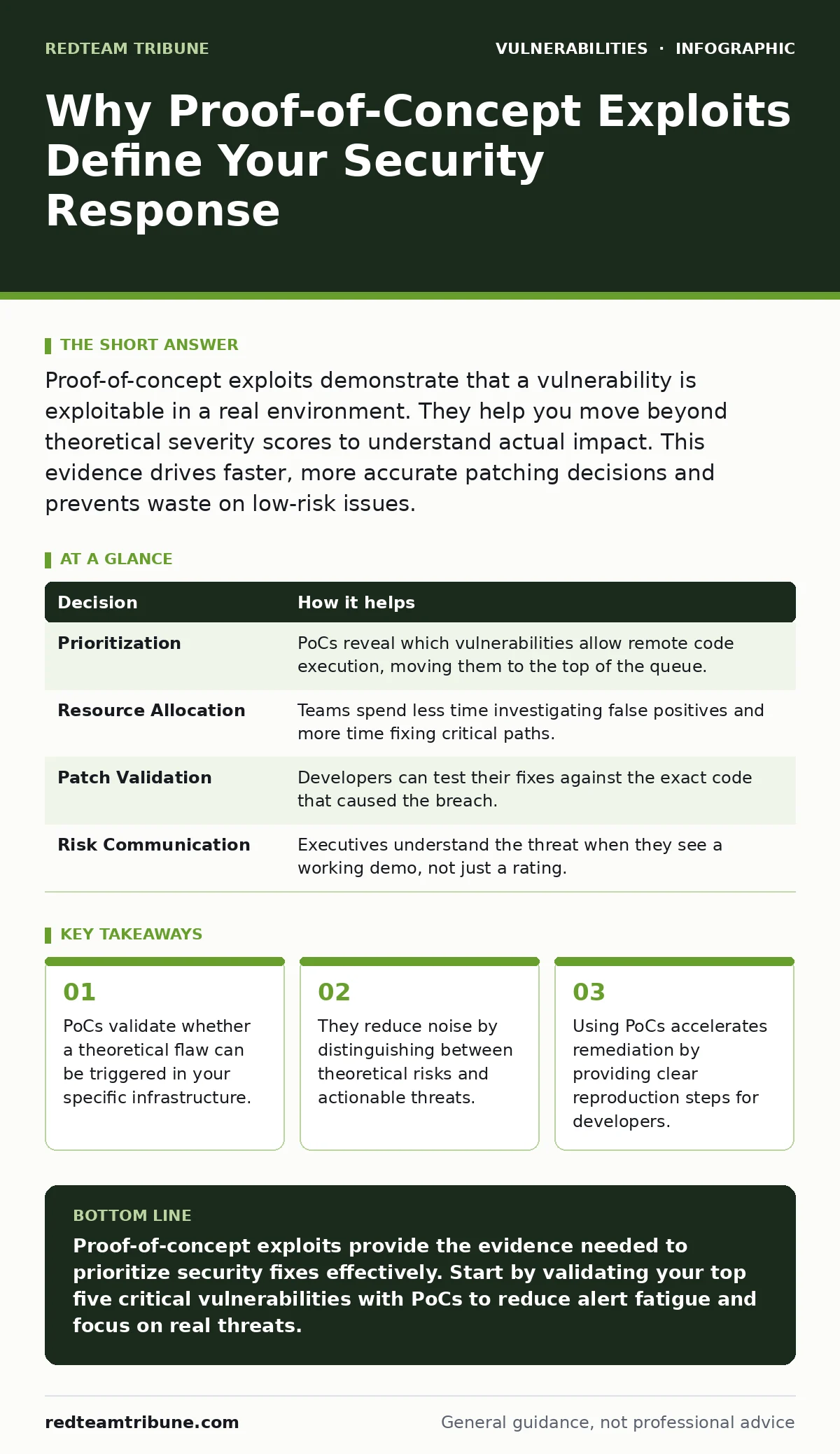
Proof-of-concept exploits demonstrate that a vulnerability is exploitable in a real environment. They help you move beyond theoretical severity scores to understand actual impact. This evidence drives faster, more accurate patching decisions and prevents waste on low-risk issues.
The Gap Between Theory and Reality
Vulnerability scanners report thousands of issues daily. Most of these reports rely on static analysis or signature matching. They tell you a flaw exists in the code, but they do not tell you if an attacker can actually use it. This gap creates a state of alert fatigue. You patch everything because you cannot tell what matters.
A proof-of-concept exploit, often called a PoC, is a minimal piece of code or script. It demonstrates how to trigger a specific vulnerability. It proves the flaw is not just a theoretical possibility. It shows the exact steps an attacker takes to gain access or execute code.
Without a PoC, you are guessing. With a PoC, you have evidence. This evidence changes how you allocate resources. It shifts your focus from volume to impact.
Decisions Informed by Evidence
Your security decisions become sharper when you have working exploits. You stop treating every finding as equally urgent. You start looking at the mechanics of the attack.
| Decision | How it helps |
|---|---|
| Prioritization | PoCs reveal which vulnerabilities allow remote code execution, moving them to the top of the queue. |
| Resource Allocation | Teams spend less time investigating false positives and more time fixing critical paths. |
| Patch Validation | Developers can test their fixes against the exact code that caused the breach. |
| Risk Communication | Executives understand the threat when they see a working demo, not just a rating. |
This table shows how evidence drives action. You move from reactive scanning to proactive defense. The key is using the PoC to understand the attack surface.
What Goes Wrong Without It
Imagine a team that relies solely on automated scanners. They receive a report about a high-severity issue in a legacy component. They spend weeks patching it. Later, they discover the component is isolated from the network. The vulnerability was real, but the risk was zero.
This is the hidden cost of ignoring PoCs. You waste time on low-impact issues. Meanwhile, a simpler, easier-to-exploit flaw goes unnoticed. Attackers do not care about your patching schedule. They care about what works.
Without PoCs, you miss the nuance of insecure deserialization. This flaw allows attackers to run arbitrary code by sending crafted data. A scanner might flag the library, but only a PoC shows how to craft the payload. You might patch the library, but if the input handling remains weak, the risk persists.
How Teams Use Proof-of-Concepts
Security teams use PoCs in three main ways. First, they validate findings. They run the PoC in a sandbox to confirm the vulnerability exists. Second, they use them for training. Developers learn how the attack works by seeing it happen. Third, they use them to test patches. They run the PoC again after the fix. If it still works, the patch failed.
This process requires a safe environment. You never run PoCs in production. You use isolated labs or containers. This ensures you do not disrupt services while testing.
The Role of Severity Ratings
Vulnerability severity ratings, such as CVSS scores, provide a standardized way to measure risk. They consider factors like attack complexity and privileges required. However, these scores are theoretical. They assume ideal conditions for the attacker.
A PoC grounds these ratings in reality. It shows whether the attack complexity is actually high or low in your environment. For example, a vulnerability might have a high score because it allows remote access. But if your firewall blocks the necessary port, the practical risk is lower.
PoCs help you adjust these ratings. You can assign an internal risk score based on exploitability. This makes your prioritization more accurate. You focus on what attackers can actually do, not what they might do in theory.
See also: Vulnerability Severity Ratings: How to Read and Apply Scores
Edge Cases and Hidden Costs
Using PoCs is not without challenges. One hidden cost is the time required to maintain them. PoCs break when software updates. You must keep them current. Another cost is the risk of accidental deployment. A PoC in production can cause damage.
There are also edge cases where PoCs fail. Some vulnerabilities require specific conditions to trigger. These might be rare in your environment. A PoC might work in a lab but fail in production due to configuration differences.
Another edge case is business logic flaws. These are hard to automate. A PoC for a business logic flaw might require manual steps. It might involve abusing a workflow rather than a code error. These are often missed by scanners but are critical for security.
Integrating with Change Management
Once you have a PoC, you need to fix the issue. This is where change management for security patches comes in. You cannot just patch everything immediately. You need a process.
The PoC provides the urgency. It shows why the patch is needed now. It helps you justify the change request. Without it, change management might delay the fix for weeks. With it, you have concrete evidence of risk.
This integration speeds up remediation. It reduces the time between discovery and fix. It ensures that critical vulnerabilities are addressed first.
Looking Beyond the Code
PoCs are not the only tool. You also need to understand the broader context. For example, output encoding prevents many web vulnerabilities. If you encode output correctly, many PoCs will fail.
Similarly, web cache poisoning attacks rely on how servers store and serve content. A PoC can show how an attacker injects malicious content into a cache. This is a different class of problem than code execution.
This contrast shows the value of evidence. You move from guessing to knowing. You build a stronger defense.
Dynamic Analysis for Complex Threats
Some vulnerabilities are hard to detect. They might be obfuscated or polymorphic. Dynamic malware analysis helps here. It runs the malicious code in a safe environment. It observes what the code does.
PoCs can be part of this analysis. They help you understand the behavior of the exploit. You can see which files it touches, which ports it opens, and what data it exfiltrates.
This deep understanding helps you detect similar attacks in the future. You can create signatures based on the behavior shown in the PoC. You move from static detection to behavioral detection.
Building a Sustainable Process
Using PoCs effectively requires a sustainable process. You need a dedicated environment for testing. You need skilled analysts to create and maintain PoCs. You need a clear workflow for prioritization.
This process takes time to build. But the payoff is significant. You reduce risk more effectively. You save resources by focusing on what matters. You build a culture of evidence-based security.
The goal is not to find every vulnerability. The goal is to fix the ones that matter. PoCs help you do that. They turn abstract risks into concrete actions.
Key takeaways
- PoCs validate whether a theoretical flaw can be triggered in your specific infrastructure.
- They reduce noise by distinguishing between theoretical risks and actionable threats.
- Using PoCs accelerates remediation by providing clear reproduction steps for developers.
Proof-of-concept exploits provide the evidence needed to prioritize security fixes effectively. Start by validating your top five critical vulnerabilities with PoCs to reduce alert fatigue and focus on real threats.
Frequently asked questions
How do I find proof-of-concept exploits for known vulnerabilities?
Many PoCs are published in public repositories and security advisories. Look for official vendor disclosures and trusted security research groups.
Is it legal to use proof-of-concept exploits?
Using PoCs on systems you own or have explicit permission to test is legal. Never use them on systems without authorization.
Can I create my own proof-of-concept exploits?
Yes, if you have the skills. Start with simple vulnerabilities and use safe, isolated environments. Ensure you understand the legal and ethical implications.
How long should I keep proof-of-concept exploits?
Keep them as long as the vulnerability is relevant. Update them when software changes. Archive them once the risk is mitigated and no longer relevant.
How this guide was produced: written by the RedTeam Tribune editorial team with AI assistance, checked against the public references listed below, and reviewed when the facts change. See our editorial policy or report an error.