Logging Library Vulnerabilities: Hidden Risks and Low-Cost Protections
Logging libraries often run with high privileges, turning a simple information leak into a full system compromise that bypasses standard network defenses.

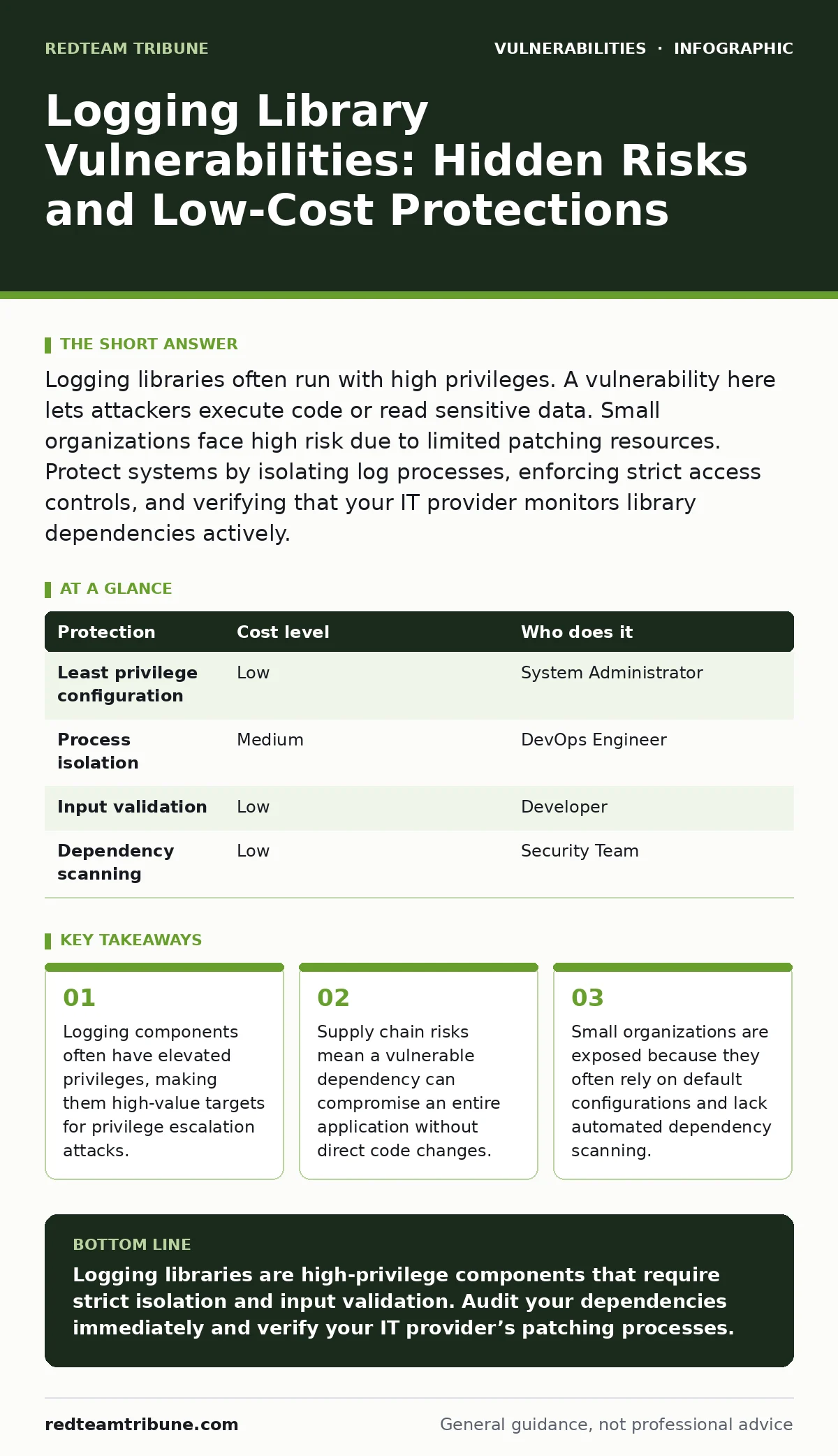
Logging libraries often run with high privileges. A vulnerability here lets attackers execute code or read sensitive data. Small organizations face high risk due to limited patching resources. Protect systems by isolating log processes, enforcing strict access controls, and verifying that your IT provider monitors library dependencies actively.
Why Small Organizations Face Disproportionate Risk
Small organizations often assume that logging is a passive function. Logging records events for debugging and audit purposes. This assumption is dangerous. Logging libraries frequently run with the same privileges as the main application. If the application runs as an administrator, the logger does too. An attacker who compromises the logging component gains those same elevated rights.
Small teams rarely have dedicated security engineers. They rely on developers to manage dependencies. Developers often prioritize feature delivery over security audits. This creates a gap where vulnerable libraries remain in production for months. The supply chain nature of these vulnerabilities means you are trusting the code of every library you import. You cannot easily inspect every line of code in a third-party logging framework.
The risk compounds when logging infrastructure is centralized. Many small businesses send logs to a single server or cloud service. If that central logger is vulnerable, the entire organization’s visibility and integrity are at stake. This mirrors the risks seen in broken access control, where a single misconfigured endpoint exposes vast amounts of data. Unlike network firewalls, library vulnerabilities exist inside your trusted boundary.
The Mechanics of Logging Exploits
Logging libraries process data from various sources. They format this data for storage or transmission. This processing often involves parsing complex strings. Attackers exploit this by injecting malicious payloads into log messages. When the library processes these messages, it executes the hidden code. This is similar to server-side template injection (SSTI), where user input is rendered as executable code.
A common attack vector is deserialization. Many logging libraries serialize objects to save them to disk or send them over the network. Deserialization is the process of converting this data back into an object. If the library does not validate the data structure, an attacker can send a crafted object. When deserialized, this object executes arbitrary commands on the server. This allows remote code execution without needing to breach the application logic directly.
Another vector is log injection. Attackers inject control characters into log entries. These characters can break the log format or trigger commands in log parsing tools. If your monitoring system executes commands based on log content, this becomes a critical failure point. You must treat log data as untrusted input, just as you would treat data entering a web form.
Hidden Costs of Default Configurations
Default configurations in logging libraries often prioritize ease of use over security. They may log sensitive information by default. This includes passwords, session tokens, and personal identification numbers. While this helps developers debug issues, it creates a persistent data leak. If an attacker gains read access to the logs, they obtain this sensitive data immediately.
The hidden cost is the latency of detection. Small organizations rarely review raw log files manually. They rely on automated alerts. If the logging library itself is compromised, alerts may be suppressed or altered. The attacker can hide their activity by modifying the logs in real-time. This creates a blind spot that traditional antivirus software cannot detect. You are fighting an enemy who controls your eyes.
This situation parallels API vulnerabilities where default endpoints expose internal services. In both cases, the path of least resistance for the developer becomes the path of least resistance for the attacker. The cost of fixing this after a breach is significantly higher than securing the configuration initially. You pay for the breach in downtime, data recovery, and reputational damage.
Low-Cost Protection Strategies
You do not need expensive security tools to mitigate these risks. Basic architectural changes provide significant protection. The first step is principle of least privilege. The process running the logging library should have the minimum permissions necessary. It should not have write access to the entire file system. It should not have administrative rights. Restricting these limits the damage if the library is compromised.
Isolate the logging process from the main application. Run the logger as a separate service with its own user account. This containment prevents an attacker who exploits the logger from easily pivoting to the main application database. This strategy is effective against mass assignment vulnerabilities, where attackers try to modify unintended properties. By isolating components, you reduce the attack surface.
Use allowlists for log formats. Configure the library to only accept specific, safe data types. Reject any input that contains executable code or complex objects. Validate input before it reaches the logging function. This prevents injection attacks at the source. It is a simple check that blocks many common exploits.
| Protection | Cost level | Who does it |
|---|---|---|
| Least privilege configuration | Low | System Administrator |
| Process isolation | Medium | DevOps Engineer |
| Input validation | Low | Developer |
| Dependency scanning | Low | Security Team |
Managing Dependencies Effectively
You must know every library in your application. This is called software composition analysis. Small teams often neglect this because it feels tedious. However, a single vulnerable logging library can undo all other security efforts. You need to track the versions of all dependencies. Outdated libraries often contain known vulnerabilities that have patches available.
Automate the update process where possible. Manual updates are prone to human error and delay. Set up alerts for security advisories related to your dependencies. This ensures you are aware of new threats immediately. Do not wait for a breach to update your libraries. Proactive maintenance is cheaper than reactive remediation.
Review the security posture of the libraries you choose. Prefer well-maintained libraries with active communities. Avoid obscure libraries with few contributors. The community acts as a security audit. More eyes on the code mean vulnerabilities are found and fixed faster. This reduces your reliance on a single vendor’s security practices.
What to Ask Your IT Provider
Your IT provider plays a critical role in managing these risks. You must verify their capabilities during onboarding and regular reviews. Do not assume they are monitoring your dependencies. Ask specific questions to uncover gaps in their process.
- How do you monitor for vulnerabilities in third-party libraries?
- What is your process for patching critical logging components?
- Do you isolate logging processes from main application services?
- How do you validate input before it is logged?
- Can you provide a recent report on dependency security?
These questions force the provider to demonstrate their technical depth. They reveal whether they rely on automated tools or have manual oversight. A provider who cannot answer these questions clearly is not adequately protecting your infrastructure. You need a partner who understands the nuance of GitHub Actions workflow injection and similar supply chain risks.
Integrating with Broader Security
Logging security is not an isolated issue. It connects to your overall security posture. If your logging is compromised, your ability to detect other attacks is impaired. This makes logging a foundational security control. You must treat it with the same rigor as your firewall or antivirus.
Consider how logging interacts with other vulnerabilities. If an attacker exploits SQL injection to gain access, they will likely try to disable logging to hide their tracks. A robust logging strategy includes tamper-evident logs. These logs detect any unauthorized modifications. This ensures you have a reliable record of events even during an attack.
Regularly test your logging infrastructure. Use proof-of-concept exploits in a safe, isolated environment to verify your defenses. This confirms that your configurations are working as intended. It also trains your team to respond to logging-related incidents. Preparation reduces the impact of a real breach.
Key takeaways
- Logging components often have elevated privileges, making them high-value targets for privilege escalation attacks.
- Supply chain risks mean a vulnerable dependency can compromise an entire application without direct code changes.
- Small organizations are exposed because they often rely on default configurations and lack automated dependency scanning.
Logging libraries are high-privilege components that require strict isolation and input validation. Audit your dependencies immediately and verify your IT provider’s patching processes.
Frequently asked questions
How do I know if my logging library is vulnerable?
Check the version against known vulnerability databases. Use automated scanning tools to identify outdated or insecure dependencies in your project.
Should I turn off logging to reduce risk?
No. Turning off logging blinds you to attacks. Instead, secure the logging process by limiting privileges and validating input to prevent exploitation.
Can antivirus software protect against logging vulnerabilities?
Antivirus software detects known malware signatures. It often misses logic-based exploits in libraries. You need application-level security controls and dependency management.
How often should I update logging libraries?
Update immediately when security patches are released. Regular updates prevent the accumulation of known vulnerabilities that attackers can easily exploit.
How this guide was produced: written by the RedTeam Tribune editorial team with AI assistance, checked against the public references listed below, and reviewed when the facts change. See our editorial policy or report an error.