Difference Between Encryption at Rest and Transit: Protecting Data Lifecycle
Encryption at rest secures static files on disk, while encryption in transit protects data moving across networks, creating two distinct attack surfaces.

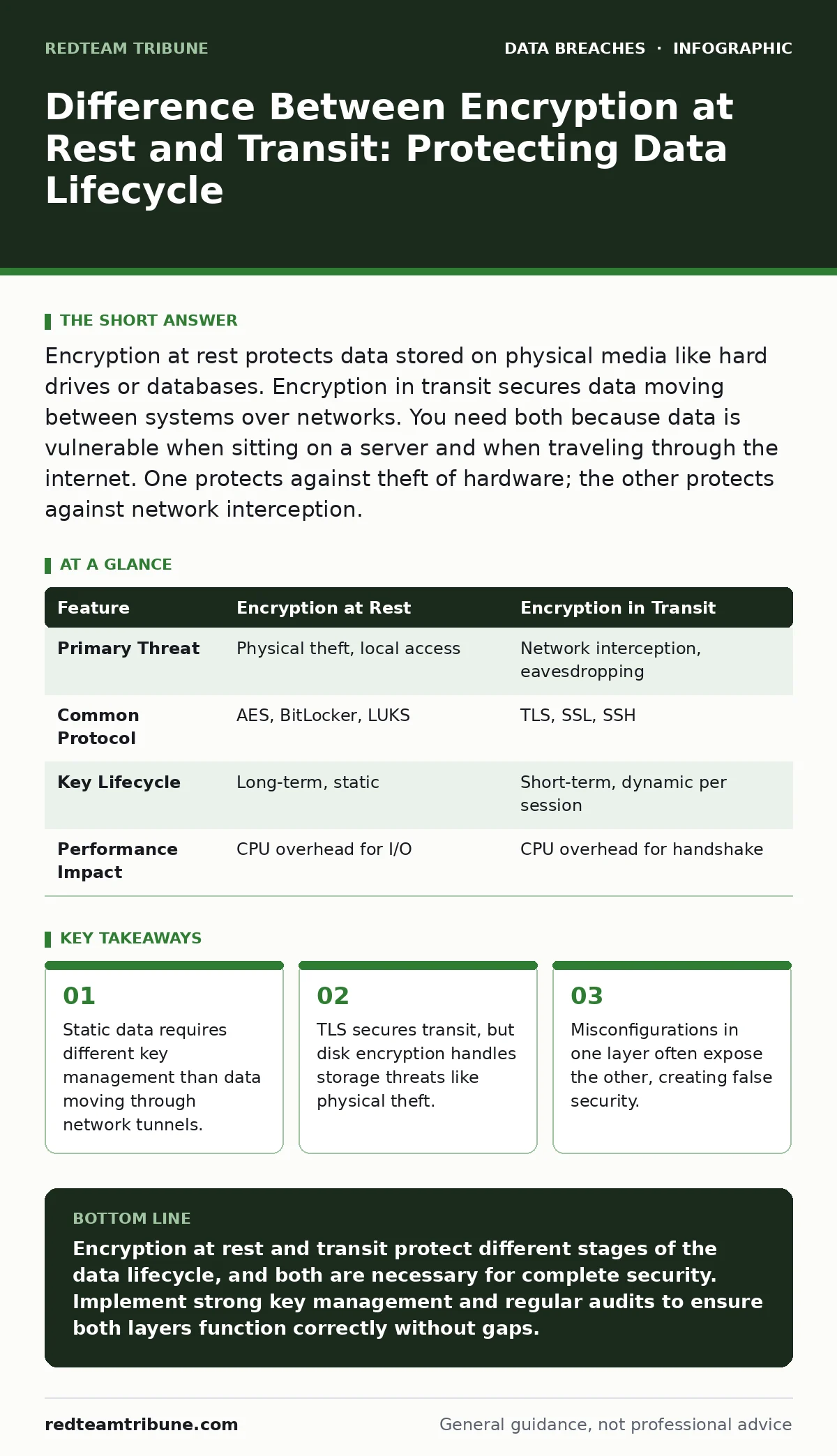
Encryption at rest protects data stored on physical media like hard drives or databases. Encryption in transit secures data moving between systems over networks. You need both because data is vulnerable when sitting on a server and when traveling through the internet. One protects against theft of hardware; the other protects against network interception.
What is the difference between encryption at rest and transit?
The difference between encryption at rest and transit lies in the state of the data when protection is applied. Encryption at rest scrambles data stored on physical media, such as hard drives, solid-state drives, or database files. This protects the information if the storage device is stolen or lost. Encryption in transit scrambles data while it moves between systems, servers, or user devices over a network. This prevents eavesdroppers from reading the payload during transmission. Both mechanisms use cryptographic algorithms, but they serve different points in the data lifecycle.
Why does encryption at rest matter for storage security?
Encryption at rest matters because physical theft and unauthorized local access remain primary threats to stored information. When a laptop or server is stolen, the attacker has direct access to the storage medium. Without encryption, they can read every file on the disk. Encryption at rest ensures that the data remains unreadable without the correct decryption key. This protects sensitive records even if the hardware falls into the wrong hands. It also helps organizations meet compliance requirements for data protection.
How does encryption in transit protect network communications?
Encryption in transit protects network communications by creating a secure tunnel between two endpoints. When data moves from a client to a server, it passes through multiple routers and switches. Any device along this path could potentially intercept the traffic. Encryption in transit, typically using TLS (Transport Layer Security), scrambles the data packets. Only the intended recipient can decrypt them. This prevents man-in-the-middle attacks where an attacker reads or modifies the data in real time.
What happens if you only encrypt data in transit?
If you only encrypt data in transit, your stored data remains vulnerable to physical theft and local breaches. Imagine a server that uses strong TLS for all incoming connections. An attacker steals the server’s hard drive. Because the data was never encrypted at rest, the attacker can plug the drive into another machine and read all files. The transit protection was useless once the data stopped moving. This gap leaves organizations exposed to insider threats and physical security failures.
What happens if you only encrypt data at rest?
If you only encrypt data at rest, your data is vulnerable while moving across networks. Suppose an employee sends a sensitive file from an encrypted laptop to a cloud server. The file is safe on the laptop. However, if the connection to the cloud is not encrypted, the data travels in plain text. Attackers monitoring the network can capture the entire file. The encryption at rest does not protect the data during the journey. This exposes the organization to interception and data leakage.
See also: 7 Common CASB Mistakes That Create Blind Spots · Stop Cloud Data Exfiltration: Small Business Risks and Low-Cost Fixes
How do key management strategies differ for each method?
Key management strategies differ because static keys and dynamic session keys have different lifecycle requirements. Encryption at rest often uses a master key stored in a hardware security module. This key must remain secure for years. Encryption in transit generates temporary session keys for each connection. These keys are destroyed after the session ends. Managing these two types requires distinct processes. Static key rotation is complex and risky. Dynamic key exchange is automated but requires certificate management.
| Feature | Encryption at Rest | Encryption in Transit |
|---|---|---|
| Primary Threat | Physical theft, local access | Network interception, eavesdropping |
| Common Protocol | AES, BitLocker, LUKS | TLS, SSL, SSH |
| Key Lifecycle | Long-term, static | Short-term, dynamic per session |
| Performance Impact | CPU overhead for I/O | CPU overhead for handshake |
Where do standard encryption implementations fail in practice?
Standard encryption implementations often fail due to misconfiguration and improper scope. Many organizations enable disk encryption but exclude temporary files or swap space. Attackers can extract sensitive data from these unencrypted areas. In transit, weak cipher suites or outdated protocol versions can undermine security. Some applications bypass system-level encryption by storing data in plain text within logs. These gaps render the encryption ineffective. Regular audits are necessary to identify these blind spots.
How does this relate to secure data disposal practices?
Encryption at rest simplifies secure data disposal by allowing cryptographic erasure. When you delete the encryption key, the data becomes permanently unreadable. This is faster and more reliable than overwriting physical media multiple times. It ensures that retired hard drives cannot be recovered by attackers. This method supports efficient lifecycle management. It reduces the risk of data leakage from discarded equipment. Proper disposal is a critical component of overall data protection.
What role do privacy impact assessments play in this context?
Privacy impact assessments help identify where encryption is required based on data sensitivity. They map data flows to determine when data is at rest or in transit. This mapping reveals gaps in protection. For example, an assessment might show that personal data is stored unencrypted on a backup server. It might also reveal that data is sent over unencrypted channels to a third-party vendor. Addressing these findings ensures compliance and reduces risk. These assessments inform the selection of appropriate encryption controls.
Key takeaways
- Static data requires different key management than data moving through network tunnels.
- TLS secures transit, but disk encryption handles storage threats like physical theft.
- Misconfigurations in one layer often expose the other, creating false security.
Encryption at rest and transit protect different stages of the data lifecycle, and both are necessary for complete security. Implement strong key management and regular audits to ensure both layers function correctly without gaps.
Frequently asked questions
Can I use the same encryption algorithm for both rest and transit?
Yes, algorithms like AES are used for both, but the implementation and key management differ significantly between the two contexts.
Does cloud storage automatically encrypt data at rest?
Most cloud providers offer encryption at rest by default, but you must verify that the keys are managed correctly and that data is encrypted before upload.
Is SSL still used for encryption in transit?
SSL is outdated and insecure; modern systems use TLS, which provides stronger security and is the current standard for encrypting data in transit.
How often should I rotate encryption keys for data at rest?
Key rotation frequency depends on your risk assessment, but annual rotation is a common baseline for high-sensitivity data to limit exposure.
How this guide was produced: written by the RedTeam Tribune editorial team with AI assistance, checked against the public references listed below, and reviewed when the facts change. See our editorial policy or report an error.