DNS Hijacking Detection: How to Spot and Stop Domain Redirection
DNS hijacking detection relies on monitoring for unexpected IP address changes and verifying cryptographic signatures rather than trusting cached records.
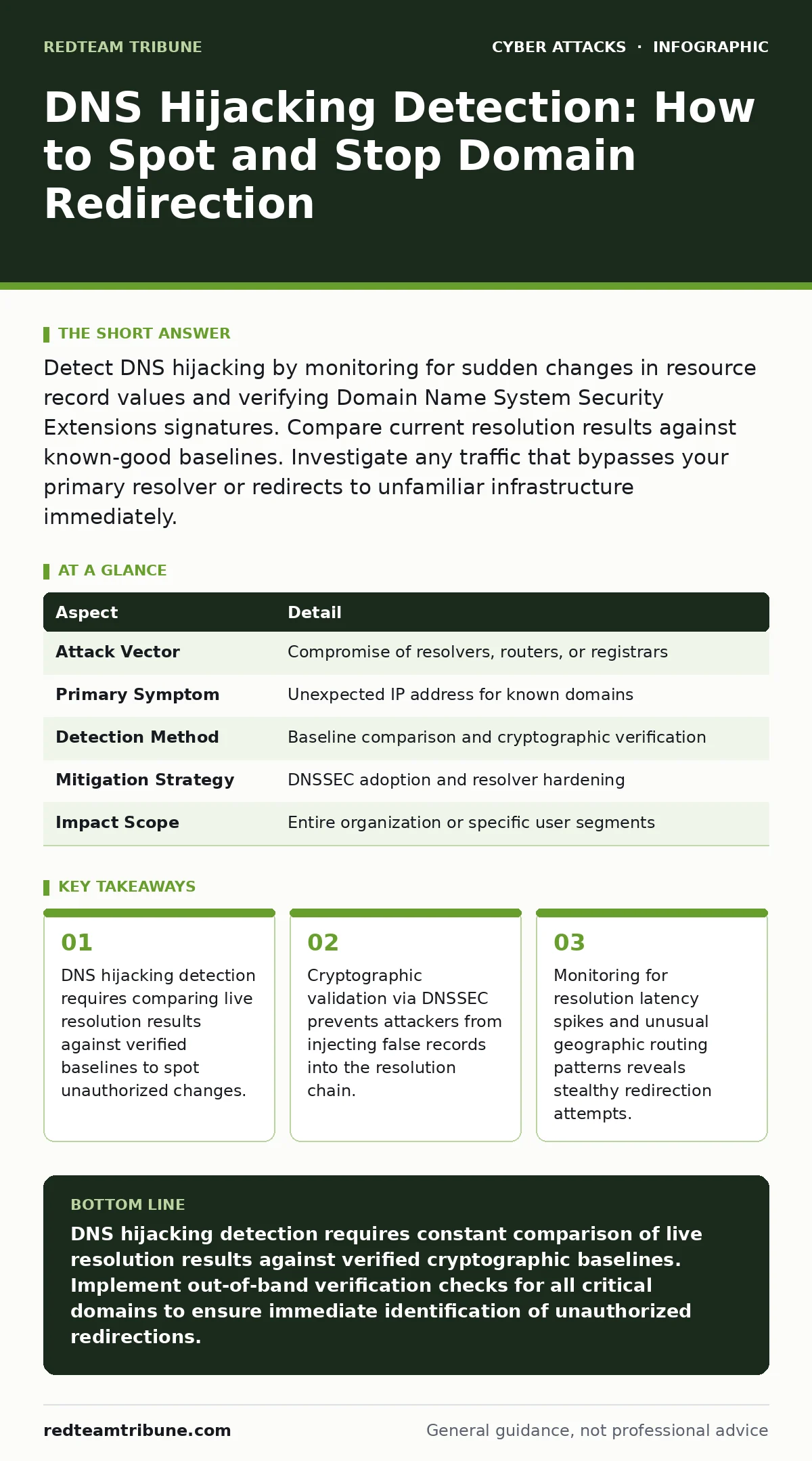
Detect DNS hijacking by monitoring for sudden changes in resource record values and verifying Domain Name System Security Extensions signatures. Compare current resolution results against known-good baselines. Investigate any traffic that bypasses your primary resolver or redirects to unfamiliar infrastructure immediately.
Understanding the Mechanism of Domain Redirection
Imagine sending a letter to a friend using a trusted postal system. You write the correct address on the envelope, but someone intercepts the mail truck and swaps your letter with one addressed to a thief. The recipient never receives your message. DNS hijacking operates on this same principle of interception and substitution. It involves altering the Domain Name System translation process so that a domain name resolves to an incorrect Internet Protocol address.
The Domain Name System acts as the phonebook of the internet, translating human-readable names like "example.com" into numerical IP addresses that computers use to locate each other. When this translation is compromised, users are silently redirected to malicious infrastructure without their knowledge. The attacker does not need to break into your computer directly. They only need to corrupt the translation step that occurs before your browser connects to the intended server.
| Aspect | Detail |
|---|---|
| Attack Vector | Compromise of resolvers, routers, or registrars |
| Primary Symptom | Unexpected IP address for known domains |
| Detection Method | Baseline comparison and cryptographic verification |
| Mitigation Strategy | DNSSEC adoption and resolver hardening |
| Impact Scope | Entire organization or specific user segments |
How DNS Hijacking Detection Works in Practice
DNS hijacking detection focuses on identifying discrepancies between expected and actual resolution outcomes. You must establish a baseline of what legitimate resolution looks like for your critical assets. This baseline includes the correct IP addresses, Time to Live values, and geographic routing paths for every domain your organization accesses or hosts. When a query returns a result that deviates from this baseline, the detection system flags it as a potential hijacking event.
The detection process often involves out-of-band verification. Instead of trusting the local resolver that might be compromised, you query a secondary, independent resolver to compare results. If the primary resolver returns an IP address that differs from the secondary resolver, a hijacking attempt is likely occurring. This method catches attacks that target specific network segments or local caching servers. It also reveals attacks that manipulate the routing path between your network and the authoritative name servers.
Who Is Affected by Domain Translation Attacks
DNS hijacking affects any entity that relies on accurate domain resolution. Small businesses with single points of failure are particularly vulnerable because they often lack redundant monitoring systems. Large enterprises face complex risks where partial hijacking affects only specific departments or geographic offices. This partial impact makes detection harder because the rest of the organization continues to operate normally.
Managed service providers face unique challenges in this area. They must monitor resolution integrity across dozens of client networks simultaneously. A failure in one client's local resolver can cascade into broader trust issues if the provider relies on that resolver for other clients. The attack surface expands when third-party registrars or hosting providers are compromised. In these cases, the hijacking occurs at the source, making it difficult for any single organization to detect the change independently.
What People Usually Get Wrong About Detection
Many organizations assume that firewalls and antivirus software protect against DNS hijacking. These tools inspect traffic after the connection is established. They cannot prevent a user from connecting to a malicious server if the DNS translation already pointed them there. Relying on perimeter defenses alone creates a blind spot in the initial connection phase.
Another common error is trusting cached records without verification. Attackers often inject false records into local caches with long Time to Live values. This ensures that even if the attack stops, the poisoned data remains in use for hours or days. Detection systems that do not force cache refreshes or validate records against authoritative sources will miss these persistent threats.
Implementing Robust Monitoring Strategies
Effective DNS hijacking detection requires continuous monitoring of resolution logs. You should track every query and response for anomalies. Look for sudden changes in the Time to Live values, which might indicate an attacker trying to force a cache update. Monitor for queries that fail to resolve or return server error codes unexpectedly. These errors can signal an attempt to disrupt normal resolution while testing hijacking vectors.
Integrate monitoring with your existing security information and event management systems. Correlate DNS logs with web proxy logs and firewall logs. If a user connects to an IP address that does not match the expected domain resolution, the correlation engine should flag it. This cross-referencing helps identify cases where the DNS layer is compromised but the application layer remains unaware.
The Role of Cryptographic Validation
Domain Name System Security Extensions provide cryptographic signatures for DNS records. DNSSEC ensures that the data received is exactly what the authoritative server sent. It prevents attackers from injecting false records without possessing the private keys for the domain. Implementing DNSSEC is one of the most effective ways to detect and prevent hijacking.
Detection systems should validate DNSSEC signatures for all critical domains. If a signature fails validation, the system should treat the record as invalid and refuse to resolve it. This approach stops the hijacking attempt before the user connects to the malicious server. It also provides a clear audit trail for forensic analysis, showing exactly when and where the validation failed.
Preventing Future Compromise Vectors
Prevention complements detection by reducing the attack surface. Use network segmentation to isolate DNS infrastructure from general user traffic. This limits the ability of an attacker who compromises a user device from accessing and poisoning the resolver. Implement strict access controls on DNS management interfaces to prevent unauthorized changes to zone files.
Regularly review and update your DNS provider configurations. Ensure that transfer protocols are restricted to authorized secondary servers only. This prevents zone transfers from being intercepted and used to create mirror copies of your domain data for hijacking. Combine these technical controls with administrative procedures that require dual approval for any changes to DNS records.
Related concepts like domain spoofing often accompany hijacking attempts, as attackers try to mimic legitimate branding once they have redirected traffic. Understanding how phishing kits exploit these redirections helps you recognize the broader campaign. Similarly, insider threats can facilitate hijacking by providing attackers with the credentials needed to modify zone files. Addressing these related risks strengthens your overall defense posture.
Key takeaways
- DNS hijacking detection requires comparing live resolution results against verified baselines to spot unauthorized changes.
- Cryptographic validation via DNSSEC prevents attackers from injecting false records into the resolution chain.
- Monitoring for resolution latency spikes and unusual geographic routing patterns reveals stealthy redirection attempts.
DNS hijacking detection requires constant comparison of live resolution results against verified cryptographic baselines. Implement out-of-band verification checks for all critical domains to ensure immediate identification of unauthorized redirections.
Frequently asked questions
Can DNS hijacking be detected by users without technical tools?
Users may notice unexpected certificate warnings or login pages that look slightly different. However, sophisticated hijacking often mimics legitimate sites perfectly, making user detection unreliable. Automated monitoring is required for consistent detection.
Does using a public DNS resolver prevent hijacking?
Public resolvers reduce the risk of local network compromise but do not eliminate it. Attackers can still hijack the connection between the user and the public resolver. DNSSEC validation remains necessary regardless of the resolver used.
How often should DNS baselines be updated?
Baselines should be updated whenever legitimate infrastructure changes occur. Regular audits ensure that the expected IP addresses and routing paths remain accurate. Stale baselines can lead to false positives or missed detections.
What is the difference between DNS hijacking and DNS spoofing?
DNS hijacking typically involves redirecting queries to a malicious resolver or modifying zone records. DNS spoofing involves sending false DNS responses to poison a cache. Both result in incorrect resolution but use different technical methods.
How this guide was produced: written by the RedTeam Tribune editorial team with AI assistance, checked against the public references listed below, and reviewed when the facts change. See our editorial policy or report an error.