Kubernetes Admission Controllers: Security Gains and Hidden Costs
Admission controllers enforce policy at the API layer, but they cannot inspect running containers or prevent misconfigurations that slip through initial validation.
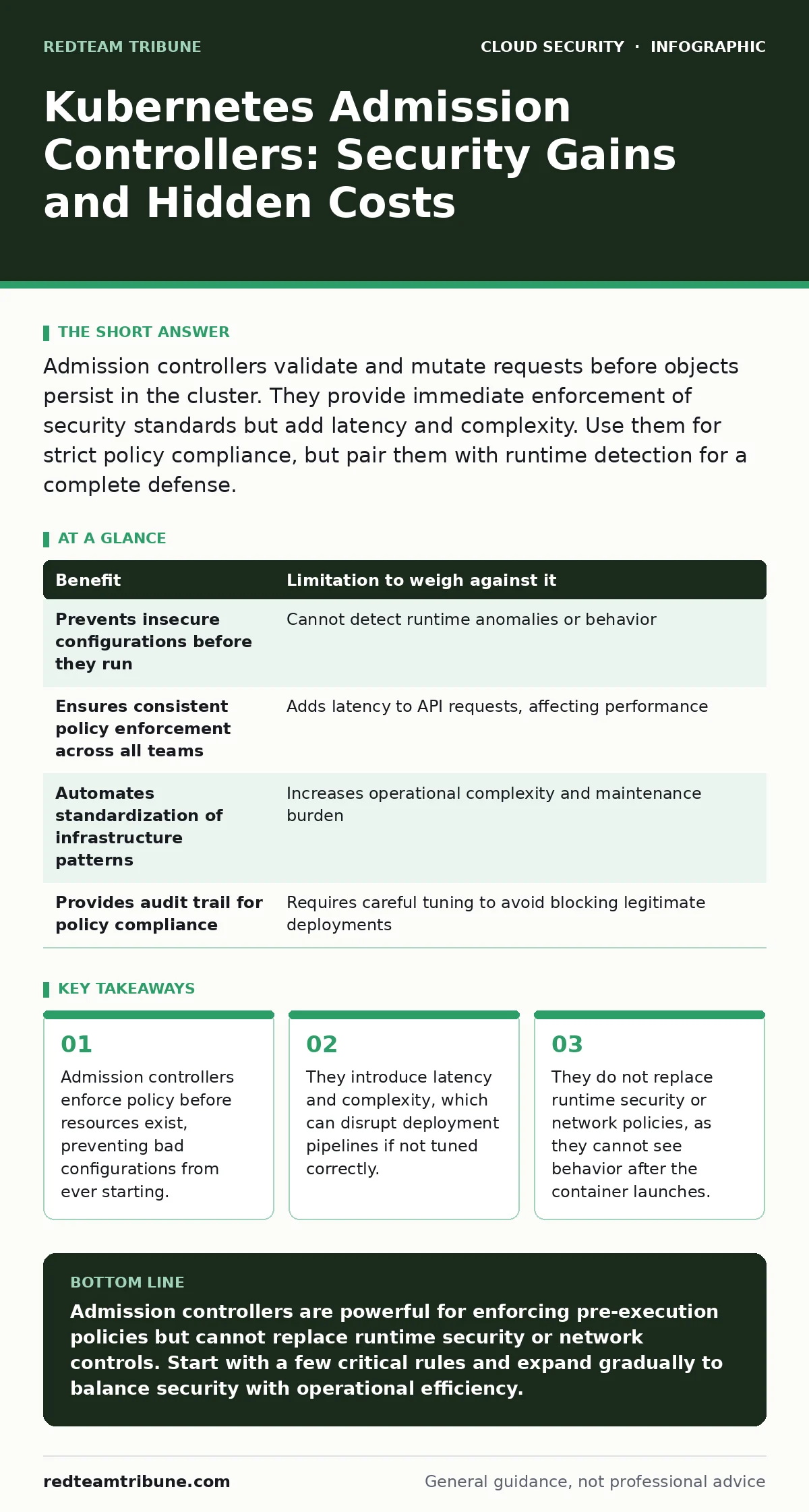
Admission controllers validate and mutate requests before objects persist in the cluster. They provide immediate enforcement of security standards but add latency and complexity. Use them for strict policy compliance, but pair them with runtime detection for a complete defense.
The Gatekeeper Mechanism
Kubernetes admission controllers act as interceptors in the API server request flow. When you submit a manifest to create a pod or service, the API server validates the syntax but does not accept the object immediately. Instead, it passes the request to a chain of admission controllers. Each controller reviews the request against a set of rules. If a rule fails, the request is rejected before the object is stored in etcd. If the request passes, the object is persisted.
This mechanism allows you to enforce organizational standards automatically. You can block the creation of pods that request excessive resources or deny images from untrusted registries. The enforcement happens at the source of truth, ensuring that no pod exists in the cluster that violates your defined policies.
Concrete Benefits of Enforcement
The primary benefit is prevention. You stop insecure configurations before they become running workloads. This reduces the attack surface by ensuring that every new resource meets your baseline security requirements. For example, you can mandate that all pods run as non-root users. This prevents a container breakout from granting root access to the host node.
Another benefit is consistency. Manual checks are prone to human error and fatigue. Admission controllers apply the same rules to every request, regardless of who submits it. This uniformity is critical for maintaining compliance across large environments. It also simplifies audits because you can prove that certain configurations were technically impossible to deploy.
You can also use mutating admission controllers to inject security tools automatically. Suppose you want to add a sidecar proxy to every pod for observability. A mutating controller can add this container to the pod spec before it is created. This ensures that no workload is deployed without the required monitoring infrastructure.
Honest Limitations and Trade-Offs
Admission controllers cannot inspect running containers. They only see the request to create or update an object. Once the pod is running, the admission controller has no visibility into its behavior. If a container starts a malicious process after launch, the admission controller will not detect it. You need runtime security tools for that layer of defense.
Latency is a significant trade-off. Each admission controller adds processing time to the API request. If you chain multiple complex controllers, the delay can become noticeable. This affects the user experience for developers and can slow down automated deployment pipelines. High latency in the API server can also impact the stability of the cluster during peak loads.
Complexity increases with the number of controllers. Each controller requires maintenance, updates, and debugging. If a controller crashes or becomes unresponsive, it can block all API traffic. You must design your system to handle these failures gracefully, often requiring fallback mechanisms or circuit breakers.
When It Is Worth It
Implement admission controllers when you need strict, automated compliance. If your organization must adhere to specific security standards, such as those covered in Pod Security Standards, admission controllers are the most reliable enforcement mechanism. They ensure that no exceptions are made without explicit approval.
They are also worth it when you manage a multi-tenant cluster. In these environments, you need to isolate workloads and enforce resource limits strictly. Admission controllers can prevent tenants from accessing resources they are not authorized to use. This complements Kubernetes RBAC by adding a layer of policy enforcement at the object level.
Consider them when you want to standardize infrastructure patterns. If every team must use specific labels, annotations, or sidecars, admission controllers can enforce this automatically. This reduces the burden on developers to remember these requirements and ensures uniformity across the platform.
When It Is Not
Avoid admission controllers for simple, static checks that can be handled by other means. For example, if you only need to restrict image sources, using a simpler image policy mechanism might be sufficient. Adding a full admission controller for a single rule adds unnecessary complexity and maintenance overhead.
Do not rely on them for detecting runtime anomalies. They are not designed to monitor behavior or network traffic. If you need to detect cloud cryptojacking or other runtime threats, you need specialized runtime security solutions. Admission controllers will not help you identify a compromised container that was initially valid.
They are not suitable for environments with high churn and low trust. If your deployment frequency is extremely high, the latency introduced by admission controllers can become a bottleneck. In such cases, you might need to optimize your controllers for speed or consider alternative enforcement methods that have lower overhead.
See also: Overprivileged Cloud Identities: How to Find and Fix Excess Access · 7 Common CASB Mistakes That Create Blind Spots
Balancing the Approach
A balanced security strategy uses admission controllers as one layer of defense. They are effective for pre-execution checks but insufficient on their own. You should combine them with runtime security, network policies, and regular cloud security assessments. This layered approach ensures that you catch issues at multiple stages of the lifecycle.
Regularly review your admission controller rules. Policies can become outdated or too restrictive over time. Engage with developers to understand the impact of your rules and adjust them as needed. This collaboration helps maintain a balance between security and productivity.
Integration with Broader Security
Admission controllers work best when integrated with other security tools. For instance, they can validate identities used by workloads, complementing workload identity solutions. This ensures that only authorized services can access specific resources.
They can also enforce encryption standards for secrets and configurations. This aligns with best practices for cloud cryptojacking prevention by ensuring that sensitive data is not exposed in plain text. However, remember that admission controllers do not encrypt data; they only enforce that encryption is declared in the manifest.
Regular access key rotation is another practice that admission controllers cannot enforce directly. They can ensure that secrets are used correctly, but they cannot rotate keys automatically. You need separate automation for key management and rotation.
| Benefit | Limitation to weigh against it |
|---|---|
| Prevents insecure configurations before they run | Cannot detect runtime anomalies or behavior |
| Ensures consistent policy enforcement across all teams | Adds latency to API requests, affecting performance |
| Automates standardization of infrastructure patterns | Increases operational complexity and maintenance burden |
| Provides audit trail for policy compliance | Requires careful tuning to avoid blocking legitimate deployments |
Key takeaways
- Admission controllers enforce policy before resources exist, preventing bad configurations from ever starting.
- They introduce latency and complexity, which can disrupt deployment pipelines if not tuned correctly.
- They do not replace runtime security or network policies, as they cannot see behavior after the container launches.
Admission controllers are powerful for enforcing pre-execution policies but cannot replace runtime security or network controls. Start with a few critical rules and expand gradually to balance security with operational efficiency.
Frequently asked questions
Do admission controllers slow down deployments?
Yes, they add latency to API requests. The impact depends on the complexity and number of controllers in the chain.
Can admission controllers detect malware in containers?
No, they only validate the manifest. They cannot inspect the container image or runtime behavior for malware.
How do I debug a failed admission controller request?
Check the API server logs and the controller logs. The error message returned to the user should indicate which rule failed.
Are admission controllers part of Kubernetes core?
Some are built-in, but most custom policies require external controllers that interact with the API server via webhooks.
How this guide was produced: written by the RedTeam Tribune editorial team with AI assistance, checked against the public references listed below, and reviewed when the facts change. See our editorial policy or report an error.