Tailgating Warning Signs: How to Spot Physical Breach Attempts
Most tailgating attempts fail because defenders miss the subtle social cues that precede the physical breach, not because the door lock is weak.
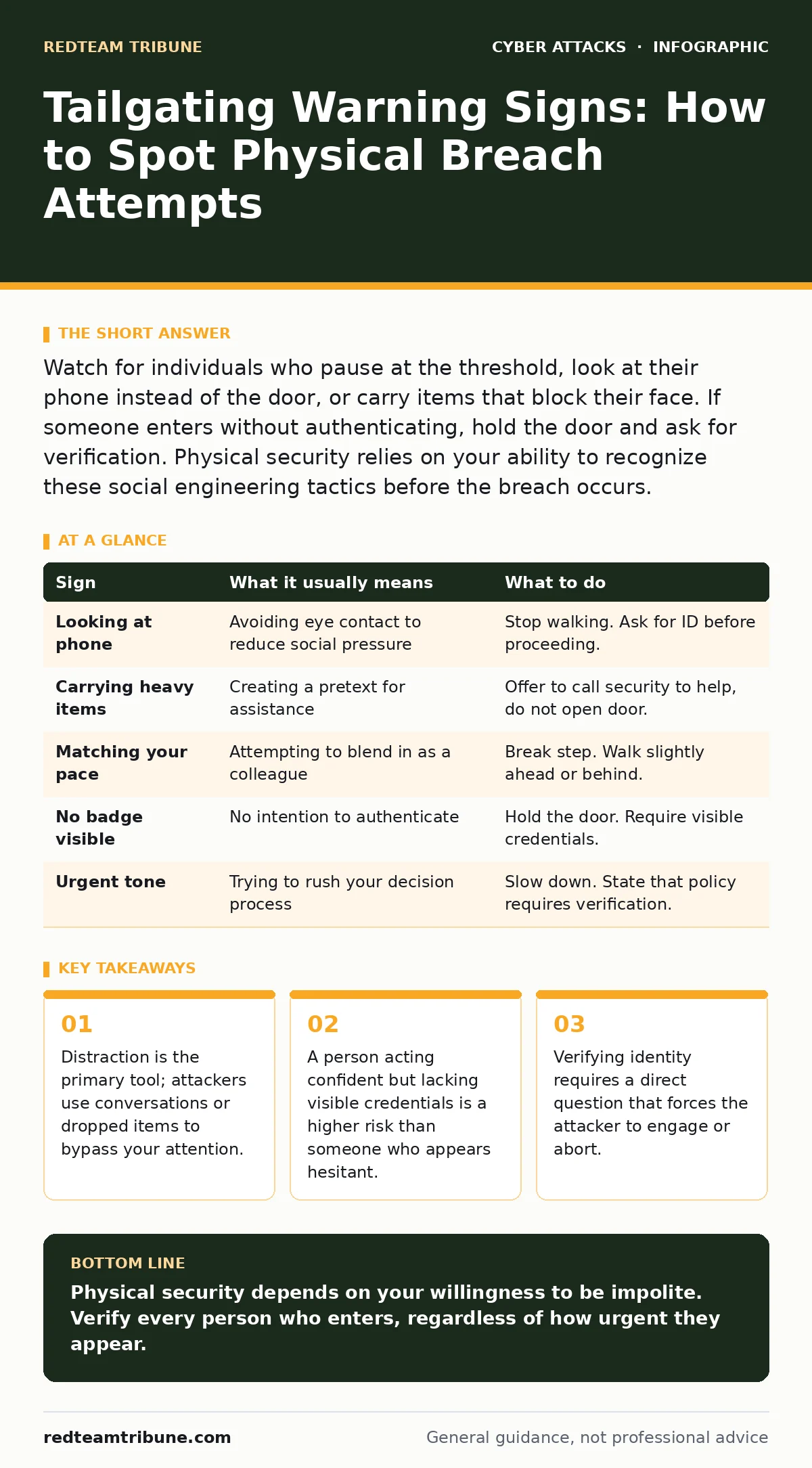
Watch for individuals who pause at the threshold, look at their phone instead of the door, or carry items that block their face. If someone enters without authenticating, hold the door and ask for verification. Physical security relies on your ability to recognize these social engineering tactics before the breach occurs.
The Psychology of the Threshold
Physical security fails when people prioritize politeness over protocol. An attacker does not need to pick a lock to enter a secure facility. They rely on your reluctance to be rude. This technique is called tailgating or piggybacking. It involves an unauthorized person following an authorized user through a secured entry point. The goal is to bypass the electronic access control system.
You often feel a subtle pressure to hold the door. This social expectation is the vulnerability. Attackers exploit this by creating a scenario where denying entry feels aggressive. They may appear burdened with heavy boxes or urgent deliveries. They might claim to be a new employee who forgot their badge. These narratives are designed to trigger your empathy or fear of causing inconvenience.
Obvious Indicators of Intrusion
Some signs are loud and clear. You notice them immediately because they violate basic security norms. An individual approaches the door while looking at their phone. They do not make eye contact with you. They do not present a badge or ID card. They simply walk toward the threshold as if they expect the door to open for them.
Another obvious sign is the lack of preparation. The person does not have their hands free to present credentials. They might be holding a laptop bag in a way that obscures their torso. They might wear sunglasses indoors, hiding their eyes and identity. These behaviors signal that they are not prepared to authenticate. They are relying on you to open the door for them.
Subtle Signals That Slip By
The dangerous attempts are quiet. They blend into the normal flow of traffic. The attacker walks beside you, matching your pace. They engage in small talk about the weather or the building. This conversation distracts you from the act of entry. You focus on the dialogue, not the door. By the time you realize they are entering, they are already inside.
Suppose someone asks for help with a package just as you approach the door. They position themselves between you and the handle. They create a physical barrier that makes it awkward for you to step back. This is a deliberate tactic. It forces you to either let them in or physically move them. Most people choose the path of least resistance. They hold the door.
The Table of Behavioral Cues
| Sign | What it usually means | What to do |
|---|---|---|
| Looking at phone | Avoiding eye contact to reduce social pressure | Stop walking. Ask for ID before proceeding. |
| Carrying heavy items | Creating a pretext for assistance | Offer to call security to help, do not open door. |
| Matching your pace | Attempting to blend in as a colleague | Break step. Walk slightly ahead or behind. |
| No badge visible | No intention to authenticate | Hold the door. Require visible credentials. |
| Urgent tone | Trying to rush your decision process | Slow down. State that policy requires verification. |
The Cost of Politeness
Holding the door seems harmless. It is not. Every time you allow an unverified person to enter, you weaken the security culture. Other employees see this and assume it is acceptable. The standard drops. Soon, everyone tailgates. The electronic logs show a single entry for multiple people. This masks the presence of unauthorized individuals.
This behavior also creates a false sense of safety. You believe the door is locked. You believe the access control system is working. In reality, the human element has bypassed the technology. This is similar to how insider threats often go unnoticed. The breach is not technical. It is behavioral. The system recorded an entry. It did not record a violation.
Responding to the Approach
When you see a potential tailgater, do not open the door. Stop before the threshold. Turn to face the person. Ask a direct question. "Can I see your badge?" or "Who are you here to see?" This forces a reaction. An authorized employee will present their ID. An attacker will hesitate, make an excuse, or leave.
Do not accept verbal confirmation. Names are easy to guess. Badges are harder to fake. If they claim to be with a vendor, ask for their visitor badge. If they say they forgot it, tell them to wait for security. Do not let them in. Do not hold the door. Your job is to verify, not to facilitate.
Escalation and Documentation
If the person refuses to show ID, do not engage in a debate. Step back. Keep the door closed. Alert security personnel. Most facilities have a panic button or a direct line to the security operations centers. Use it. Do not worry about being rude. Security is not a courtesy. It is a requirement.
Document the incident. Note the time, the description of the person, and their behavior. This data helps security teams identify patterns. It may reveal a coordinated attempt. It might connect to other activities like USB drop attacks or adversary-in-the-middle phishing. Physical breaches often precede digital ones. The attacker needs physical access to plant devices or intercept signals.
Training Your Instincts
You must train yourself to see these cues. Practice in low-stress situations. Hold the door for someone who clearly has a badge. Then hold it for someone who does not. Feel the difference. Notice the hesitation. Notice the lack of eye contact. Build the muscle memory of stopping.
This awareness protects more than just the building. It protects the data inside. Without physical security, firewalls and encryption are less effective. An attacker with physical access can bypass many digital controls. They can plug a device directly into a network port. They can steal a laptop. They can observe a screen. Physical security is the first line of defense.
Key takeaways
- Distraction is the primary tool; attackers use conversations or dropped items to bypass your attention.
- A person acting confident but lacking visible credentials is a higher risk than someone who appears hesitant.
- Verifying identity requires a direct question that forces the attacker to engage or abort.
Physical security depends on your willingness to be impolite. Verify every person who enters, regardless of how urgent they appear.
Frequently asked questions
What if the person is angry or aggressive?
Do not open the door. Step back and call security immediately. Your safety is more important than the door.
Can I use a mirror to check behind me?
Yes. Use mirrors in hallways to spot people approaching from behind. This gives you time to prepare.
What if I am carrying heavy items too?
Set your items down. Do not compromise security for convenience. Ask for help from security instead.
Does this apply to glass doors?
Yes. Glass doors offer no physical barrier. The security relies entirely on your decision to hold or not hold the door.
How this guide was produced: written by the RedTeam Tribune editorial team with AI assistance, checked against the public references listed below, and reviewed when the facts change. See our editorial policy or report an error.